Editorial Book
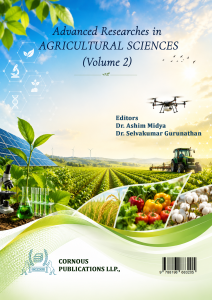
Book Title: Advanced Researches in Agricultural Sciences (Volume 2)
PAID ACCESS | Published on : 19-Mar-2026 | Pages: 54-60 |
Role of Agroforestry in Climate Resilient Regenerative Agriculture and Environmental Conservation for Sustainable Agricultural Development
- Deepa Rana
- Department of Forestry, Kumaun University Nainital, Uttarakhand, India.
Abstract
Agroforestry is a sustainable land-use system that integrates trees with crops and/or livestock to enhance productivity while maintaining ecological balance. Rooted in traditional farming practices, it has evolved into a scientifically recognized approach that promotes beneficial ecological interactions, efficient resource use, and long-term sustainability. Agroforestry systems improve soil fertility, conserve biodiversity, regulate micro-climate, reduce erosion, and sequester carbon, improve nutrient recycling making them important tools for climate change mitigation and adaptation. Case studies from different regions demonstrate their role in supporting livelihoods and restoring degraded lands. Despite its multiple benefits, wider adoption requires supportive policies, technical awareness, and region-specific research. Overall, agroforestry offers a practical pathway towards climate resilient Regenerative Agriculture (RA) for sustainable agricultural development.
Keywords
Agroforestry, Conservation, Sustainable, livelihoods, Adaptation, Regenerative Agriculture
References
Das, A. K., Rahman, M. A., Rahman, M. M., Saha, S. R., Keya, S. S., Suvoni, S. S., & Rizvi, J. (2022). Scaling up of jujube-based agroforestry practice and management innovations for improving efficiency and profitability of land uses in Bangladesh. Agroforestry Systems, 96(2), 249–263.
Dhyani, S. K., Gupta, R. K., & Handa, A. K. (2017). Agroforestry for climate resilience and livelihood security in India. Indian Council of Agricultural Research.
Fahad, S., Chavan, S. B., Chichaghare, A. R., Uthappa, A. R., Kumar, M., Kakade, V., Pradhan, A., Jinger, D., Rawale, G., Yadav, D. K., & Kumar, V. (2022). Agroforestry systems for soil health improvement and maintenance. Sustainability, 14(22), 14877.
Garrity, D. P. (2004). Agroforestry and the achievement of the Millennium Development Goals. Agroforestry Systems, 61–62, 5–17.
Garrity, D. P., Akinnifesi, F. K., Ajayi, O. C., Weldesemayat, S. G., Mowo, J. G., Kalinganire, A., Larwanou, M., & Bayala, J. (2010). Evergreen agriculture: A robust approach to sustainable food security in Africa. Food Security, 2, 197–214.
Jeffery, S., Verheijen, F. G., van der Velde, M., & Bastos, A. C. (2011). A quantitative review of the effects of biochar application to soils on crop productivity using meta-analysis. Agriculture, Ecosystems & Environment, 144(1), 175–187.
Jose, S. (2009). Agroforestry for ecosystem services and environmental benefits: An overview. Agroforestry Systems, 76, 1–10.
Judijanto, L. (2024). Rejuvenating smallholder oil palm plantations: Challenges and pathways to sustainability. Jambura Agribusiness Journal, 6(1), 37–50.
Kandula, R. K., Ulhe, P. P., & Sharma, M. N. (2025). Principles of soil conservation and land management. Academic Guru Publishing House.
Kumar, B. M., & Nair, P. K. R. (2004). The enigma of tropical homegardens. Agroforestry Systems, 61, 135–152.
Montagnini, F., & Nair, P. K. R. (2004). Carbon sequestration: An underexploited environmental benefit of agroforestry systems. Agroforestry Systems, 61, 281–295.
Nair, P. K. R. (1993). An introduction to agroforestry. Kluwer Academic Publishers.
Nair, P. K. R. (1993). State-of-the-art of agroforestry research and education. Agroforestry Systems, 23(2), 95–119.
Nair, P. K. R., Nair, V. D., Kumar, B. M., & Showalter, J. M. (2010). Carbon sequestration in agroforestry systems. Advances in Agronomy, 108, 237–307.
Paoletti, M. G. (1999). Biodiversity, traditional landscapes and agroecosystem management. Landscape and Urban Planning, 46, 3–9.
Sangha, K. K., Gordon, I. J., & Costanza, R. (2023). Editorial: Ecosystem services, policy, and human well-being. Frontiers in Ecology and Evolution, 11, 1174160.
Scherr, S. J., & McNeely, J. A. (2008). Biodiversity conservation and agricultural sustainability: Towards ecoagriculture landscapes. Philosophical Transactions of the Royal Society B.
Steppler, H. A., & Nair, P. K. R. (1987). Agroforestry: A decade of development. ICRAF.
Indexing In




Types of Books We Publish




Uniqueness of our Publication

DOI Assignment

ISBN Registration

Online Publication

High Visibility

Open & Closed Access
DOI Assignment
ISBN Registration
Online Publication
High Visibility