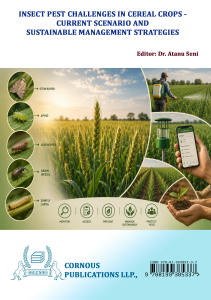
Editorial Book
Book Title: Insect Pest Challenges in Cereal Crops - Current Scenario and Sustainable Management Strategies
PAID ACCESS | Published on : 24-Sep-2026 | Pages: 104-119 | Doi : 10.37446/edibook212025/104-119
Recent Innovations in Organic Insect Pest Management in Cereal Crops
- Gitanjali Devi
- Department of Nematology, SCS College of Agriculture, Assam Agricultural University, Chapar, Dhubri – 783376, Assam, India.
Abstract
Wheat, rice, maize, sorghum, millet, barley, oats, and rye are the cereal crops under Gramineae family mainly grown for their edible starchy seeds. Cereal crops provide essential nutrients in human as well as animal diet. Besides nutritional value, cereal crops have industrial applications like biofuel production (bioethanol), paper and pulp production, and packaging applications. Thus a cereal crop plays a major role in global food security and nutrition. To sustain the expanding global population and food demand, it is essential to increase cereal crop production. Several insect pests pose serious obstacles to cereal crop production. Therefore it is essential to protect crops from various pests. By using synthetic chemicals showed a spectacular yield increase but long-term use leads to pest resistance and cause harm to non target organisms, human health, threaten biodiversity and environmental sustainability. Organic management of cereal crop has drawn consideration in the pest control field. Organic management is environmentally friendly mainly focuses on preventive and ecological methods. Now-a-days organic farming is practicing a fundamental shift from the conventional method to the advancement and integration of new technologies. Several new innovations and their adaptation to modern or smart agriculture technology has enabled many farmers to produce more yields through organic farming. These innovation support real-time monitoring and data driven decision-making through Artificial Intelligence (AI) create rapid, high-resolution insect surveillance and forecasting, optimizing strategies for pest, disease, and weed management and yet natural process, enhance soil health, reduce labor costs, and ensure higher yields improving sustainability and profitability. This chapter deals in detail with the concept of organic farming, innovations in this field.
Keywords
Artificial Intelligence (AI), Cereal crops, Insect pests, Innovations, Organic management, Smart agriculture
References
Abdullah, R. R., & Sukar, N. A. (2021). Enhancing the efficacy of the biopesticide Beauveria bassiana by adding chitosan to its secondary metabolites. International Journal of Entomology Research, 6(1), 30–35.
Ahmed, S., Marwat, S. N. K., Brahim, G. B., Khan, W. U., Khan, S., Al-Fuqaha, A., & Koziel, S. (2024). IoT based intelligent pest management system for precision agriculture. Scientific Reports, 14, 31917. https://doi.org/10.1038/s41598-024-83012-3
Ali, M. A., Abdellah, I. M., & Eletmany, M. R. (2023). Towards sustainable management of insect pests: Protecting food security through ecological intensification. International Journal of Chemical and Biochemical Sciences, 24(4), 386–394.
Amrani, A., Diepeveen, D., Murray, D. M. G. K., & Sohel, J. F. (2024). Multi-task learning model for agricultural pest detection from crop-plant imagery: A Bayesian approach. Computers and Electronics in Agriculture, 218, 108719. https://doi.org/10.1016/j.compag.2024.108719
Anonymous. (2023). Annual report (2020–21). Ministry of Agriculture, Government of India.
Baltazar, A. R., Santos, F. N. D., Moreira, A. P., Valente, A., & Cunha, J. B. (2021). Smarter robotic sprayer system for precision agriculture. Electronics, 10, 2061. https://doi.org/10.3390/electronics10172061
Borrelli, G. M., & Ficco, D. B. M. (2025). Cereals and cereal-based foods: Nutritional, phytochemical characterization and processing technologies. Foods, 14(7), 1234. https://doi.org/10.3390/foods14071234
Chen, C., Imran, M., Feng, X., Shen, X., & Sun, Z. (2025). Spray-induced gene silencing for crop protection: Recent advances and emerging trends. Frontiers in Plant Science, 16, 1527944. https://doi.org/10.3389/fpls.2025.1527944
Demis, E. (2025). Population dynamics, yield loss and management of major insect pests of rice (Oryza sativa L.) crop: A review. American Journal of Entomology, 9(1), 6–14. https://doi.org/10.11648/j.aje.20250901.12
Gahukar, R. T., & Jotwani, M. G. (1980). Present status of field pests of sorghum and millets in India. International Journal of Pest Management, 26, 138–151.
Gregg, P. C., Del Socorro, A. P., & Landolt, P. J. (2018). Advances in attract-and-kill for agricultural pests: Beyond pheromones. Annual Review of Entomology, 63, 453–470. https://doi.org/10.1146/annurev-ento-031616-035040
Gu, M., Tian, J., Lou, Y., Ran, J., Mohamed, A., Keyhani, N. O., Jaronski, S., Wang, G., Chen, X., Zang, L., & Zhang, W. (2023). Efficacy of Metarhizium rileyi granules for the control of Spodoptera frugiperda and its synergistic effects with chemical pesticide, sex pheromone and parasitoid. Entomologia Generalis, 43, 1211–1219. https://doi.org/10.1127/entomologia/2023/2079
Huang, X., Jiang, S., Feng, S., Zhang, L., Gan, Y., Hou, L., Mao, C., Chen, R., Xiao, H., Li, Y., Xu, Z., & Zhou, C. (2025). A novel method for detecting brown planthopper (Nilaparvata lugens Stål) early infestation using dual-temporal hyperspectral images. Frontiers in Plant Science, 16, 1680474. https://doi.org/10.3389/fpls.2025.1680474
Korkidis, P., & Dounis, A. (2023). Intelligent fuzzy models: WM, ANFIS, and patch learning for the competitive forecasting of environmental variables. Sustainability, 15, 8032. https://doi.org/10.3390/su15108032
Kotliarevski, L., Cohen, R., Ramakrishnan, J., Wu, S., Mani, K. A., & Amar-Feldbaum, R. (2022). Individual coating of entomopathogenic nematodes with titania (TiO₂) nanoparticles based on oil-in-water Pickering emulsion: A new formulation for biopesticides. Journal of Agricultural and Food Chemistry, 70, 13518–13527. https://doi.org/10.1021/acs.jafc.2c04424
Li, W., Wang, D., Li, M., Gao, Y., Wu, J., & Yang, X. (2021). Field detection of tiny pests from sticky trap images using deep learning in agricultural greenhouse. Computers and Electronics in Agriculture, 183, 106048. https://doi.org/10.1016/j.compag.2021.106048
Li, W., Wang, D., Li, M., Gao, Y., Wu, J., & Yang, X. (2021). Field detection of tiny pests from sticky trap images using deep learning in agricultural greenhouse. Computers and Electronics in Agriculture, 183, 106048. https://doi.org/10.1016/j.compag.2021.106048
Li, X., Liu, X., Lu, W., Yin, X., & An, S. (2022). Application progress of plant-mediated RNAi in pest control. Frontiers in Bioengineering and Biotechnology, 10, 963026. https://doi.org/10.3389/fbioe.2022.963026
Ma, G., Mohammadzamani, D., Javidan, S. M., Ampatzidis, Y., & Zhang, Z. (2026). Development and evaluation of a smart robotic sprayer for precision weed control in tomato crops. Results in Engineering, 31, 111403. https://doi.org/10.1016/j.rineng.2026.111403
Mana, A. A., Allouhi, A., Hamrani, A., Rehman, S., El Jamaoui, I., & Jayachandran, K. (2024). Sustainable AI-based production agriculture: Exploring AI applications and implications in agricultural practices. Smart Agricultural Technology, 7, 100416. https://doi.org/10.1016/j.atech.2024.100416
Mathyam, P., Kodigal, A. G., Nakka, R. K., Merugu, T., Uppu, S. S., Golla, S. K., Gutti, S. S., Pebbeti, C., Adhikari, S., & Singh, V. K. (2024). Assessment of yield loss due to fall armyworm in maize using high-resolution multispectral spaceborne remote sensing. International Journal of Remote Sensing, 45(18), 6744–6758. https://doi.org/10.1080/01431161.2024.2394233
Meng, X., Zhang, Y., Quan, L., & Qiao, J. (2023). A self-organizing fuzzy neural network with hybrid learning algorithm for nonlinear system modeling. Information Sciences, 642, 119145. https://doi.org/10.1016/j.ins.2023.119145
Moses-Gonzales, N., & Brewer, M. J. (2021). A special collection: Drones to improve insect pest management. Journal of Economic Entomology, 114(5), 1853–1856.
Mridha, D., Lamsal, B., & Antonangelo, J. A. (2025). Nanotechnology in agriculture: Innovations for sustainability and greenhouse gas mitigation–A review. Science of the Total Environment, 995, 180065. https://doi.org/10.1016/j.scitotenv.2025.180065
Murugasridevi, K., Manivasagam, V. S., & Manalil, S. (2025). Spatial prediction of Spodoptera frugiperda expansion in India using MaxEnt under shifting climate regimes. Scientific Reports, 15(1), 38632. https://doi.org/10.1038/s41598-025-22589-9
Paini, D. R., Sheppard, A. W., Cook, D. C., & Thomas, M. B. (2016). Global threat to agriculture from invasive species. Proceedings of the National Academy of Sciences of the United States of America, 113, 7575–7579.
Pérez-Montaño, F., Alías-Villegas, C., Bellogín, R. A., del Cerro, P., Espuny, M. R., Jiménez-Guerrero, I., López-Baena, F. J., Ollero, F. J., & Cubo, T. (2014). Plant growth promotion in cereal and leguminous agricultural important plants: From microorganism capacities to crop production. Microbiological Research, 169, 325–336. https://doi.org/10.1016/j.micres.2013.09.011
Perier, J. D., Wu, S., Arthurs, S. P., Toews, M. D., & Shapiro-Ilan, D. I. (2025). Persistence of the entomopathogenic nematode Steinernema feltiae in a novel capsule formulation. Biological Control, 200, 105684. https://doi.org/10.1016/j.biocontrol.2024.105684
Peterson, S. O. Nunes, Lacerda-Junior, G. V., Mascarin, G. M., Guimarães, R. A., Medeiros, F. H. V., Arthurs, S., & Bettiol, W. (2024). Microbial consortia of biological products: Do they have a future? Biological Control, 188, 105439. https://doi.org/10.1016/j.biocontrol.2024.105439
Prasad, G. S., Stanley, J., Babu, K., Kalisekar, A., Padmaja, P. G., & Subbarayudu, B. (2023). Emerging pests of millets and their management. Indian Farming, 73(1), 64–66. https://epubs.icar.org.in/index.php/IndFarm/article/view/132579
Press Information Bureau. (2026, April 4). India’s resilient production systems in agriculture. Government of India. https://www.pib.gov.in/PressReleasePage.aspx?PRID=2248987®=3&lang=20
Puza, V., & Tarasco, E. (2023). Interactions between entomopathogenic fungi and entomopathogenic nematodes. Microorganisms, 11(1), 163. https://doi.org/10.3390/microorganisms11010163
Reddy, G. V., Sharma, A., & Guerrero, A. (2020). Advances in the use of semiochemicals in integrated pest management: Pheromones. In Biopesticides for sustainable agriculture. Burleigh Dodds Science Publishing. https://doi.org/10.19103/AS.2020.0073.12
Sadiq, M., Rahim, N., Tahir, M. M., Alasmari, A., Alqahtani, M. M., Albogami, A., Ghanem, K. Z., Abdein, M. A., Ali, M., Mehmood, N., Yuan, J., Shaheen, A., Shehzad, M., El-Sayed, M. H., Chen, G., & Li, G. (2024). Conservation tillage: A way to improve yield and soil properties and decrease global warming potential in spring wheat agroecosystems. Frontiers in Microbiology, 15, 1356426. https://doi.org/10.3389/fmicb.2024.1356426
Shamshiri, R. R., Sturm, B., Weltzien, C., Fulton, J., Khosla, R., Schirrmann, M., Raut, S., Basavegowda, D. H., Yamin, M., & Hameed, I. A. (2024). Digitalization of agriculture for sustainable crop production: A use-case review. Frontiers in Environmental Science, 12, 1375193. https://doi.org/10.3389/fenvs.2024.1375193
Sharma, K., & Shivandu, S. K. (2024). Integrating artificial intelligence and Internet of Things (IoT) for enhanced crop monitoring and management in precision agriculture. Sensors International, 5, 100292. https://doi.org/10.1016/j.sintl.2024.100292
Singh, G., & Joshi, N. K. (2025). Insect pests of wheat in North India: A comprehensive review of their bio-ecology and integrated management strategies. Agriculture, 15(19), 2067. https://doi.org/10.3390/agriculture15192067
Sohan, M., Sai Ram, T., & Rami Reddy, C. V. (2024). A review on YOLOv8 and its advancements. In [Book title not provided] (pp. 529–545). Springer.
Subedi, B., Poudel, A., & Aryal, S. (2023). The impact of climate change on insect pest biology and ecology: Implications for pest management strategies, crop production, and food security. Journal of Agriculture and Food Research, 14, 100733. https://doi.org/10.1016/j.jafr.2023.100733
Sushil, S. N., Sampathkumar, M., Mohan, M., Nagaraju, D. K., & Singh, J. P. (2022). Recent events of invasive and migratory pests and lessons learnt. Indian Journal of Entomology, 84, 108–120.
Tannous, M., Stefanini, C., & Romano, D. (2023). A deep-learning-based detection approach for the identification of insect species of economic importance. Insects, 14(2), 148. https://doi.org/10.3390/insects14020148
Tiwari, A. K. (2024). Insect pests in agriculture: Identifying and overcoming challenges through IPM. Archives of Current Research International, 24(3), 124–130.
Ullah, Q., Haider, W., Waqar, M., Nur Athiqah, M. Y., Maysaroh, U., Sajjad, N., Khomphet, T., & Ageru, T. A. (2025). Innovative biotechnological approaches in agriculture: From biopesticides against insect pests to flavor enhancement in crops. Journal of Agriculture and Food Research, 24, 102369. https://doi.org/10.1016/j.jafr.2025.102369
United Nations, Department of Economic and Social Affairs, Population Division. (2019). World population 2019: Highlights (ST/ESA/SER.A/423). United Nations.
Yan, J., Wu, H., Diao, Z., Miao, Y., Zhang, B., & Zhao, C. (2025). Recent developments and applications of crop disease detection, prediction, and early warning: A review. Engineering. https://doi.org/10.1016/j.eng.2025.10.032
Yaseen, M. U., & Long, J. M. (2024). Laser weeding technology in cropping systems: A comprehensive review. Agronomy, 14, 2253. https://doi.org/10.3390/agronomy14102253
Zhang, L., Liu, C., Yao, W., Shao, J., Peixoto, L., Yang, Y., Zeng, Z., Olesen, J. E., & Zang, H. (2025). Legume-based rotation benefits crop productivity and agricultural sustainability in the North China Plain. Soil and Tillage Research, 250, 106502. https://doi.org/10.1016/j.still.2025.106502
Zhang, W. F. (2024). CRISPR-based gene editing in Bt for improved insecticidal properties. Bioscience Methods, 15(5), 216–225. https://doi.org/10.5376/bm.2024.15.0022
Zhang, W., Huang, H., Sun, Y., & Wu, X. (2022). AgriPest-YOLO: A rapid light-trap agricultural pest detection method based on deep learning. Frontiers in Plant Science, 13, 1079384. https://doi.org/10.3389/fpls.2022.1079384
Indexing In




Types of Books We Publish




Uniqueness of our Publication

DOI Assignment

ISBN Registration

Online Publication

High Visibility

Open & Closed Access
DOI Assignment
ISBN Registration
Online Publication
High Visibility