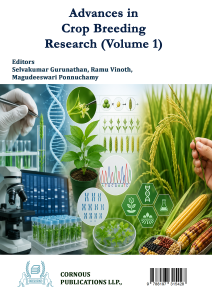
Editorial Book
Book Title: Advances in Crop Breeding Research (Volume 1)
PAID ACCESS | Published on : 23-Feb-2026 | Pages: 34-41 |
QTL mapping to determine the genetic foundation of plant characteristics
- S. Anandhi Lavanya
- Associate Professor, Department of Plant Breeding and Genetics, School of Agriculture, Bharath Institute of Higher Education and Research, Chennai, Tamil Nadu, India.
- N. Vairam
- Assistant Professor, Department of Agricultural Engineering, SRM Valliammai Engineering college, Tamil Nadu, India.
- V. Prakash
- Associate Professor, Department of Agronomy, School of Agriculture, Bharath Institute of Higher Education and Research, Chennai, Tamil Nadu, India.
Abstract
A genetically diverse population's phenotype and genotype must be measured in In order to determine if quantitative traits are influenced by genetic factors. Statistical associations can then be used to link specific quantitative trait loci (QTL) to the regulation of the observed phenotype. For genetic improvement to satisfy the demands of the global community, determining the genetic architecture for yield and important quality traits has received a lot of attention. Landraces are an impressive source of natural allelic variation in this regard. The suggested genomic areas could be the focus of genome editing to create a novel allelic variation. The landraces that were employed in our research can be used as a source for a novel natural variation and can be added as parents to breeding programs. To improve cultivars using molecular-based methods, it is crucial to analyze the genetic underpinnings of complex traits in crop breeding. Finding QTLs and markers has been the subject of numerous prior attempts.
Keywords
QTL, Marker assisted selection, Landraces, Crop Improvement
References
Graybosch, R. A., Peterson, C. J., Shelton, D. R., & Baenziger, P. S. (1996). Genotypic and environmental modification of wheat flour protein composition in relation to end-use quality. Crop Science, 36, 296–300.
Guzmán, C., Mondal, S., Govindan, V., Autrique, J. E., Posadas-Romano, G., Cervantes, F., et al. (2016). Use of rapid tests to predict quality traits of CIMMYT bread wheat genotypes grown under different environments. LWT – Food Science and Technology, 69, 327–333.
Guzmán, C., Posadas-Romano, G., Hernández-Espinosa, N., Morales-Dorantes, A., & Peña, R. J. (2015). A new standard water absorption criterion based on solvent retention capacity (SRC) to determine dough mixing properties, viscoelasticity, and bread-making quality. Journal of Cereal Science, 66, 59–65.
Huebner, F. R., Nelsen, T. C., Chung, O. K., & Bietz, J. A. (1997). Protein distributions among hard red winter wheat varieties as related to environment and baking quality. Cereal Chemistry, 74, 123–128.
Li, Y. L., Dong, Y., Niu, S., Cui, D., Wang, Y., Liu, Y., Wei, M., & Li, X. (2008). Identification of agronomically favorable quantitative trait loci alleles from a dent corn inbred Dan232 using advanced backcross QTL analysis and comparison with the F2:3 populations in popcorn. Molecular Breeding, 21, 1–14.
Mohan, M., Nair, S., Bhagwat, A., Krishna, T. G., Yano, M., Bhatia, C. R., & Sasaki, T. (1997). Genome mapping, molecular markers and marker-assisted selection in crop plants. Molecular Breeding, 3, 87–103.
Naz, A. A., Kunert, A., Lind, V., Pillen, K., & Léon, J. (2008). AB-QTL analysis in winter wheat: II. Genetic analysis of seedling and field resistance against leaf rust in a wheat advanced backcross population. Theoretical and Applied Genetics, 117, 561–572.
Paterson, A. H. (1996). Making genetic maps. In A. H. Paterson (Ed.), Genome mapping in plants (pp. 23–39). Academic Press.
Peña, R. J. (2002). Wheat for bread and other foods. In B. C. Curtis, S. Rajaram, & H. G. Macpherson (Eds.), Bread wheat – Improvement and production (Vol. 30). FAO Plant Production and Protection Series.
Reiter, R. S., Williams, J. G. K., Feldmann, K. A., Rafalski, J. A., Tingey, S. V., & Scolnik, P. A. (1992).
Global and local genome mapping in Arabidopsis thaliana by using recombinant inbred lines and random amplified polymorphic DNAs. Proceedings of the National Academy of Sciences of the United States of America, 89, 1477–1481.
Sanchez-Garcia, M., Álvaro, F., Peremarti, A., Martín-Sánchez, J. A., & Royo, C. (2015). Changes in bread-making quality attributes of bread wheat varieties cultivated in Spain during the 20th century. European Journal of Agronomy, 63, 79–88.
Stevens, R., Buret, M., Duffé, P., Garchery, C., Baldet, P., Rothan, C., & Causse, M. (2007). Candidate genes and quantitative trait loci affecting fruit ascorbic acid content in three tomato populations. Plant Physiology, 143, 1943–1953.
Zhu, J., & Khan, K. (2001). Effects of genotype and environment on glutenin polymers and bread making quality. Cereal Chemistry, 78, 125–130.
Indexing In




Types of Books We Publish




Uniqueness of our Publication

DOI Assignment

ISBN Registration

Online Publication

High Visibility

Open & Closed Access
DOI Assignment
ISBN Registration
Online Publication
High Visibility