Editorial Book
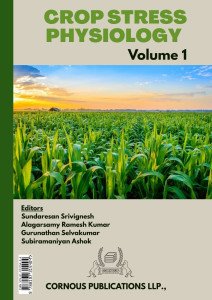
Book Title: Crop Stress Physiology (Volume 1)
PAID ACCESS | Published on : 05-Apr-2024 | Pages: 28-35 |
Proteomics in Crop Stress Physiology
- M. P. Ellampirai
- Department of Horticulture, School of Life Sciences, Central University of Tamil Nadu, Thiruvarur, Tamil Nadu, India.
- Srivignesh Sundaresan
- Department of Horticulture, School of Life Sciences, Central University of Tamil Nadu, Thiruvarur, Tamil Nadu, India.
- Subramanian Manivannan
- Department of Horticulture, School of Life Sciences, Central University of Tamil Nadu, Thiruvarur, Tamil Nadu, India.
- Manonmani S
- Department of Horticulture, School of Life Sciences, Central University of Tamil Nadu, Thiruvarur, Tamil Nadu, India.
- Indian G
- Department of Horticulture, School of Life Sciences, Central University of Tamil Nadu, Thiruvarur, Tamil Nadu, India.
- Taneti Sravya Keerthana
- Department of Horticulture, School of Life Sciences, Central University of Tamil Nadu, Thiruvarur, Tamil Nadu, India.
Abstract
Proteomics is one of the tools for understanding the responses and adaptations of crops to several biotic and abiotic stresses. Environmental stresses negatively impact the plant growth, metabolism, and productivity which has been creating a significant challenge to world food security. Proteomic studies are employed to found out the stress-responsive proteins, signaling pathways, and metabolic changes that occur during stress conditions. Proteomics approaches play a major role in improving the discerning of key regulatory proteins involved in stress tolerance. Furthermore, post-translational modifications and subcellular protein localization are critical in cellular signaling and adaptation mechanisms under adverse environments. This chapter provides a summary of the proteomic methods utilized to examine crops ability to withstand abiotic stress and the significance of PTMs and subcellular localization. Prospective use of complex signaling pathways in plant adaptation to biotic and abiotic stress were investigated to address issues of food security.
Keywords
Proteomics, stress-responsive proteins, post-translational modifications
References
Afroz, A., Ali, G. M., Mir, A., & Komatsu, S. (2011). Application of proteomics to investigate stress-induced proteins for improvement in crop protection. Plant cell reports, 30, 745-763.
Ahmad, P., Abdel Latef, A. A., Rasool, S., Akram, N. A., Ashraf, M., & Gucel, S. (2016). Role of proteomics in crop stress tolerance. Frontiers in plant science, 7, 1336.
Aslam, B., Basit, M., Nisar, M. A., Khurshid, M., & Rasool, M. H. (2016). Proteomics: technologies and their applications. Journal of chromatographic science, 1-15.
Barkla, B. J., Vera‐Estrella, R., & Pantoja, O. (2013). Progress and challenges for abiotic stress proteomics of crop plants. Proteomics, 13(12-13), 1801-1815.
Chen, S., & Harmon, A. C. (2006). Advances in plant proteomics. Proteomics, 6(20), 5504-5516.
Hashiguchi, A., & Komatsu, S. (2016). Impact of post-translational modifications of crop proteins under abiotic stress. Proteomes, 4(4), 42.
Hashiguchi, A., Ahsan, N., & Komatsu, S. (2010). Proteomics application of crops in the context of climatic changes. Food research international, 43(7), 1803-1813.
Kausar, R., Wang, X., & Komatsu, S. (2022). Crop proteomics under abiotic stress: from data to insights. Plants, 11(21), 2877.
Khan, P. S. V., Nagamallaiah, G. V., Rao, M. D., Sergeant, K., & Hausman, J. F. (2014). Abiotic stress tolerance in plants: insights from proteomics. In Emerging technologies and management of crop stress tolerance (pp. 23-68). Academic Press.
Komatsu, S., & Hossain, Z. (2013). Organ-specific proteome analysis for identification of abiotic stress response mechanism in crop. Frontiers in Plant Science, 4, 71.
Kosova, K., Vítamvas, P., Urban, M. O., Prasil, I. T., & Renaut, J. (2018). Plant abiotic stress proteomics: the major factors determining alterations in cellular proteome. Frontiers in plant science, 9, 122.
Kumar, A., Bimolata, W., Kannan, M., Kirti, P. B., Qureshi, I. A., & Ghazi, I. A. (2015). Comparative proteomics reveals differential induction of both biotic and abiotic stress response associated proteins in rice during Xanthomonas oryzae pv. oryzae infection. Functional & integrative genomics, 15, 425-437.
Naik, B., Kumar, V., Rizwanuddin, S., Chauhan, M., Choudhary, M., Gupta, A. K., & Rustagi, S. (2023). Genomics, proteomics, and metabolomics approaches to improve abiotic stress tolerance in tomato plant. International Journal of Molecular Sciences, 24(3), 3025.
Perez-Clemente, R. M., Vives, V., Zandalinas, S. I., López-Climent, M. F., Muñoz, V., & Gómez-Cadenas, A. (2013). Biotechnological approaches to study plant responses to stress. BioMed research international, 2013(1), 654120.
Qureshi, M. I., Qadir, S., & Zolla, L. (2007). Proteomics-based dissection of stress-responsive pathways in plants. Journal of plant physiology, 164(10), 1239-1260.
Sergeant, K., & Renaut, J. (2010). Plant biotic stress and proteomics. Current Proteomics, 7(4), 275-297.
Sha Valli Khan, P. S., Nagamallaiah, G. V., Dhanunjay Rao, M., Sergeant, K., & Hausman, J. F. (2014). Abiotic stress tolerance in plants: Insights from proteomics. Emerg. Technol. Manag. Crop Stress Toler, 2, 23-68.
Uday, G., Shardha, H. B., Priyanka, K., & Jagirdhar, S. (2024). Advances in Plant Proteomics toward Improvement of Crop Productivity and Stress Resistance. Plant Proteomics: Implications in Growth, Quality Improvement, and Stress Resilience, 11-29.
Van Wijk, K. J. (2001). Challenges and prospects of plant proteomics. Plant Physiology, 126(2), 501-508.
Wang, Y., Kim, S. G., Kim, S. T., Agrawal, G. K., Rakwal, R., & Kang, K. Y. (2011). Biotic stress-responsive rice proteome: An overview. Journal of Plant Biology, 54, 219-226.
Wu, X., Gong, F., Cao, D., Hu, X., & Wang, W. (2016). Advances in crop proteomics: PTMs of proteins under abiotic stress. Proteomics, 16(5), 847-865.
Zhao, J., Zhang, Y., Bian, X., Lei, J., Sun, J., Guo, N., & Xing, H. (2013). A comparative proteomics analysis of soybean leaves under biotic and abiotic treatments. Molecular biology reports, 40, 1553-1562.
Zheng, Q., Song, J., Campbell-Palmer, L., Thompson, K., Li, L., Walker, B., & Li, X. (2013). A proteomic investigation of apple fruit during ripening and in response to ethylene treatment. Journal of proteomics, 93, 276-294.
Indexing In




Types of Books We Publish




Uniqueness of our Publication

DOI Assignment

ISBN Registration

Online Publication

High Visibility

Open & Closed Access
DOI Assignment
ISBN Registration
Online Publication
High Visibility