Editorial Book
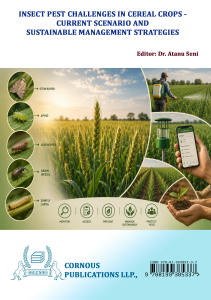
Book Title: Insect Pest Challenges in Cereal Crops - Current Scenario and Sustainable Management Strategies
OPEN ACCESS | Published on : 03-Feb-2026 | Pages: 92-103 | Doi : 10.37446/edibook212025/92-103
Post-harvest Insect Pests of Cereal Grains and their Management Strategies
- Reem Mohammad
- Department of Entomology, Faculty of Agricultural Sciences (FAS), Siksha 'O' Anusandhan Deemed to be University (SOADU), Bhubaneswar, Odisha, India.
Abstract
After harvest, the majority of the grain is stored for periods that may be long or short, depending on the purpose of storage. During the post-harvest period, grain is typically stored in warehouses that meet appropriate storage conditions to keep the seeds as viable and intact as possible. However, grain in warehouses is susceptible to numerous pests (insects, fungi, mites, rodents, etc.). Insect pests constitute a large group of stored grain pests. These infestations may originate from the field. In this case, the insect is a pest of both the field and the warehouse. Consequently, it can easily be transported with the harvested grain to the store, from where it can spread to healthy grains. Infestations may also be present in the warehouse itself due to ineffective pre-storage sterilization, or due to the presence of entry points for insects that can cause new infestations at any time. Therefore, preventive measures are paramount in warehouses. If insect infestation is detected in a store, it is essential to accurately diagnose the infestation, identify the insect causing the damage, its stage, and the density of its population. It is also necessary to assess the damage rate and the severity of the damage to determine the most appropriate measure to manage the specific pest. Therefore, this chapter reviews the most important points related to post-harvest insect pests of grains and how to deal with them.
Keywords
Infestation, Insect pest, Detection management, Post- harvest, Stored grains
References
Ahmad, R., Hassan, S., Ahmad, S., Nighat, S., Devi, Y. K., Javeed, K., ... & Hussain, B. (2021). Stored grain pests and current advances for their management. Postharvest Technology-Recent Advances, New Perspectives and Applications.
Arora, S., Stanley, J., & Srivastava, C. (2021). Temporal dynamics of phosphine fumigation against insect pests in wheat storage. Crop Protection, 144, 105602.
Bareil, N., Crépon, K., & Piraux, F. (2018). Prediction of insect mortality in cooled stored grain. Journal of Stored Products Research, 78, 110-117.
Campolo, O., Giunti, G., Russo, A., Palmeri, V., & Zappalà, L. (2018). Essential oils in stored product insect pest control. Journal of Food Quality, 2018(1), 6906105.
Chaudhari, A. K., Singh, V. K., Kedia, A., Das, S., & Dubey, N. K. (2021). Essential oils and their bioactive compounds as eco-friendly novel green pesticides for management of storage insect pests: Prospects and retrospects. Environmental Science and Pollution Research, 28, 18918-18940.
Deshwal, R., Vaibhav, V., Kumar, N., Kumar, A., & Singh, R. (2020). Stored grain insect pests and their management: An overview. Journal of Entomology and Zoology Studies, 8(5), 969-974.
Guru, P. N., Mridula, D., Dukare, A. S., Ghodki, B. M., Paschapur, A. U., Samal, I., ... & Subbanna, A. R. (2022). A comprehensive review on advances in storage pest management: Current scenario and future prospects. Frontiers in Sustainable Food Systems, 6, 993341.
Harush, A., Quinn, E., Trostanetsky, A., Rapaport, A., Kostyukovsky, M., & Gottlieb, D. (2021). Integrated pest management for stored grain: Potential natural biological control by a parasitoid wasp community. Insects, 12(11), 1038.
Kirst, H. A. (2010). The spinosyn family of insecticides: Realizing the potential of natural products research. The Journal of Antibiotics, 63(3), 101-111.
Lampiri, E., Losic, D., & Athanassiou, C. G. (2025). Synergetic enhancement of insecticidal efficacy of graphene with spinosad against major stored grain insects. Journal of Stored Products Research, 112, 102623.
Malaikozhundan, B., Vaseeharan, B., Vijayakumar, S., & Thangaraj, M. P. (2017). Bacillus thuringiensis coated zinc oxide nanoparticle and its biopesticidal effects on the pulse beetle, Callosobruchus maculatus. Journal of Photochemistry and Photobiology B: Biology, 173, 306-314.
Mangang, I. B., & Manickam, L. (2022). Insect repellent pellets–An application of botanicals against red flour beetle–Their antifungal activity during storage and use as potential fumigants. Journal of the Science of Food and Agriculture, 102(14), 6696-6706.
Maurya, A., Yadav, A., Soni, M., Paul, K. K., Banjare, U., Jha, M. K., & Dubey, N. K. (2024). Nanoencapsulated essential oils for post-harvest preservation of stored cereals: A review. Foods, 13(24), 4013.
Mohammad, R., Roy, S., Mishra, B. K., & Khamari, B. (2024). Biological repercussions of addition of botanicals to wheat grains on the progeny and damage potential of rice weevil (Sitophilus oryzae L.) at different temperature regimes. Cereal Research Communications, 52(1), 203-213.
Navarro, S. (2012). The use of modified and controlled atmospheres for the disinfestation of stored products. Journal of Pest Science, 85(3), 301-322.
Olorunfemi, B. J., & Kayode, S. E. (2021). Post-harvest loss and grain storage technology-a review. Turkish Journal of Agriculture-Food Science and Technology, 9(1), 75-83.
Rajkumar, V., Gunasekaran, C., Paul, C. A., & Dharmaraj, J. (2020). Development of encapsulated peppermint essential oil in chitosan nanoparticles: Characterization and biological efficacy against stored-grain pest control. Pesticide Biochemistry and Physiology, 170, 104679.
Shankar, V. S., Velmurugan, G., Kaliappan, S., Baskara Sethupathy, S., Sekar, S., Patil, P. P., & Kailo, G. G. (2022). Optimization of CO2 concentration on mortality of various stages of Callosobruchus maculatus and development of controlled atmosphere storage structure for black gram grains. Adsorption Science & Technology, 2022, 3381510.
Sowmya, M., Bindhu, O. S., Subaharan, K., Kumar, V., Senthoorraja, R., Varshney, R., & NBV, C. R. (2023). Toxicity, ovipositional behaviour and electrophysiological response of rice moth Corcyra cephalonica (Stainton) adults to essential oils. Indian Journal of Entomology, 86(4).
Upadhyay, R. K., & Ahmad, S. (2011). Management strategies for control of stored grain insect pests in farmer stores and public ware houses. World Journal of Agricultural Sciences, 7(5), 527-549.
Vassilakos, T. N., & Athanassiou, C. G. (2023). Spinetoram: A potential grain protectant. Crop Protection, 173.
Vassilakos, T. N., Athanassiou, C. G., Saglam, O., Chloridis, A. S., & Dripps, J. E. (2012). Insecticidal effect of spinetoram against six major stored grain insect species. Journal of Stored Products Research, 51, 69-73.
Indexing In




Types of Books We Publish




Uniqueness of our Publication

DOI Assignment

ISBN Registration

Online Publication

High Visibility

Open & Closed Access
DOI Assignment
ISBN Registration
Online Publication
High Visibility