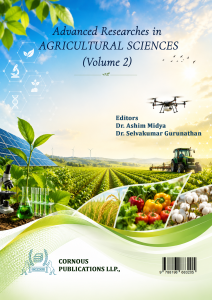
Editorial Book
Book Title: Advanced Researches in Agricultural Sciences (Volume 2)
OPEN ACCESS | Published on : 19-Mar-2026 | Pages: 29-40 | Doi : 10.37446/vol2book092025/29-40
Pesticide Induced Environmental Toxicity in Indian Agriculture and Emerging Mitigation Strategies for Environmental Safety and Sustainable Food Security
- Chandani Lakhani
- Academy of Scientific and Innovative Research (AcSIR), Ghaziabad, India; Environmental Impact Assessment, Audit and Planning, CSIR-National Environmental Engineering Research Institute (CSIR-NEERI), Nehru Marg, Nagpur, India.
- Sandeep Bodkhe
- Academy of Scientific and Innovative Research (AcSIR), Ghaziabad, India; Environmental Impact Assessment, Audit and Planning, CSIR-National Environmental Engineering Research Institute (CSIR-NEERI), Nehru Marg, Nagpur, India.
Abstract
Pesticides play an essential role in sustaining agricultural productivity; nevertheless, their prevalence and often indiscriminate use have resulted in significant concerns related to the environmental toxicity and human health hazards. This chapter presents a detailed examination of pesticide use patterns in Indian agriculture and examines the associated environmental toxicity through evidence drawn from peer-reviewed research, national surveys, and government reports. Data from regulatory and monitoring agencies, including the Ministry of Agriculture and Farmers Welfare, Central Pollution Control Board (CPCB), Directorate of Plant Protection, Quarantine and Storage (DPPQS), and Food Safety and Standards Authority of India (FSSAI), are synthesized to highlight trends in pesticide consumption, poisoning incidents, and regulatory enforcement. The chapter critically evaluates the fate and transport of pesticides in soil and water systems, as well as their ecotoxicological impacts on biodiversity. Policy frameworks such as the Insecticides Act, 1968, the proposed Pesticides Management Bill, and national Integrated Pest Management (IPM) programs are discussed to assess their effectiveness in mitigating environmental risks. Emerging alternative solutions, such as microbial and nano-enabled pesticides, precision application technologies, eco-friendly pest management protocols and sustainable pest management strategies, are also reviewed. By integrating scientific literature with government policy and monitoring data, this chapter aims to provide a holistic understanding of pesticide-induced environmental toxicity in Indian agriculture and outlines future directions for environmentally sustainable and health-conscious pesticide management.
Keywords
Pesticides, Indian Agriculture, Environmental Toxicity, Exposure Risks, Policy Frameworks, Sustainable Pest Management
References
Abbasi, E. (2026). Nanotechnology-based innovations for overcoming insecticide resistance in disease vectors: An experimental approach. Research Square. https://doi.org/10.21203/rs.3.rs-8390384/v1
Bhakar, A., Singh, Y. V., Abhishek, & Tabassum, R. (2023). Pesticides in India in the twenty-first century and their impact on biodiversity. Vegetos, 36(3), 768–778. https://doi.org/10.1007/s42535-022-00434-y
Bommineni, S. R., Alekhya, K., Chary, R. P., Reddy, S. B., & Sahithi, P. (2024). A study of acute pesticide poisoning in a tertiary care centre in South India. International Journal of Research in Medical Sciences, 12(12), 4541–4544. https://doi.org/10.18203/2320-6012.ijrms20243703
Brar, G. S., Kumar Patyal, S., Dubey, J. K., & Singh, G. (2018). Survey on pesticide use pattern and farmers’ perceptions in cauliflower and brinjal growing areas in three districts of Himachal Pradesh, India. International Journal of Current Microbiology and Applied Sciences, 7(3), 2417–2423.
Carranza, C. S., Aluffi, M. E., Benito, N., Magnoli, K., De Gerónimo, E., Aparicio, V. C., Barberis, C. L., & Magnoli, C. E. (2025). Glyphosate and aminomethylphosphonic acid removal by fungal strains native to pesticide-exposed agricultural soil: A field study. International Journal of Environmental Science and Technology, 22(4), 2421–2430. https://doi.org/10.1007/s13762-024-05809-z
Chaudhry, D. (2024). Pesticide use in Indian agriculture: Policy alternatives for environmental health. Journal of Development Policy and Practice, 9(1), 133–161. https://doi.org/10.1177/24551333221121890
Depenbusch, L., Sequeros, T., Schreinemachers, P., Sharif, M., Mannamparambath, K., Uddin, N., & Hanson, P. (2025). Tomato pests and diseases in Bangladesh and India: Farmers’ management and potential economic gains from insect-resistant varieties and integrated pest management. International Journal of Pest Management, 71(4), 552–566. https://doi.org/10.1080/09670874.2023.2252760
Directorate of Plant Protection, Quarantine & Storage. (2026). Statistical database. https://ppqs.gov.in/en
Food and Agriculture Organization. (2025, July 15). Pesticides use and trade: 1990–2023. FAO Statistics Division. https://www.fao.org/statistics/highlights-archive/highlights-detail/pesticides-use-and-trade-1990-2023/en
Ghosh, B., & Chakma, N. (2022). Impact of agricultural pesticides on ecosystem and human health: A case study in lower Gangetic plain, India. Arabian Journal of Geosciences, 15, 626.
Government of India. (2025). Environment statistics of India.
Indu, Baghel, A. S., Bhardwaj, A., & Ibrahim, W. (2022). Optimization of pesticide spray on crops in agriculture using machine learning. Computational Intelligence and Neuroscience, 2022, 408535.
Kukanur, V. S., & Deshmukh, S. S. (2025). Measuring what matters: Environmental impact assessment of pesticides in modern agriculture. Indian Journal of Plant Protection, 53(1), 1–12.
Kumar, A., Bhople, B. S., & Jeganathan, J. (2025). Balancing food security and environmental health: The dual challenge of pesticide use in India. Environmental Science and Pollution Research, 32(9), 4949–4956.
Madduri, K., Hiremath, S., Lokesh, J., Chiniwar, D. S., & Shrishail, M. H. (2025). Environment-friendly experimental solar-powered UV light pest trapping mechanism for open agricultural fields. Environmental Research Communications, 7(3), 035002. https://doi.org/10.1088/2515-7620/adb8a5
Mondal, S., Sardar, C., Das, A., Jana, H. K., & Mandal, T. K. (2026). A sustainable solution for environmental cleanup: Innovative bio-adsorbent method to remove pesticide residues from water samples. Clean – Soil, Air, Water, 54(1). https://doi.org/10.1002/clen.70099
Naik, M. A., Kumar, A., Kushwaha, D. K., Kushwaha, H. L., Gupta, S., Ramasubramanian, V., Singh, A. K., & Hasan, M. (2025). Development of a telerobotic target-specific pesticide applicator: An intervention for enhanced safety and efficiency. Journal of Field Robotics, 42(6), 2469–2491. https://doi.org/10.1002/rob.22524
Padhiary, M., Kumar, K., Hussain, N., Roy, D., Barbhuiya, J. A., & Roy, P. (2025). Artificial intelligence in farm management: Integrating smart systems for optimal agricultural practices. International Journal of Smart Agriculture, 3(1), 1–11. https://doi.org/10.54536/ijsa.v3i1.3674
Peshin, R., Hansra, B. S., Nanda, R., Singh, K., Sharma, R., Garg, L., Bajiya, M. R., Showkat, A., Kumar, R., & Yangsdon, S. (2020). Pesticide hazardous hotspots: Empirical evidences from North India. Environmental Management, 66(5), 899–915. https://doi.org/10.1007/s00267-020-01317-1
Reddy, A. A., Reddy, M., & Mathur, V. (2024). Pesticide use, regulation, and policies in Indian agriculture. Sustainability, 16(17). https://doi.org/10.3390/su16177839
Saka, W. A., Ayandele, O. A., Oladipo, O. O., Adeshina, O. S., & Kehinde, B. D. (2025). Andrographis paniculata aqueous extract exhibits cardioprotective effect against dichlorvos-induced toxicity, a commonly used organophosphate pesticide. Toxicology Reports, 14, 102038. https://doi.org/10.1016/j.toxrep.2025.102038
Singh, H. (2022). Current status and recent developments in microbial pesticide use in India. Indian Journal of Plant Genetic Resources, 35(3), 369–374. https://doi.org/10.5958/0976-1926.2022.00102.4
Smith, J., Martins, B. A. B., Beffa, R., Field, L. M., Goertz, A., Le Goupil, G., Mehl, A., Langewald, J., Martinelli, S., Rossi, C. V. S., & Wiles, J. A. (2026). Challenges facing the management of pesticide resistance in weeds, diseases and insect pests in European agriculture and the future of effective IPM implementation. Pest Management Science. https://doi.org/10.1002/ps.70522
Soliman Sabra, F., & El-Deeb Mehana, E.-S. (2015). Pesticides toxicity in fish with particular reference to insecticides. Asian Journal of Agriculture and Food Sciences, 3(1), 40–60.
Wan, N. F., Fu, L., Dainese, M., Kiær, L. P., Hu, Y. Q., Xin, F., Goulson, D., Woodcock, B. A., Vanbergen, A. J., Spurgeon, D. J., Shen, S., & Scherber, C. (2025). Pesticides have negative effects on non-target organisms. Nature Communications, 16(1), 1360. https://doi.org/10.1038/s41467-025-56732-x
Yadav, S., & Dutta, S. (2019). A study of pesticide consumption pattern and farmer’s perceptions towards pesticides: A case of Tijara Tehsil, Alwar (Rajasthan). International Journal of Current Microbiology and Applied Sciences, 8(4), 96–104. https://doi.org/10.20546/ijcmas.2019.804.012.
Indexing In




Types of Books We Publish




Uniqueness of our Publication

DOI Assignment

ISBN Registration

Online Publication

High Visibility

Open & Closed Access
DOI Assignment
ISBN Registration
Online Publication
High Visibility