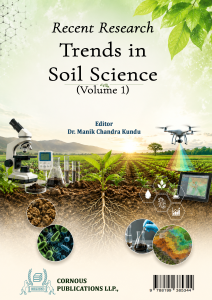
Editorial Book
Book Title: Recent Research Trends in Soil Science (Volume 1)
PAID ACCESS | Published on : 14-Oct-2026 | Pages: 103-119 | Doi : https://doi.org/10.37446/volbook122026/103-119
Mycorrhizal Associations and Their Role in Nutrient Acquisition and Soil Health
- Shivani Chauhan
- Department of Soil Science and Water Management, College of Horticulture and Forestry, Dr. YSP UHF, Neri, 177001 Hamirpur, India
- Samriti Jaswal
- Department of Soil Science and Water Management, College of Horticulture and Forestry, Dr. YSP UHF, Neri, 177001 Hamirpur, India.
- Arti Ghabru
- Department of Food Science, College of Horticulture and Forestry, Dr. YSP UHF, Neri, 177001 Hamirpur, India.
- Neerja Rana
- Department of Biotechnology, College of Horticulture and Forestry, Dr. YSP UHF, Neri, 177001 Hamirpur, India.
- Himani Sharma
- Department of Basic Sciences, College of Forestry, Dr. YSP UHF, 173230 Nauni, Solan, India.
- Bandana Kumari
- Department of Forest Products, College of Horticulture and Forestry, Dr. YSP UHF, Neri, 177001 Hamirpur, India.
Abstract
Mycorrhizal associations are mutualistic interactions between soil fungi and plant roots that improve nutrient uptake, plant growth, and soil health. These mushrooms enhance the absorption of essential nutrients, including phosphorus, nitrogen, zinc and copper, while improving water absorption and resistance to stress. Their hyphal networks contribute to soil aggregation, nutrient cycling, and maintenance of soil structure. Mycorrhizae also support beneficial rhizosphere microorganisms and can increase plant resistance to soil pathogens. Their effectiveness depends on soil conditions, host plant species, and agricultural practices. Integrating mycorrhizal fungi into sustainable farming systems can improve nutrient-use efficiency, reduce fertilizer dependence, and promote long-term soil fertility and ecosystem resilience.
Keywords
Mycorrhizal associations, arbuscular mycorrhizal fungi, nutrient acquisition, soil health, phosphorus uptake, nutrient cycling, sustainable agriculture
References
Brundrett, M. C., & Tedersoo, L. (2018). Evolutionary history of mycorrhizal symbioses and global host plant diversity. New Phytologist, 220(4), 1108–1115. https://doi.org/10.1111/nph.14976
Cairney, J. W. G., & Meharg, A. A. (2003). Ericoid mycorrhiza: A bridge between soil and plant nutrition. Mycologist, 17(3), 105–111.
Dearnaley, J. D. W., Martos, F., & Selosse, M.-A. (2012). Orchid mycorrhizas: Molecular ecology, physiology, evolution and conservation aspects. In Fungal associations. Springer.
Genre, A., Lanfranco, L., Perotto, S., & Bonfante, P. (2020). Unique and common traits in mycorrhizal symbioses. Nature Reviews Microbiology, 18, 649–660. https://doi.org/10.1038/s41579-020-0402-3
Govindarajulu, M., Pfeffer, P. E., Jin, H., Abubaker, J., Douds, D. D., Allen, J. W., Bücking, H., Lammers, P. J., & Shachar-Hill, Y. (2005). Nitrogen transfer in the arbuscular mycorrhizal symbiosis. Nature, 435, 819–823. https://doi.org/10.1038/nature03610
Rasmussen, H. N., Dixon, K. W., Jersáková, J., & Těšitelová, T. (2015). Germination and seedling establishment in orchids: A complex of requirements. Annals of Botany, 116(3), 391–402. https://doi.org/10.1093/aob/mcv087
Read, D. J. (1996). The structure and function of the ericoid mycorrhizal root. Annals of Botany, 77, 365–374.
Read, D. J., & Perez-Moreno, J. (2003). Mycorrhizas and nutrient cycling in ecosystems–A journey towards relevance? New Phytologist, 157(3), 475–492. https://doi.org/10.1046/j.1469-8137.2003.00704.x
Smith, F. A., & Smith, S. E. (2009). More than a carbon economy: Nutrient trade and ecological sustainability in facultative arbuscular mycorrhizal symbioses. New Phytologist, 182(2), 347–358. https://doi.org/10.1111/j.1469-8137.2008.02753.x
Smith, S. E., & Read, D. J. (2008). Mycorrhizal symbiosis (3rd ed.). Academic Press. https://doi.org/10.1016/B978-0-12-370526-6.X5001-6
Van der Heijden, M. G. A., Martin, F. M., Selosse, M.-A., & Sanders, I. R. (2015). Mycorrhizal ecology and evolution: The past, the present and the future. New Phytologist, 205(4), 1406–1423. https://doi.org/10.1111/nph.13288
Zhang, J., Zhao, R., Li, X., & Zhang, J. (2024). Potential of arbuscular mycorrhizal fungi for soil health: A review. Pedosphere, 34(2), 279–288. https://doi.org/10.1016/j.pedsph.2024.02.002
Indexing In




Types of Books We Publish




Uniqueness of our Publication

DOI Assignment

ISBN Registration

Online Publication

High Visibility

Open & Closed Access
DOI Assignment
ISBN Registration
Online Publication
High Visibility