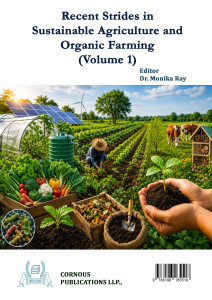
Editorial Book
Book Title: Recent Strides in Sustainable Agriculture and Organic Farming (Volume 1)
OPEN ACCESS | Published on : 14-Jan-2026 | Pages: 139-147 | Doi : 10.37446/volbook112024/139-147
Mycorrhizae for Climate Smart Sustainable Agriculture
- Somdatta Ghosh
- Mycorrhizae Lab. Department of Botany (UG & PG) Midnapore College (Autonomous), Midnapore, West Bengal, India.
- Som Subhra Dutta
- Mycorrhizae Lab. Department of Botany (UG & PG) Midnapore College (Autonomous), Midnapore, West Bengal, India.
- Suvashree Bhaumik
- Mycorrhizae Lab. Department of Botany (UG & PG) Midnapore College (Autonomous), Midnapore, West Bengal, India.
- Debashis Kuila
- Mycorrhizae Lab. Department of Botany (UG & PG) Midnapore College (Autonomous), Midnapore, West Bengal, India.
Abstract
To reduce global warming and climate change, a serious threat to agricultural production, we urgently need to reduce the global footprint, specially, the huge portion generated through agricultural practice. To adopt a climate smart agricultural practice, mycorrhizae may be an effective cost-effective tool. Mycorrhizae saves nutrient and water need in soil, offer biocontrol and sequester CO2 and nitrous oxide. Thus, long-term practice may offer a climate smart agriculture.
Keywords
Global warming, Climate change, Smart agriculture, Nitrous oxide, Chemical fertilizer
References
Arias, P., Bellouin, N., Coppola, E., Jones, R., Krinner, G., Marotzke, J., et al. (2021). Climate change 2021: The physical science basis. Contribution of working group I to the sixth assessment report of the intergovernmental panel on climate change. Cambridge University Press. https://www.ipcc.ch/report/ar6/wg1/
Augé, R. M., Toler, H. D., & Saxton, A. M. (2015). Arbuscular mycorrhizal symbiosis alters stomatal conductance of host plants more under drought than under amply watered conditions: A meta-analysis. Mycorrhiza, 25, 13–24.
Basiru, S., Mhand, K. A. S., & Hijri, M. (2023). Disentangling arbuscular mycorrhizal fungi and bacteria at the soil-root interface. Mycorrhiza, 33(3), 119–137. https://doi.org/10.1007/s00572-023-01107-7
Battini, F., Grønlund, M., Agnolucci, M., Giovannetti, M., & Jakobsen, I. (2017). Facilitation of phosphorus uptake in maize plants by mycorrhizosphere bacteria. Scientific Reports, 7(1), 4686.
Deepika, S., Goswami, V., & Kothamasi, D. (2023). Arbuscular Mycorrhizal Fungi (AMF) and Climate‐Smart Agriculture: Prospects and Challenges. In Global Climate Change and Plant Stress Management (Vol. 2, pp. 175–200).
Dey, M., & Ghosh, S. (2022). Arbuscular mycorrhizae in plant immunity and crop pathogen control. Rhizosphere, 22, 100524. https://doi.org/10.1016/j.rhisph.2022.10052
Faghihinia, M., Jansa, J., Halverson, L. J., & Staddon, P. L. (2022). Hyphosphere microbiome of arbuscular mycorrhizal fungi: a realm of unknowns. Biology and Fertility of Soils, 59(1), 17–34. https://doi.org/10.1007/s00374-022-01683-4
Fracasso, A., Telò, L., Lanfranco, L., Bonfante, P., & Amaducci, S. (2020). Physiological beneficial effect of Rhizophagus intraradices inoculation on tomato plant yield under water deficit conditions. Agronomy, 10(1), 71. https://doi.org/10.3390/agronomy10010071
Guo, L., Shen, J., Li, B., Li, Q., Wang, C., Guan, Y., D’Acqui, L. P., Luo, Y., Tao, Q., Xu, Q., Li, H., Yang, J., & Tang, X. (2019). Impacts of agricultural land use change on soil aggregate stability and physical protection of organic C. The Science of the Total Environment, 707, 136049. https://doi.org/10.1016/j.scitotenv.2019.136049
Hagenbo, A., Clemmensen, K. E., Finlay, R. D., Kyaschenko, J., Lindahl, B. D., Fransson, P., & Ekblad, A. (2017). Changes in turnover rather than production regulate biomass of ectomycorrhizal fungal mycelium across a Pinus sylvestris chronosequence. New Phytologist, 214(1), 424–431. https://doi.org/10.1111/nph.14379
Hart, M., Ehret, D. L., Krumbein, A., Leung, C., Murch, S., Turi, C., & Franken, P. (2015). Inoculation with arbuscular mycorrhizal fungi improves the nutritional value of tomatoes. Mycorrhiza, 25, 359–376. https://doi.org/10.1007/s00572-014-0617-0
Hu, X., Chen, D., Yan, F., Zheng, X., Fang, X., Bai, Y., Zhao, J., Ma, X., Ma, C., Cai, X., Deng, D., Sun, G., Sun, F., Zhou, J., & Liu, L. (2024). Global research trends on the effects of arbuscular mycorrhizal fungi on the soil carbon cycle: A bibliometric analysis. Ecological Indicators, 158, 111543. https://doi.org/10.1016/j.ecolind.2023.111543
Kumar, S., Saxena, S., & Samiksha. (2020). Mycorrhiza: A Sustainable Option for Better Crop Production. In Current trends in microbial biotechnology for sustainable agriculture (pp. 279–299). Springer Nature. https://doi.org/10.1007/978-981-15-6949-4_12
Leake, J., Johnson, D., Donnelly, D., Muckle, G., Boddy, L., & Read, D. (2004). Networks of power and influence: the role of mycorrhizal mycelium in controlling plant communities and agroecosystem functioning. Canadian Journal of Botany, 82(8), 1016–1045. https://doi.org/10.1139/b04-060
Li, X., He, G., Li, D., Bei, S., Luan, D., Sun, X., Yang, G., Huo, L., Zhen, L., & Zhao, R. (2023). Arbuscular mycorrhizal fungi reduce N2O emissions from degraded residue patches. Frontiers in Ecology and Evolution, 11, 1224849. https://doi.org/10.3389/fevo.2023.1224849
Liu, F., Xu, Y., Jiang, H., Jiang, C., Du, Y., Gong, C., et al. (2016). Systematic identification, evolution and expression analysis of the Zea mays PHT1 gene family reveals several new members involved in root colonization by arbuscular mycorrhizal fungi. International Journal of Molecular Sciences, 17(6), 1–18.
Liu, J., Gao, W., Liu, T., Dai, L., Wu, L., Miao, H., & Yang, C. (2023). A bibliometric analysis of the impact of ecological restoration on carbon sequestration in ecosystems. Forests, 14(7), 1442. https://doi.org/10.3390/f14071442
Lovarelli, D., Bacenetti, J., & Fiala, M. (2016). Water Footprint of crop productions: A review. Science of the Total Environment, 548–549, 236–251. https://doi.org/10.1016/j.scitotenv.2016.01.022
Luthfiana, N., Inamura, N., Tantriani, N., Sato, T., Saito, K., Oikawa, A., Chen, W., & Tawaraya, K. (2021). Metabolite profiling of the hyphal exudates of Rhizophagus clarus and Rhizophagus irregularis under phosphorus deficiency. Mycorrhiza, 31(3), 403–412. https://doi.org/10.1007/s00572-020-01016-z
Molden, D., Oweis, T., Steduto, P., Bindraban, P., Hanjra, M. A., & Kijne, J. (2010). Improving agricultural water productivity: Between optimism and caution. Agricultural Water Management, 97, 528–535. https://doi.org/10.1016/j.agwat.2009.03.023
Myers, S. S., Smith, M. R., Guth, S., Golden, C. D., Vaitla, B., Mueller, N. D., et al. (2017). Climate Change and Global Food Systems: Potential Impacts on Food Security and Undernutrition. Annual Review of Public Health, 38, 259–277.
Parihar, M., Rakshit, A., Meena, V. S., Gupta, V. K., Rana, K., Choudhary, M., Tiwari, G., Mishra, P. K., Pattanayak, A., Bisht, J. K., Jatav, S. S., Khati, P., & Jatav, H. S. (2020). The potential of arbuscular mycorrhizal fungi in C cycling: a review. Archives of Microbiology, 202(7), 1581–1596. https://doi.org/10.1007/s00203-020-01915-x
Pérez-De-Luque, A., Tille, S., Johnson, I., Pascual-Pardo, D., Ton, J., & Camferon, D. D. (2017). The interactive effects of arbuscular mycorrhiza and plant growth-promoting rhizobacteria synergistically enhance host plant defenses against pathogens. Scientific Reports, 7(1). https://doi.org/10.1038/s41598-017-16697-4
Sadhana, B. (2014). Arbuscular Mycorrhizal Fungi (AMF) as a Biofertilizer- a Review. International Journal of Current Microbiology and Applied Sciences, 3(4), 384–400. http://www.ijcmas.com
Tian, H., Xu, R., Canadell, J. G., Thompson, R. L., Winiwarter, W., & Suntharalingam, P., et al. (2020). A comprehensive quantification of global nitrous oxide sources and sinks. Nature, 586, 248–256. https://doi.org/10.1038/s41586-020-2780-0
Tomè, E., Tagliavini, M., & Scandellari, F. (2015). Recently fixed carbon allocation in strawberry plants and concurrent inorganic nitrogen uptake through arbuscular mycorrhizal fungi. Journal of Plant Physiology, 179, 83–89. https://doi.org/10.1016/j.jplph.2015.02.008
Torres, N., Goicoechea, N., & Antolín, M. C. (2018). Influence of irrigation strategy and mycorrhizal inoculation on fruit quality in different clones of Tempranillo grown under elevated temperatures. Agricultural Water Management, 202, 285–298. https://doi.org/10.1016/j.agwat.2017.12.004
Trejo, D., Sangabriel-Conde, W., Gavito-Pardo, M. E., & Banuelos, J. (2021). Mycorrhizal inoculation and chemical fertilizer interactions in pineapple under field conditions. Agriculture, 11(10), 934. https://doi.org/10.3390/agriculture11100934
Wang, X. X., Wang, X., Sun, Y., Cheng, Y., Liu, S., Chen, X., Feng, G., & Kuyper, T. W. (2018). Arbuscular mycorrhizal fungi negatively affect nitrogen acquisition and grain yield of maize in a N deficient soil. Frontiers in Microbiology, 9, 418. https://doi.org/10.3389/fmicb.2018.00418
Wang, Z., Bi, Y., Jiang, B., Zhakypbek, Y., Peng, S., Liu, W., & Liu, H. (2016). Arbuscular mycorrhizal fungi enhance soil carbon sequestration in the coalfields, northwest China. Scientific Reports, 6(1). https://doi.org/10.1038/srep34336
Weissert, L., Salmond, J., & Schwendenmann, L. (2016). Variability of soil organic carbon stocks and soil CO2 efflux across urban land use and soil cover types. Geoderma, 271, 80–90. https://doi.org/10.1016/j.geoderma.2016.02.014
Wu, S., Fu, W., Rillig, M. C., Chen, B., Zhu, Y., & Huang, L. (2023). Soil organic matter dynamics mediated by arbuscular mycorrhizal fungi – an updated conceptual framework. New Phytologist, 242(4), 1417–1425. https://doi.org/10.1111/nph.19178
Zayova, E., Stancheva, I., Geneva, M., Hristozkova, M., Dimitrova, L., Petrova, M., Sichanova, M., Salamon, I., & Mudroncekova, S. (2018). Arbuscular mycorrhizal fungi enhance antioxidant capacity of in vitro propagated garden thyme (Thymus vulgaris L.). Symbiosis, 74, 177–187. https://doi.org/10.1007/s13199-017-0502-7.
Indexing In




Types of Books We Publish




Uniqueness of our Publication

DOI Assignment

ISBN Registration

Online Publication

High Visibility

Open & Closed Access
DOI Assignment
ISBN Registration
Online Publication
High Visibility