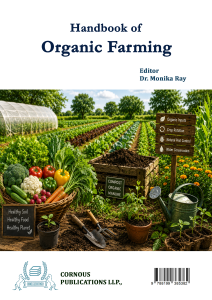
Editorial Book
Book Title: Handbook of Organic Farming
PAID ACCESS | Published on : 23-Nov-2026 | Pages: 103-116 | Doi : https://doi.org/10.37446/edibook142024/103-116
Livestock Management in Organic Farming
- Dr Sudeep Solanki
- Senior Assistant Professor, College of Veterinary and Animal Science (CVAS), Navania, Udaipur – 313001, Rajasthan, India.
Abstract
Organic livestock farming connects animal nutrition, health, welfare, land management and product integrity within a certified production system. Its scientific value depends on demonstrable outcomes rather than the organic label alone. This chapter explains the Indian National Programme for Organic Production (NPOP), eighth edition 2024, with specific clause and annex references, and develops practical applications for cattle, buffaloes, sheep, goats and backyard poultry. It presents quantitative housing requirements, dry matter budgeting and illustrative ration calculations, preventive healthcare, welfare monitoring, traceability and economic sensitivity analysis. Indian field evidence and international studies show that balanced nutrition and competent management are essential, while benefits for udder health, profitability and greenhouse gas intensity vary with context. Certification must never delay effective treatment of a sick animal. Successful conversion therefore requires verified feed supply, a veterinary health plan, measurable welfare indicators, realistic market access and auditable records.
Keywords
Organic livestock, NPOP, Animal welfare, Ration balancing, Preventive veterinary medicine, India, Traceability
References
Agricultural and Processed Food Products Export Development Authority. (2024). National programme for organic production (8th ed.). Ministry of Commerce and Industry. https://npop.apeda.gov.in/sites/default/files/2024-10/NPOP_Eight_Edition_2024.pdf
Agricultural and Processed Food Products Export Development Authority. (2026). Amendment of Annex 3(17) of the NPOP 8th Edition (Notification No. APEDA-ORG/11/2025-26, May 18, 2026). https://npop.apeda.gov.in/sites/default/files/announcements/Notification_on_amendment_Annex3_17_NPOP_8th_Edition.pdf
Department of Animal Husbandry and Dairying. (n.d.-a). Livestock health and disease control program. Government of India. https://www.dahd.gov.in/en/schemes-programmes/lhdcp
Department of Animal Husbandry and Dairying. (n.d.-b). National Animal Disease Control Programme for FMD and brucellosis. Government of India. https://www.dahd.gov.in/en/schemes/programmes/nadcp
Halder, R., Bandyopadhyay, S., & Ghosh, S. (2024). Study on incidences, risk factors and bacterial populations involved in subclinical mastitis cases in the conventional vis-à-vis organic dairy farming under small holder system in Indian Sundarban region. Indian Journal of Dairy Science, 77(1). https://epubs.icar.org.in/index.php/IJDS/article/view/139132
IFOAM Organics International. (n.d.). The four principles of organic agriculture. https://www.ifoam.bio/why-organic/shaping-agriculture/four-principles-organic
Kenyon, F., Greer, A. W., Coles, G. C., Cringoli, G., Papadopoulos, E., Cabaret, J., et al. (2009). The role of targeted selective treatments in the development of refugia-based approaches to the control of gastrointestinal nematodes of small ruminants. Veterinary Parasitology, 164(1), 3–11. https://doi.org/10.1016/j.vetpar.2009.04.015
Lambotte, M., De Cara, S., Brocas, C., & Bellassen, V. (2023). Organic farming offers promising mitigation potential in dairy systems without compromising economic performances. Journal of Environmental Management, 334, Article 117405. https://doi.org/10.1016/j.jenvman.2023.117405
Linehan, K., Patangia, D. V., Ross, R. P., & Stanton, C. (2024). Production, composition and nutritional properties of organic milk: A critical review. Foods, 13(4), Article 550. https://doi.org/10.3390/foods13040550
National Academies of Sciences, Engineering, and Medicine. (2021). Nutrient requirements of dairy cattle (8th rev. ed.). The National Academies Press. https://doi.org/10.17226/25806
National Dairy Development Board. (n.d.-a). Area specific mineral mixture. https://www.nddb.org/services/animalnutrition/mineralmixture
National Dairy Development Board. (n.d.-b). Carbon footprint of milk. https://www.nddb.org/services/animalnutrition/climate-smart-dairying/carbon-footprint-of-milk
National Dairy Development Board. (n.d.-c). Ration balancing programme. https://www.nddb.org/services/animalnutrition/programmes/ration-balancing-programme
National Research Council. (2007). Nutrient requirements of small ruminants: Sheep, goats, cervids, and new world camelids. The National Academies Press. https://doi.org/10.17226/11654
Neri, T. A. N., Park, H., Kang, S., Baek, S. H., & Nam, I. S. (2024). Comparative antimicrobial resistance and prevalence of methicillin resistance in coagulase-positive staphylococci from conventional and organic dairy farms in South Korea. Antibiotics, 13(7), Article 617. https://doi.org/10.3390/antibiotics13070617
Średnicka-Tober, D., Barański, M., Seal, C. J., Sanderson, R., Benbrook, C., Steinshamn, H., et al. (2016). Higher PUFA and n-3 PUFA, conjugated linoleic acid, α-tocopherol and iron, but lower iodine and selenium concentrations in organic milk: A systematic literature review and meta- and redundancy analyses. British Journal of Nutrition, 115(6), 1043–1060. https://doi.org/10.1017/S0007114516000349
Tamil Nadu Agricultural University. (n.d.). Feeding management of sheep and goats. https://agritech.tnau.ac.in/expert_system/sheepgoat/Feeding%20Management%20of%20Sheep%20and%20Goats.html
World Organisation for Animal Health. (2024). Animal welfare and dairy cattle production systems. In Terrestrial animal health code (Chapter 7.11). https://www.woah.org/fileadmin/Home/eng/Health_standards/tahc/2024/en_chapitre_aw_dairy_cattle.htm
Indexing In




Types of Books We Publish




Uniqueness of our Publication

DOI Assignment

ISBN Registration

Online Publication

High Visibility

Open & Closed Access
DOI Assignment
ISBN Registration
Online Publication
High Visibility