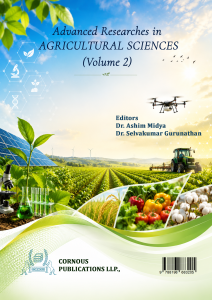
Editorial Book
Book Title: Advanced Researches in Agricultural Sciences (Volume 2)
PAID ACCESS | Published on : 26-Oct-2026 | Pages: 183-192 | Doi : https://doi.org/10.37446/vol2book092025/183-192
Integrated Pest Management in Tomato: Sustainable Strategies, Emerging Technologies and Future Prospects
- Dr. Yogesh Kumar Sidar
- Subject Matter Specialist, Department of Entomology, Krishi Vigyan Kendra, Sukma, IGKV, Raipur, Chhattisgarh, India.
- Dr. Yogesh Kumar Meshram
- Professor, Department of Entomology, IGKV, Raipur, Chhattisgarh, India.
- Dr. Vivek Kumar Kurrey
- Rural Horticulture Extension Officer, Department of Horticulture Government of Chhattisgarh, India.
- Dr. Gunjeshree Gond
- Subject Matter Specialist, Department of Vegetable Science, Krishi Vigyan Kendra, Sukma, IGKV, Raipur, Chhattisgarh, India.
Abstract
Tomato (Solanum lycopersicum L.) is one of the most economically important vegetable crops cultivated in tropical, subtropical and temperate regions. Its production is constrained by a complex of insect and mite pests that damage seedlings, foliage, flowers and fruits, reduce marketable yield, and transmit viral pathogens. Major pests include the tomato fruit borer, Helicoverpa armigera; South American tomato pinworm, Tuta absoluta; whiteflies, Bemisia tabaci; aphids, Myzus persicae and Aphis gossypii; thrips, Thrips spp.; leaf miners, Liriomyza spp.; and several mite species. Excessive dependence on synthetic insecticides may lead to resistance, resurgence, destruction of natural enemies, pesticide residues and increased production costs. Integrated Pest Management (IPM) provides an ecologically based alternative by combining preventive agronomic practices, regular pest surveillance, mechanical removal, pheromone-based monitoring, biological control, botanical products and need-based chemical interventions. Natural farming approaches further emphasise crop diversity, soil health, ecological balance, botanical preparations and conservation of beneficial organisms. However, natural farming inputs should be evaluated according to their efficacy, safety, preparation quality and consistency rather than assumed to provide complete protection against every pest. This chapter reviews the identification, biology, damage symptoms, monitoring and integrated management of major tomato pests, with particular emphasis on field-level implementation in India. It also presents an IPM schedule, decision-making principles and research priorities for sustainable tomato production.
Keywords
Tomato, insect pests, integrated pest management, Helicoverpa armigera, Tuta absoluta, biological control, botanical pesticides, sustainable agriculture
References
Ajij, M., Hasan, M., Iqbal, J., & Ali, A. (2009). Role of different weather factors on fluctuation of fruit and shoot infestation of spotted bollworms, Earias spp. on okra (Abelmoschus esculentus L.). IJAVMS, 3(2), 64–72.
Biondi, A., Guedes, R. N. C., Wan, F.-H., & Desneux, N. (2018). Ecology, worldwide spread, and management of the invasive South American tomato pinworm, Tuta absoluta: Past, present, and future. Annual Review of Entomology, 63, 239–258.
Choudhary, B. R. (2002). Importance of tomato vegetable crop. P. B., 121(4), 292–296.
Meena, L. K., & Raju, S. V. S. (2014). Bioefficacy of newer insecticides against tomato fruit borer, Helicoverpa armigera (Hübner), on tomato (Lycopersicon esculentum Mill.) under field conditions. The Bioscan, 9(1), 347–350.
National Horticulture Board. (2015). National horticulture database 2014 (pp. 177–185).
Olaniyi, J. O. (2010). Vegetable production can be adopted as a strategy for improving livelihood and alleviating the nutritional status of the people. African Journal of Food Science, 4(6), 398–402.
Pareek, P. L., & Bhargava, M. C. (2003). Estimation of avoidable losses in vegetables caused by borers under semi-arid conditions of Rajasthan. Insect Environment, 9, 59–60.
Rapisarda, C., & Garzia, G. T. (2000). Tomato yellow leaf curl Sardinia virus and its vector Bemisia tabaci in Sicilia (Italy): Present status and control possibilities. OEPP/EPPO Bulletin, 32, 25–29.
Talekar, N. S., Open, R. T., & Hanson, P. (2006). Helicoverpa armigera management: A review of AVRDC’s esearch on host plant resistance in tomato. Crop Protection, 5, 461–467.
Taram, S. K. (2016). Population dynamics, extent of damage and estimation of losses caused by the invasive South American tomato moth, Tuta absoluta (Povolny) (Lepidoptera: Gelechiidae) on solanaceous crops with special reference to tomato [Doctoral dissertation, Indira Gandhi Krishi Vishwavidyalaya].
Indexing In




Types of Books We Publish




Uniqueness of our Publication

DOI Assignment

ISBN Registration

Online Publication

High Visibility

Open & Closed Access
DOI Assignment
ISBN Registration
Online Publication
High Visibility