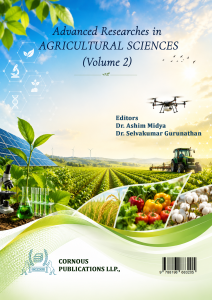
Editorial Book
Book Title: Advanced Researches in Agricultural Sciences (Volume 2)
OPEN ACCESS | Published on : 18-Apr-2026 | Pages: 106-116 | Doi : 10.37446/vol2book092025/106-116
Integrated Pest Management in Redgram
- Chitta Ranjan Satpathi
- Professor, Department of Agricultural Entomology, Bidhan Chandra Krishi Vishwavidyalaya, PO- Mahanpur, District: Nadia, West Bengal, India.
Abstract
Redgram Cajanus cajan (L.) Millsp. an important leguminous crop harboring about 77 insect pests but only the appearance of forget-me-not butterfly Catochrysops strabo (Fab.), plume moth Exelastes atomosa W., Bengal borer Cletthara floccifera Hamp., maruca pod borer Maruca testulalis (Geyer), gram pod borer (Helicoverpa armigera Hub.), pod boring weevil Apion clavipes Gerst. and pod fly Melanagromyza obtusa Mall. caused considerable damage to the crop, all these insects are serious pest of red gram and it is very common that five lepidopteran larvae per plant and 4.50 percent pod damage or 2.04 percent grain damage either by pod boring weevil Apion clavipes Gerst. or pod fly Melanagromyza obtusa Mall. caused economic threshold level of damage in red gram. Although the body size of these insects are small but hand picking and destruction of mature larva and egg masses could suppress to build up the initial population of this pest. Among the different bioagents the application of Ha NPV 3 x10¹² POB/ha in 0.1% teepol or Bacillus thuringiensis serovar kurstaki 5%WP1000-1250 g/ha might be considered as an alternate to chemical insecticides. If the insect population reached too high application of chemicals like emamectin benzoate 5% SG @ 220 g/ha, chlorantraniliprole 18.5% SC @ 150ml/ha, spinosad 45% SC @ 125-162 ml/ha are useful to keep pest population within threshold limits.
Keywords
Pod borer, Plume moth, Bengal borer, Pod fly, Pod boring weevil, Parasitoids, Natural enemies, Bio agents, Augmentation, Insecticides
References
Altieri, M. A., Lewis, W. J., Nordlund, D. A., Gueldner, R. C., & Todd, J. W. (1981). Chemical interactions between plants and Trichogramma sp. wasps in Georgia soybean fields. Protection Ecology, 3, 259–263.
Altieri, M. A., & Whitcomb, W. H. (1979). The potential use of weeds in the manipulation of beneficial insects. Horticultural Science, 14, 12–18.
Chakravarty, S., Agnihotri, M., & Kumar, L. (2016). Diversity of insect fauna associated with pigeon pea and their succession in relation to crop phenology at Pant Nagar, Uttarakhand. Journal of Experimental Zoology, 19(Suppl. 1), 1327–1332.
Dicke, M., & Sabelis, M. W. (1988). How plants obtain predatory mites as bodyguards. Netherlands Journal of Zoology, 38, 148–165.
Ehlers, R. U. (2011). Regulation of biological control agents (pp. 3–23). Springer Science.
FAOSTAT. (2023–2024). Food and Agriculture Organization of the United Nations. https://www.fao.org/faostat/
Ghosh, M. R., Satpathi, C. R., & Bandyopadhyay, B. (1992). New record of Cletthara floccifera Hampson (Noctuidae: Lepidoptera) on pigeon pea in West Bengal. Annals of Entomology, 10(2), 55–56.
Gopali, J. B., Tegelli, R. D., Mannur, M., & Yelshetty, S. (2010). Web forming lepidopteran, Maruca vitrata (Geyer): An emerging and destructive pest in pigeonpea. Karnataka Journal of Agricultural Sciences, 23, 35–38.
Ketipearachchi, Y. (2002). Hymenoptera parasitoids and hyperparasitoids of crop pests at Aralaganwila in north central province of Sri Lanka. Annals of the Sri Lanka Department of Agriculture, 4, 293–306.
Khan, Z., James, D., & Pickett, J. (2008). Chemical ecology and conservation biological control. Journal of Biological Control, 45(2), 210–224.
Kumar, T. N. V., Srivastava, C. P., Ganguly, S., & Premkumari, S. (2020). Identification of resistance to pod fly, Melanagromyza obtusa (Malloch) infestation in pigeon pea genotypes evaluated in the field experiment. International Journal of Current Microbiology and Applied Sciences, 9(9), 2546–2554.
Makinson, J. R., Goolsby, J. A., Meyerdirk, D. E., Kirk, A. A., & Burwell, C. J. (2005). A new record and host association for the pigeon pea pod fly, Melanagromyza obtusa (Malloch) (Diptera: Agromyzidae) and notes on its parasitoids in the Northern Territory, Australia. Australian Entomology, 32(2), 79–82.
Narendran, T. C., David, B. V., & Selvaraj, P. (2005). A new species of Aprostocetus Westwood (Hymenoptera: Eulophidae) parasitic on Melanagromyza obtusa (Malloch) (Diptera: Agromyzidae) from India. Entomon, 30(3), 221–225.
Satpathi, C. R. (1995). Spiders controlling different insect pests of flowering plants in Kalimpong, West Bengal, India. Annals of Entomology, 13(2), 97–98.
Satpathi, C. R., & Ghosh, M. R. (1994). Phased application of monocrotophos and its effects on insects infesting reproductive parts of Cajanus cajan (L.) Millsp. Indian Journal of Agricultural Sciences, 64(7), 507–508.
Satpathi, C. R., Pal, S., & Ghosh, M. R. (1992). List of insects and mites infesting red gram [Cajanus cajan (L.) Millsp.] in West Bengal. Annals of Entomology, 10(2), 52–53.
Satpathi, C. R. (1992). Incidence of insect pests of red gram (Doctoral dissertation, Bidhan Chandra Krishi Viswavidyalaya, Mahanpur, West Bengal, India).
Shannon, C. E., & Weaver, W. (1949). The mathematical theory of communication. University of Illinois Press.
Sharma, O. P., Gopali, G. B., Yelshetty, S., Bambawale, O. M., Garg, D. K., & Bhosle, B. B. (2010). Pests of pigeon pea and their management. NCIPM, IARI Campus, New Delhi, India.
Singh, S. P. (2003). Status of biological control in India. In P. Santha Kumari (Ed.), Biological control of crop pests in India (p. 349). Kalyani Publishers.
Srilaxmi, K., & Paul, R. (2010). Diversity of insect pests of pigeon pea Cajanus cajan (L.) Millsp and their succession in relation to crop phenology in Gulbarga, Karnataka. The Ecoscan, 4, 273–276.
Srivastava, C. P., & Joshi, N. (2011). Insect pest management in pigeon pea in Indian scenario: A critical review. Indian Journal of Entomology, 73(1), 63–75.
Stern, V. M., Smith, R. F., van den Bosch, R., & Hagen, K. S. (1959). The integrated control concept. Hilgardia, 29, 81–101.
Sujithra, M., & Chander, S. (2014). Seasonal incidence and damage of major insect pests of pigeonpea, Cajanus cajan (L.). Indian Journal of Entomology, 76(3), 202–206.
Wadaskar, R. M., Bhalkare, S. K., & Patil, A. N. (2013). Field efficacy of newer insecticides against pod borer complex of pigeon pea. Journal of Food Legumes, 26(1–2), 62–66.
Wu, H., Hou, C., Huang, L. Q., Yan, F. S., & Wang, C. Z. (2013). Peripheral coding of sex pheromone blends with reverse ratios in two Helicoverpa species PLoS ONE, 8(7), e70078. https://doi.org/10.1371/journal.pone.0070078.
Indexing In




Types of Books We Publish




Uniqueness of our Publication

DOI Assignment

ISBN Registration

Online Publication

High Visibility

Open & Closed Access
DOI Assignment
ISBN Registration
Online Publication
High Visibility