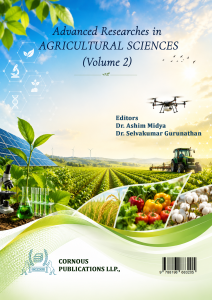
Editorial Book
Book Title: Advanced Researches in Agricultural Sciences (Volume 2)
PAID ACCESS | Published on : 06-Jul-2026 | Pages: 129-135 | Doi : 10.37446/vol2book092025/129-135
Innovative Approaches of Agricultural Extension Outreach Programmes
- Devayan Chatterjee
- Faculty of Agriculture, JIS University, West Bengal, India.
- Krishanu Pal
- Faculty of Agriculture, JIS University, West Bengal, India.
- Niladri Jana
- Faculty of Agriculture, JIS University, West Bengal, India.
- Suparna Sarkar
- Faculty of Agriculture, JIS University, West Bengal, India.
- Deblina Ghosh
- Faculty of Agriculture, JIS University, West Bengal, India.
Abstract
The function of Extension programs is dynamic in nature, with an emphasis on encouraging end users to innovate. Extension programs formerly focused on top-down program delivery, but increasingly it recognizes the benefits of adapting technology locally to meet local needs and resources. To promote adaptive innovation, the emphasis is on high-quality alliances and teamwork. A decentralized, demand-driven extension system is intended to take the role of a supply-driven strategy. An iterative, co-learning process is supported by this participatory action extension strategy, in which the user is given alternatives and then adjusts to meet local problems. The rapidly expanding domains of social media and information technologies are starting to facilitate mass communication and participatory extension, which will continue to increase in value and application. Radio plays and reality programs are methods that rely on folk traditions and have been demonstrated to enhance farmer decision-making on crop and pest management. Even in the most isolated locations, cell phones provide better communication and feedback, making them a rapidly adopted technology. As part of a sustainable outreach strategy, the emphasis is on fellow farmers as equal partners in order to guarantee that change originates from within and to provide case studies that represent local objectives, resources and circumstances.
Keywords
Agricultural Extension, Innovative extension approaches, Information Communication Technologies (ICTs), Transfer of technology, Outreach Programmes
References
Aker, J. C. (2011). Dial "A" for agriculture: A review of information and communication technologies for agricultural extension in developing countries. Agricultural Economics, 42(6), 631–647. https://doi.org/10.1111/j.1574-0862.2011.00545.x
Aker, J. C., & Ksoll, C. (2016). Can mobile phones improve agricultural outcomes? Evidence from a randomized experiment in Niger. Food Policy, 60, 44–51. https://doi.org/10.1016/j.foodpol.2015.03.006
Anderson, J. R., & Feder, G. (2007). Agricultural extension. In R. E. Evenson & P. Pingali (Eds.), Handbook of agricultural economics (Vol. 3, pp. 2343–2378). Elsevier.
Davis, K., Babu, S. C., & Blom, S. (2012). Agricultural extension: Global status and performance in selected countries. International Food Policy Research Institute (IFPRI).
Devanand, I. I., & Kamala, I. M. (2019). Innovative extension approach for sustainable agricultural development: WhatsApp groups for farming solution. Current Journal of Applied Science and Technology, 37(3), 1–8.
Donaldson, T. J. (2019). Co-designing digital information-seeking activities with and for small-scale farmers (Doctoral dissertation, University of Johannesburg).
Fu, X., & Akter, S. (2016). The impact of mobile phone technology on agricultural extension services delivery: Evidence from India. The Journal of Development Studies, 52(11), 1561–1576.
Hanna, R., Mullainathan, S., & Schwartzstein, J. (2014). Learning through noticing: Theory and evidence from a field experiment. The Quarterly Journal of Economics, 129(3), 1311–1353.
Hidayat, R., Cindrakasih, R. R., Feriyanti, Y. G., & Razali, G. (2024). The use of modern information technology in extension services. INTERACTION, 11(2), 905–915.
Munthali, N., Leeuwis, C., van Paassen, A., Lie, R., Asare, R., van Lammeren, R., & Schut, M. (2018). Innovation intermediation in a digital age. NJAS – Wageningen Journal of Life Sciences, 86, 64–76.
Muto, M., & Yamano, T. (2009). The impact of mobile phone coverage expansion on market participation. World Development, 37(12), 1887–1896.
Omulo, G., & Kumeh, E. M. (2020). Farmer-to-farmer digital network as a strategy to strengthen agricultural performance in Kenya: A research note on the Wefarm platform. Technological Forecasting and Social Change, 158, 120120. https://doi.org/10.1016/j.techfore.2020.120120
Singh, A. K., Meena, M. S., & Kumar, A. (2022). Krishi Vigyan Kendras as knowledge and resource centres for agricultural development in India. Indian Journal of Extension Education, 58(2), 1–8.
Takahashi, K., Muraoka, R., & Otsuka, K. (2020). Technology adoption and extension in developing countries. Agricultural Economics, 51(1), 31–45.
Taylor, M., & Bhasme, S. (2018). Agricultural knowledge transfer. Journal of Rural Studies, 64, 1–10.
Van Campenhout, B., Spielman, D. J., & Lecoutere, E. (2021). ICTs to provide agricultural advice: Experimental evidence from Uganda. American Journal of Agricultural Economics, 103(1), 317–337.
Van Campenhout, B., Vandevelde, S., Walukano, W., & Van Asten, P. (2017). Agricultural extension messages using video on portable devices increased knowledge about seed selection, storage and handling among smallholder potato farmers in southwestern Uganda. PLoS ONE, 12(1), e0169557.
Indexing In




Types of Books We Publish




Uniqueness of our Publication

DOI Assignment

ISBN Registration

Online Publication

High Visibility

Open & Closed Access
DOI Assignment
ISBN Registration
Online Publication
High Visibility