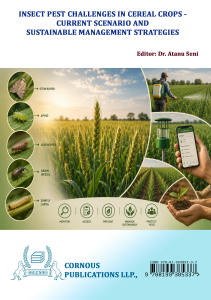
Editorial Book
Book Title: Insect Pest Challenges in Cereal Crops - Current Scenario and Sustainable Management Strategies
PAID ACCESS | Published on : 03-Feb-2026 | Pages: 28-36 | Doi : 10.37446/edibook212025/28-36
Harnessing Entomopathogens for Sustainable Insect Pest Management in Cereal Crops
- Shubham Yadav
- Department of Entomology, Chaudhary Charan Singh Haryana Agricultural University, Hisar, Haryana, India.
- Deepak Swami
- Department of Plant Pathology, Chaudhary Charan Singh Haryana Agricultural University, Hisar, Haryana, India.
- Dalip Kumar
- Department of Entomology, Chaudhary Charan Singh Haryana Agricultural University, Hisar, Haryana, India.
- Rinku Poonia
- College of Agriculture, Kaul (Kaithal), Chaudhary Charan Singh Haryana Agricultural University, Hisar, Haryana, India.
- Balbir Singh
- Krishi Vigyan Kendra, Bawal (Rewari), Chaudhary Charan Singh Haryana Agricultural University, Hisar, Haryana, India.
Abstract
Cereal crops such as wheat, rice, maize, etc. are vital to the global food security but their productivity is significantly threatened by insect pest infestations, causing major yield losses. Conventional reliance on chemical pesticides, although effective in short term, has resulted in environmental hazards and resistance development in pests. For sustainable pest management, entomopathogens which are a diverse group of insect pathogenic microorganisms offer eco-friendly and sustainable alternatives within an Integrated Pest Management (IPM) framework, thereby reducing dependence on synthetic insecticides while preserving ecological integrity. They possess unique infection mechanisms, high host specificity and are seamlessly compatible with other IPM components. Despite challenges related to their environmental stability and field persistence, advancement in strain improvement, formulation technology has led to their increased field performance. Integrating entomopathogens into pest management regimes contribute to sustainable agriculture by minimizing chemical inputs, mitigating resistance development and supporting long-term agroecosystem health. This chapter provides a comprehensive overview of various entomopathogens, highlighting their modes of action, efficacy and field applications in cereal cropping systems in controlling key pests such as stem borers, armyworms, cutworms, and rootworms.
Keywords
Entomopathogens, Cereal crops, IPM, Sustainable pest management
References
Azizoglu, U., Jouzani, G. S., Yilmaz, N., Baz, E., & Ozkok, D. (2020). Genetically modified entomopathogenic bacteria, recent developments, benefits and impacts: A review. Science of The Total Environment, 734, 139169.
Bale, J. S., Van Lenteren, J. C., & Bigler, F. (2008). Biological control and sustainable food production. Philosophical Transactions of the Royal Society B: Biological Sciences, 363(1492), 761–776.
Bravo, A., Gill, S. S., & Soberón, M. (2007). Mode of action of Bacillus thuringiensis Cry and Cyt toxins and their potential for insect control. Toxicon, 49(4), 423–435.
Chattopadhyay, A., Bhatnagar, N. B., & Bhatnagar, R. (2004). Bacterial insecticidal toxins. Critical Reviews in Microbiology, 30(1), 33–54.
Dziedziech, A., Shivankar, S., & Theopold, U. (2020). High-resolution infection kinetics of entomopathogenic nematodes entering Drosophila melanogaster. Insects, 11(1), 60.
Fallet, P., Bazagwira, D., Ruzzante, L., Ingabire, G., Levivier, S., Bustos-Segura, C., & Turlings, T. C. (2024). Entomopathogenic nematodes as an effective and sustainable alternative to control the fall armyworm in Africa. PNAS Nexus, 3(4), 122–130.
Gelaye, Y., & Negash, B. (2023). The role of baculoviruses in controlling insect pests: A review. Cogent Food & Agriculture, 9(1), 2254139.
Gutema, B. A., Achlehum, D. M., Edosa, T. T., Feyisa, B., Yimer, F., & Dinka, T. D. (2025). Evaluation of Entomopathogenic Nematode Isolates against Subterranean Termites under Laboratory and Field Conditions. F1000Research, 12, 1601.
Irsad, Shahid, M., Haq, E., Mohamed, A., Rizvi, P. Q., & Kolanthasamy, E. (2023). Entomopathogen-based biopesticides: insights into unraveling their potential in insect pest management. Frontiers in Microbiology, 14, 1208237.
Kalha, C. S., Singh, P. P., Kang, S. S., Hunjan, M. S., Gupta, V., & Sharma, R. (2014). Entomopathogenic viruses and bacteria for insect-pest control. In Integrated pest management (pp. 225–244). Academic Press.
Katti, G. (2013). Biopesticides for insect pest management in rice–present status and future scope. Journal of Rice Research, 6(1), 1–15.
Kumar, A., Suroshe, S. S., Saini, G. K., & Singh, J. (2023). Efficacy of genetically transformed Metarhizium anisopliae against Spodoptera litura and Aphis craccivora. Saudi Journal of Biological Sciences, 30(1), 103493.
Kumar, S., Chandra, A., & Pandey, K. C. (2008). Bacillus thuringiensis (Bt) transgenic crop: an environment friendly insect-pest management strategy. Journal of Environmental Biology, 29(5), 641–653.
Mantzoukas, S., Zikou, A., Triantafillou, V., Lagogiannis, I., & Eliopoulos, P. A. (2019). Ιnteractions between Beauveria bassiana and Isaria fumosorosea and their hosts Sitophilus granarius (L.) and Sitophilus oryzae (L.)(Coleoptera: Curculionidae). Insects, 10(10), 362.
Martínez-Balerdi, M., Caballero, J., Aguirre, E., Caballero, P., & Beperet, I. (2025). Baculoviruses as Microbial Pesticides: Potential, Challenges, and Market Overview. Viruses, 17(7), 917.
Nishimatsu, T., & Jackson, J. J. (1998). Interaction of insecticides, entomopathogenic nematodes, and larvae of the western corn root worm (Coleoptera: Chrysomelidae). Journal of Economic Entomology, 91(2), 410–418.
Oliveira, C. M., Auad, A. M., Mendes, S. M., & Frizzas, M. R. (2014). Crop losses and the economic impact of insect pests on Brazilian agriculture. Crop Protection, 56, 50–54.
Palma, L., Muñoz, D., Berry, C., Murillo, J., & Caballero, P. (2014). Bacillus thuringiensis toxins: an overview of their biocidal activity. Toxins, 6(12), 3296–3325.
Rajula, J., Rahman, A., & Krutmuang, P. (2020). Entomopathogenic fungi in Southeast Asia and Africa and their possible adoption in biological control. Biological Control, 151, 104399.
Sharma, A., Sharma, S., & Yadav, P. K. (2023). Entomopathogenic fungi and their relevance in sustainable agriculture: A review. Cogent Food & Agriculture, 9(1), 2180857.
Sheikh, A. A., Wani, M. A., Bano, P., Un, S., Nabi, T. A. B., Bhat, M. A., & Dar, M. S. (2017). An overview on resistance of insect pests against Bt crops. Journal of Entomology and Zoology Studies, 5(1), 941–948.
Siddiqui, J. A., Fan, R., Naz, H., Bamisile, B. S., Hafeez, M., Ghani, M. I., & Chen, X. (2023). Insights into insecticide-resistance mechanisms in invasive species: Challenges and control strategies. Frontiers in Physiology, 13, 1112278.
Stathas, I. G., Sakellaridis, A. C., Papadelli, M., Kapolos, J., Papadimitriou, K., & Stathas, G. J. (2023). The effects of insect infestation on stored agricultural products and the quality of food. Foods, 12(10), 2046.
Tarasco, E., Fanelli, E., Salvemini, C., El-Khoury, Y., Troccoli, A., Vovlas, A., & De Luca, F. (2023). Entomopathogenic nematodes and their symbiotic bacteria: from genes to field uses. Frontiers in Insect Science, 3, 1195254.
Tomar, P., & Yadav, A. N. (2024). Entomopathogenic microorganisms as biocontrol agents for agricultural sustainability. Biocatalysis and Agricultural Biotechnology, 62, 103431.
Washim, M., Manda, P., & Das, R. (2024). Pesticide resistance in insects: Challenges and sustainable solutions for modern agriculture. International Journal of Agriculture and Food Science, 6(2), 121–127.
Zhang, Y., Wang, F., & Zhao, Z. (2022). Metabonomics reveals that entomopathogenic nematodes mediate tryptophan metabolites that kill host insects. Frontiers in Microbiology, 13, 1042145.
Indexing In




Types of Books We Publish




Uniqueness of our Publication

DOI Assignment

ISBN Registration

Online Publication

High Visibility

Open & Closed Access
DOI Assignment
ISBN Registration
Online Publication
High Visibility