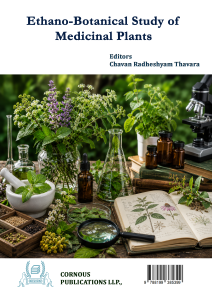
Editorial Book
Book Title: Ethano-Botanical Study of Medicinal Plants
PAID ACCESS | Published on : 24-Mar-2026 | Pages: 89-94 | Doi : 10.37446/edibook182024/89-94
Ethno - medicinal plant species for respiration and bronchial diseases
- A. Freeda Rose
- Assistant Professor of Botany, Holy Cross College, Tiruchirappalli, India.
- T. Francis Xavier
- Associate Professor of Botany, St. Joseph’s College, Tiruchirappalli, India.
Abstract
Respiratory diseases are a significant public health issue worldwide. They greatly contribute to illness, death, and healthcare expenses. Chronic respiratory diseases, such as asthma, chronic obstructive pulmonary disease (COPD), pneumonia, and tuberculosis, are especially prevalent in low- and middle-income countries. In these areas, environmental pollution, tobacco use, and limited healthcare access worsen disease outcomes. Traditional medicine is essential for primary healthcare in many rural and indigenous communities, particularly in India. Here, people widely use plant-based treatments to manage respiratory problems. This chapter provides an overview of medicinal plants traditionally used for respiratory conditions, integrating perspectives on global health, ethnomedicinal practices, and the relevance of plant therapies. It includes an account of 29 plant species used in Indian traditional systems. For each species, the chapter lists its botanical name, family, parts used, methods of preparation, and specific uses in respiratory care. Additionally, it examines the benefits of plant-based treatments compared to synthetic drugs, highlights the troubling decline of indigenous knowledge, and underscores the need for conservation efforts. The chapter highlights the important role of ethnobotany in respiratory healthcare and the potential of plant-based compounds as future treatments by integrating scientific research with cultural insights.
Keywords
Respiratory diseases, Traditional medicine, Ethnomedicinal practices, Environmental pollution
References
Ayyanar, M., & Ignacimuthu, S. (2011). Ethnobotanical survey of medicinal plants commonly used by the Kani tribals in Tirunelveli hills of Western Ghats, India. Journal of Ethnopharmacology, 134(3), 851–864.
Cock, I. E., & Van Vuuren, S. F. (2020). The traditional use of southern African medicinal plants for the treatment of bacterial respiratory diseases: A review of the ethnobotany and scientific evaluations. Journal of Ethnopharmacology, 263, 113204.
Dailah, H. G. (2022). Patterns and prevalence of respiratory diseases in developing nations. Journal of Global Health Research, 14(2), 112–128.
Global Asthma Network. (2018). Global asthma report 2018. http://globalasthmareport.org/burden/burden.php
Haile, L. M., et al. (2022). Mortality and disability-adjusted life-years (DALYs) for chronic respiratory diseases. The Lancet, 400(10357), 302–320.
Mechaala, S., et al. (2021). Natural products and respiratory diseases: An overview. Phytomedicine, 85, 153543.
Meghji, J., Mortimer, K., & Agusti, A. (2021). Improving lung health in low- and middle-income countries: From challenges to solutions. The Lancet, 397(10277), 928–940.
Nguanchoo, N., et al. (2023). Loss of traditional medicinal knowledge: A global review. Ethnobiology and Conservation, 12, 22.
Nyagumbo, R., et al. (2022). Plant-based traditional medicines and respiratory health. African Journal of Traditional, Complementary and Alternative Medicines, 19(2), 112–128.
Rehman, S., et al. (2023). Respiratory infections and global health burden. International Journal of Infectious Diseases, 128, 34–41.
Sung, H., et al. (2021). Global cancer statistics 2020: GLOBOCAN estimates of incidence and mortality worldwide for 36 cancers in 185 countries. CA: A Cancer Journal for Clinicians, 71(3), 209–249.
Wardlaw, T. M., Johansson, E. W., & Hodge, M. (2006). Pneumonia: The forgotten killer of children. UNICEF & World Health Organization.
World Health Organization. (2020). Global tuberculosis report 2020.
World Health Organization. (2022). World health statistics 2022.
Indexing In




Types of Books We Publish




Uniqueness of our Publication

DOI Assignment

ISBN Registration

Online Publication

High Visibility

Open & Closed Access
DOI Assignment
ISBN Registration
Online Publication
High Visibility