Editorial Book
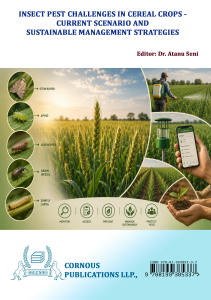
Book Title: Insect Pest Challenges in Cereal Crops - Current Scenario and Sustainable Management Strategies
OPEN ACCESS | Published on : 03-Feb-2026 | Pages: 37-62 | Doi : 10.37446/edibook212025/37-62
Effect of Botanicals for the Management of Insect Pests in Cereal Crops
- Murugesan Kiruthika
- Department of Entomology, Faculty of Agriculture, Annamalai University, Chidambaram, Tamil Nadu, India.
- Thirunavukkarasu Selvamuthukumaran
- Department of Entomology, Faculty of Agriculture, Annamalai University, Chidambaram, Tamil Nadu, India.
Abstract
Cereal crops play a pivotal role in global food systems, yet they are highly vulnerable to damage caused by insect pests. Conventional reliance on synthetic pesticides has led to numerous ecological and health-related concerns, including pest resistance, biodiversity loss and chemical residues in food and water. In response, botanical insecticides have gained attention for their eco-friendly properties and efficacy in pest suppression. This chapter explores the historical development, active ingredients and mechanisms of action of botanicals such as neem, pyrethrum, nicotine, rotenone, sabadilla, ryania and others. Emphasis is placed on their roles in pest management strategies for cereal crops. The chapter also evaluates challenges such as formulation stability, regulatory constraints and commercialization barriers, alongside opportunities for integration within sustainable agricultural practices. Botanical insecticides, with their biodegradable and target-specific nature, offer a viable component of integrated pest management systems for ensuring safer cereal production.
Keywords
Botanical insecticides, Plant-based pesticides, Azadirachtin, Pyrethrum, Phytochemicals, Antifeedants, Repellents, Cereal crops, Sustainable agriculture, Integrated pest management (IPM)
References
Abdel-Khalek, A., Amer, S., & Momen, F. (2011). Repellency and toxicity of extract from Francoeria crispa (Forsk.) to Eutetranychus orientalis (Klein) (Acari: Tetranychidae). Archives of Phytopathology and Plant Protection, 44(5), 441-450.
Ahmad, W., Singh, S., Kumar, S., & Waseem Ahmad, C. (2017). Phytochemical screening and antimicrobial study of Euphorbia hirta extracts. J Med Plants Stud, 5(2), 183-6.
Akhtar, Y., Rankin, C. H., & Isman, M. B. (2003). Decreased response to feeding deterrents following prolonged exposure in the larvae of a generalist herbivore, Trichoplusia ni (Lepidoptera: Noctuidae). Journal of Insect Behavior, 16, 811-831.
Alburo, R., & Olofson, H. (1987). Agricultural history and the use of botanical insecticides in Argao, Cebu. Philippine quarterly of culture and society, 15(3), 151-172.
Allan, E., Eeswara, J., Jarvis, A., Mordue, A., Morgan, E., & Stuchbury, T. (2002). Induction of hairy root cultures of Azadirachta indica A. Juss. and their production of azadirachtin and other important insect bioactive metabolites. Plant Cell Reports, 21, 374-379.
Arena, J. S., Omarini, A. B., Zunino, M. P., Peschiutta, M. L., Defago, M. T., & Zygadlo, J. A. (2018). Essential oils from Dysphania ambrosioides and Tagetes minuta enhance the toxicity of a conventional insecticide against Alphitobius diaperinus. Industrial Crops and Products, 122, 190-194.
Ascher KRS, Schmutterer H, Mazor M, Zebitz CPW, Naqvi SNH (2002) The Persian lilac or chinaberry tree: Melia azedarach L. Neem Found, Mumbai, pp 770–820
Atkinson, B. L., Blackman, A. J., & Faber, H. (2004). The degradation of the natural pyrethrins in crop storage. Journal of agricultural and food chemistry, 52(2), 280-287.
Balasubramanian, M. (1979). Pest management studies for rice brown planthopper in Tamil Nadu Agricultural University.
Batish, D. R., Singh, H. P., Kohli, R. K., & Kaur, S. (2008). Eucalyptus essential oil as a natural pesticide. Forest ecology and management, 256(12), 2166-2174.
Bernays, E. A. (1991). Relationship between deterrence and toxicity of plant secondary compounds for the grasshopper Schistocerca americana. Journal of chemical ecology, 17, 2519-2526.
Bomford, M. K., & Isman, M. B. (1996). Desensitization of fifth instar Spodoptera litura to azadirachtin and neem. Entomologia experimentalis et applicata, 81(3), 307-313.
Brooker MIH, Kleinig DA. (2006). Field Guide to Eucalyptus. vol.1. South-eastern Australia, Third edition. Bloomings, Melbourne.
Campos, E. V., De Oliveira, J. L., Pascoli, M., De Lima, R., & Fraceto, L. F. (2016). Neem oil and crop protection: from now to the future. Frontiers in plant science, 7, 1494.
Casanova, H., Ortiz, C., Peláez, C., Vallejo, A., Moreno, M. E., & Acevedo, M. (2002). Insecticide formulations based on nicotine oleate stabilized by sodium caseinate. Journal of agricultural and food chemistry, 50(22), 6389-6394.
Chen, W., Isman, M. B., & Chiu, S. F. (1995). Antifeedant and growth inhibitory effects of the limonoid toosendanin and Melia toosendan extracts on the variegated cutworm, Peridromasaucia (Lep., Noctuidae). Journal of Applied Entomology, 119(1‐5), 367-370.
Chiu, S. F. (1982). Experiments on insecticidal plants as a source of insect feeding inhibitors and growth regulation with special reference to Meliaceae. Plant Protection. South China Agriculture College, Cuangzhon. 42 P.
Chiu, S. F. (1989). Recent advances in research on botanical insecticides in China. In: Arnason AT, Philogene BJR, Morand P (eds) Insecticides of plant origin. American Chemical Society, Washington, DC. pp 69–77
Chiu, S. F., Huang, B. Q., & Hu, M. Y. (1983). Experiments on the use of seed oils of some meliaceous plants as antifeedants in brown planthopper control. Acta Entomologica Sinica, 26(1): 1-9
Coats JR (1994) Risks from natural versus synthetic insecticides. Annual Review of Entomology, 39, 489–515.
Dash, A., Senapati, B., & Samalo, A. P. (1995). Evaluation of neem derivatives against tissue borers of rice. Journal of Applied Zoological Research, 6(1), 35-37.
David, P. M. M. (1986). Effect of slow-release nitrogen fertilizers and of foliar application of neem products on rice pests. Madras Agriculture Journal. 73(5): 274-277.
De Souza Tavares, W., Akhtar, Y., Goncalves, G. L. P., Zanuncio, J. C., & Isman, M. B. (2016). Turmeric powder and its derivatives from Curcuma longa rhizomes: Insecticidal effects on cabbage looper and the role of synergists. Scientific reports, 6(1), 34093.
Del Fierro, R. S., & Morallo-Rajessus, B. (1976). Preliminary study on the insecticidal activity on makebuhai, tinospora rumphil Boerl. Youth Res. Apprenticeship Actiob Bogr. Rep. Soc. for Adv. Res. 9 P.
Dev, S. (2017). Insecticides of natural origin. Routledge. 365 pp
Dimetry, N. Z. (2012). Prospects of botanical pesticides for the future in integrated pest management programme (IPM) with special reference to neem uses in Egypt. Archives of Phytopathology and Plant Protection, 45(10), 1138-1161.
Dimetry, N. Z., Abd El-Salam, A. M. E., & El-Hawary, F. M. A. (2010). Importance of plant extract formulations in managing different pests attacking beans in new reclaimed area and under storage conditions. Archives of Phytopathology and Plant Protection, 43(7), 700-711.
El-Sayed, E. I. (1982a). Evaluation of the insecticidal properties of the common Indian neem, Azadirachta indica A. Juss, seeds against the Egyptian cotton leafworm Spodoptera littoralis (Boisd.). Bulletin of the Entomological Society of Egypt/Economic Series, 13, 39-47.
El-Sayed, E. I. (1982b). Neem (Azadirachta indica A. Juss) seeds as antifeedant and ovipositional repellent for the Egyptian cotton leafworm Spodoptera littoralis (Boisd.). Bulletin of the Entomological Society of Egypt/Economic Series, 13, 49–58.
El-Wakeil, N. E. (2013). Botanical pesticides and their mode of action. Gesunde Pflanzen, 65(4).
Epino, P. B., & Saxena, R. C. (1982). Neem, China berry and custard-apple: effects of seed oils on leafhopper and plant hopper pests of rice [study conducted in the Philippines]. 23 P.
Farone WA, Palmer T, Puterka J (2002) Polyol ester insecticides and method of synthesis. U.S. Patent 6,419,941
Feng, R. Y., Chen, W. K., & Isman, M. B. (1995). Synergism of malathion and inhibition of midgut esterase activities by an extract from Melia toosendan (Meliaceae). Pesticide Biochemistry and Physiology, 53(1), 34-41.
Fields, P. G., Arnason, J. T., Philogene, B. J., Aucoin, R. R., Morand, P., & Soucy-Breau, C. (1991). Phytotoxins as insecticides and natural plant defenses. The Memoirs of the Entomological Society of Canada, 123(S159), 29-38.
Floris, I., Satta, A., Cabras, P., Garau, V. L., & Angioni, A. (2004). Comparison between two thymol formulations in the control of Varroa destructor: effectiveness, persistence and residues. Journal of economic entomology, 97(2), 187-191.
Fradin, M. S., & Day, J. F. (2002). Comparative efficacy of insect repellents against mosquito bites. New England Journal of Medicine, 347(1), 13-18.
Gebbinck, E. A. K., Jansen, B. J., & de Groot, A. (2002). Insect antifeedant activity of clerodane diterpenes and related model compounds. Phytochemistry, 61(7), 737-770.
George Buta, J., Lusby, W. R., Neal, J. J., Waters, R. M., & Pittarelli, G. W. (1993). Sucrose esters from Nicotiana gossei active against the greenhouse whitefly Trialeuroides vaporariorum.
Gerland, P., Raftery, A. E., Sevcikova, H., Li, N., Gu, D., Spoorenberg, T., & Wilmoth, J. (2014). World population stabilization unlikely this century. science, 346(6206), 234-237.
Gonzalez-Coloma, A., Valencia, F., Martín, N., Hoffmann, J. J., Hutter, L., Marco, J. A., & Reina, M. (2002). Silphinene sesquiterpenes as model insect antifeedants. Journal of Chemical Ecology, 28, 117-129.
Gupta, S. P., Prakash, A., & Rao, J. (1990). Bio-pesticidal activity of certain plant products against rice earhead bug, Leptocorisa acuta Thunb. Journal of Applied Zoologist Research Association, 1(2), 55-58.
Hayes, W. J. (1982). Pesticides studied in man. P.672.
Hollingworth, R. M., Ahammadsahib, K. I., Gadelhak, G., & McLaughlin, J. L. (1994). New inhibitors of complex I of the mitochondrial electron transport chain with activity as pesticides. Biochemical Society Transactions, 22(1), 230-233.
Isman MB (2002) Insect antifeedants. Pestic Outlook 13:152–157
Isman, M. B. (1993). Growth inhibitory and antifeedant effects of azadirachtin on six noctuids of regional economic importance. Pesticide Science, 38(1), 57-63.
Isman, M. B. (1997). Neem and other botanical insecticides: barriers to commercialization. Phytoparasitica, 25, 339-344.
Isman, M. B. (2006). Botanical insecticides, deterrents, and repellents in modern agriculture and an increasingly regulated world. Annual review of entomology, 51(1), 45-66.
Isman, M. B. (2020). Botanical insecticides in the twenty-first century-fulfilling their promise? Annual Review of Entomology, 65(1), 233-249.
Isman, M. B., Matsuura, H., MacKinnon, S., Durst, T., Towers, G. N., & Arnason, J. T. (1996). Phytochemistry of the Meliaceae: So many terpenoids, so few insecticides. Phytochemical diversity and redundancy in ecological interactions, 155-178.
Jnaid, Y., Yacoub, R., & Al-Biski, F. (2016). Antioxidant and antimicrobial activities of Origanum vulgare essential oil. International Food Research Journal, 23(4).
Johnson, H. A., Oberlies, N. H., Alali, F. Q., & McLaughlin, J. L. (1999). Thwarting resistance: annonaceous acetogenins as new pesticidal and antitumor agents. In Biologically Active Natural Products (pp. 178-188). CRC Press.
Kareem, A. A., Boncodin, M. E. M., & Saxena, R. C. (1988 b). Neem seed kernel or neem cake powder and carbofuran granule mixture for controlling green leafhopper (GLH) and rice tungro virus (RTV). International Rice Research Newsletter, 13(3): 35.
Kareem, A. A., Saxena, R. C., & Justo, H. D. (1987). Evaluation of neem seed kernel (NSK) and neem bitters (NB) through seedling root-dip against rice green leaf hopper. Botanical Pest Control in Rice Based Cropping Systems. 13 PP.
Kareem, A. A., Saxena, R. C., Boncodin, M. E. M., & Malayba, M. T. (1989). Effect of neem seed and leaf bitters on oviposition and development of green leafhopper (GLH) and brown planthopper (BPH). International Rice Research Newletter, 14(6): 26-27.
Kareem, A. A., Saxena, R. C., Boncodin, M. E. M., Krishnasamy, V., & Seshu, D. V. (1988 a). Effect of neem seed treatment on rice seedling vigor and survival of brown planthopper and green leafhopper (GLH). International Rice Research Nwesletter, 13(1): 27-28.
Katz, J., Prescott, K., & Woolf, A. D. (1996). Strychnine poisoning from a Cambodian traditional remedy.
Kavianpour, M., Dabbagh, G. R., Taki, M., Shirdeli, M., & Mohammadi, S. (2014). Effect of fresh gum of asafoetida on the damage reduction of pomegranate fruit moth, Ectomyelois ceratoniae (Lep., Pyralidae) in Shahreza City. International Journal of Biosciences, 5, 86-91.
Khan, M. J., & Khan, R. J. (1985). Insecticidal effects of indigenous vegetable oils (taramira and artemisia) on some rice delphacids in Pakistan. Pakistan Journal of Scientific and Industrial Research, 28(6), 428-429.
Kostyukovsky, M., Rafaeli, A., Gileadi, C., Demchenko, N., & Shaaya, E. (2002). Activation of octopaminergic receptors by essential oil constituents isolated from aromatic plants: possible mode of action against insect pests. Pest Management Science: formerly Pesticide Science, 58(11), 1101-1106.
Kraus W (2002) Azadirachtin and other triterpenoids. Neem Found, Mumbai, pp 39–111
Krishnaiah, N. V., & Kalode, M. B. (1990). Efficacy of selected botanicals against rice insect pests under green house and field conditions. Indian Journal of Plant Protection, 18(2), 197-205.
Kumbhar, C. R. (2020). Role and mechanism of botanicals in pest management. Just Agriculture Newsletter., 1, 226-232.
Lewis, M. A., Arnason, J. T., Philogene, B. J. R., Rupprecht, J. K., & McLaughlin, J. L. (1993). Inhibition of respiration at site I by asimicin, an insecticidal acetogenin of the pawpaw, Asimina triloba (Annonaceae). Pesticide Biochemistry and Physiology, 45(1), 15-23.
Lu, R. D. (1982). A study of insect anti-juvenile hormones-chemical composition of Ageratum conyzoidis L. and its action against insects. Insect Knowledge, 19(4): 22-25.
Maistrello, L., Henderson, G., & Laine, R. A. (2001). Efficacy of vetiver oil and nootkatone as soil barriers against Formosan subterranean termite (Isoptera: Rhinotermitidae). Journal of Economic Entomology, 94(6), 1532-1537.
Mariappan, V., & Saxena, R. C. (1983). Effect of custard-apple oil and neem oil on survival of Nephotettix virescens (Homoptera: Cicadellidae) and on rice tungro virus transmission. Journal of Economic Entomology, 76(3), 573-576.
Mariappan, V., Jayaraj, S., & Saxena, R. C. (1988). Effect of nonedible seed oils on survival of Nephotettix virescens (Homoptera: Cicadellidae) and on transmission of rice tungro virus. Journal of Economic Entomology, 81(5), 1369-1372.
Mariappan, V., Saxena, R. C., & Ling, K. C. (1982). Effect of custard-apple oil and neem oil on the life span of and rice tungro transmission by Nephotettix virescens. International Rice Research Newslwtter, 7(3):13-14.
McLaughlin, J. L., Zeng, L., Oberlies, N. H., Alfonso, D., Johnson, H. A., & Cummings, B. A. (1997). Annonaceous acetogenins as new natural pesticides: recent progress. Washington, Journal of the American Chemical Society. pp 117-133.
McLaughlin, J. L., Zeng, L., Oberlies, N. H., Alfonso, D., Johnson, H. A., & Cummings, B. A. (1997). Annonaceous acetogenins as new natural pesticides: recent progress. Ref. 40, pp. 117–33
Mikolajczak, K. L., McLaughlin, J. L., & Rupprecht, J. K. (1988). U.S. Patent No. 4,721,727. Washington, DC: U.S. Patent and Trademark Office.
Moeschler, H. F., Pfluger, W., & Wendisch, D. (1987). U.S. Patent No. 4,689,232. Washington, DC: U.S. Patent and Trademark Office.
Morallo-Rajessus, B., & Silva, D. (1979). Insecticidal activity of selected plants with emphasis on marigold (Tagetes spp) and makabuhay (Tinospara rumphii). NRCP Annual Report for 1976, Univ. of Philippines Los Banod, Mimeo, Philippines. 25 PP.
Morallo-Rejesus, B., & Eroles, L. C. (1981). Two insecticidal principles from marigold (Tagetes spp.) roots. Philippines Entomologist, 4(1/2): 87-97.
Morgan, E. D. (2009). Azadirachtin, a scientific gold mine. Bioorganic & medicinal chemistry, 17(12), 4096-4105.
Narasimhan, V., & Mariappan, V. (1988). Effect of plant derivatives on green leafhopper (GLH) and rice tungro (RTV) transmission. International Rice Research Newsletter, 13(1): 28-29.
National Research Council, Commission on Life Sciences, Board on Environmental Studies, & Committee on the Future Role of Pesticides in US Agriculture. (2000). The future role of pesticides in US agriculture. National Academies Press.
Norris, E. J., Bartholomay, L., & Coats, J. (2018). Present and future outlook: the potential of green chemistry in vector control. In Advances in the Biorational Control of Medical and Veterinary Pests (pp. 43-62). American Chemical Society.
Oskoueian, E., Abdullah, N., Ahmad, S., Saad, W. Z., Omar, A. R., & Ho, Y. W. (2011). Bioactive compounds and biological activities of Jatropha curcas L. kernel meal extract. International journal of molecular sciences, 12(9), 5955-5970.
Papulwar, P. P., Rathod, B. U., & Dattagonde, N. R. (2018). Studies on insecticidal properties of citronella grass (lemon grass) essential oils against gram pod borer (Helicoverpa armigera). International Journal of Chemistry Studies, 2(1), 44-46.
Pavela, R., & Vrchotova, N. (2008). Growth inhibitory effect of extracts from Reynoutria sp. plants against Spodoptera littoralis larvae. Agrociencia, 42(5), 573-584.
Perry, A. S., Yamamoto, I., Ishaaya, I., & Perry, R. Y. (2013). Insecticides in agriculture and environment: retrospects and prospects. Springer Science & Business Media. 261 pp.
Peterson, C., & Coats, J. (2001). Insect repellents-past, present and future. Pesticide Outlook, 12(4), 154-158.
Philogene BJR, Regnault-Roger C, Vincent C (2005) Botanicals: yesterdays and today’s promises. In: Regnault-Roger C, Philogene BJR, Vincent C (eds) Biopesticides of plant origin. Lavoisier and Andover, UK, pp 1–15
Pittarelli, G. W., Buta, J. G., Neal Jr, J. W., Lusby, W. R., & Waters, R. M. (1993). U.S. Patent No. 5,260,281. Washington, DC: U.S. Patent and Trademark Office.
Plata-Rueda, A., Martínez, L. C., Santos, M. H. D., Fernandes, F. L., Wilcken, C. F., Soares, M. A., & Zanuncio, J. C. (2017). Insecticidal activity of garlic essential oil and their constituents against the mealworm beetle, Tenebrio molitor Linnaeus (Coleoptera: Tenebrionidae). Scientific reports, 7(1), 46406.
Prakash, A., Rao, J., & Nandagopal, V. (2008). Future of botanical pesticides in rice, wheat, pulses and vegetables pest management. Journal of Biopesticides, 1(2), 154-169.
Pramila, D. M., Xavier, R., Marimuthu, K., Kathiresan, S., Khoo, M. L., Senthilkumar, M., & Sreeramanan, S. (2012). Phytochemical analysis and antimicrobial potential of methanolic leaf extract of peppermint (Mentha piperita: Lamiaceae). Journal of Medicinal Plants Research, 6(2), 331-335.
Qiao, J., Zou, X., Lai, D., Yan, Y., Wang, Q., Li, W., & Gu, H. (2014). Azadirachtin blocks the calcium channel and modulates the cholinergic miniature synaptic current in the central nervous system of drosophila. Pest management science, 70(7), 1041-1047.
Rajasekaran, B., Jayraj, S., Raghuramman, S., & Narayanswamy, T. (1987). Use of neem products for the management of certain rice pests and diseases. Mid-term appraisal works on botanical pest control of rice based cropping system, 13 P.
Ramaraju, K., & Babu, P. S. (1989). Effect of plant derivatives on brown planthopper (BPH) and white backed planthopper (WBPH) nymph emergence on rice. International Rice Research Newsletter, 14(5): 30.
Rattan, R. S. (2010). Mechanism of action of insecticidal secondary metabolites of plant origin. Crop protection, 29(9), 913-920.
Regnault-Roger, C., Philogène, B. J., & Vincent, C. (2005). Biopesticides of Plant Origin. (pp.313).
Rhoda, B., Fryer, B., & Macharia, J. (2006). Towards reducing synthetic pesticide imports in favour of locally available botanicals in. In Kenya. Conference on International Agricultural Research for Development, Bonn, Germany (pp. 1-4).
Salama, H. S., & Sharaby, A. (1988). Feeding deterrence induced by some plants in Spodoptera littoralis and their potentiating effect on Bacillus thuringiensis Berliner. International Journal of Tropical Insect Science, 9(5), 573-577.
Sallena, R. C. (1989). Insecticides from neem. Insecticides of plant origin. American Chemical Society, Washington, DC, 213.
Sasmal, S. (1991). Bionomics & control of pests of Azolla pinnata R. Br (Doctoral dissertation, Ph. D. Thesis Utkal University Bhubaneswar, India). 168 PP.
Saxena, R. C., Justo Jr, H. D., & Epino, P. B. (1984). Evaluation and utilization of neem cake against the rice brown planthopper, Nilaparvata lugens (Homoptera: Delphacidae). Journal of economic entomology, 77(2), 502-507.
Saxena, R. C., Liquido, N. J., & Justo Jr, H. D. (1979). Neem oil: an antifeedant to brown plant hopper. In Proc. X Ann. Conf. of the Pest Control Council of the Philippines held at Manila (pp. 2-5).
Saxena, R. C., Rueda, B. P., Justo, H. D., Boncodin, M. E. M., & Barrion, A. A. (1987). Evaluation and utilization of neem seed" bitters" for management of planthopper and leafhopper pests of rice. In 18th Annual Conference of Pest Control Council (pp. 1-43).
Schmutterer, H. (1990). Properties and potential of natural pesticides from the neem tree, azadirachta indica. Annual review of entomology, 35(1), 271-297.
Schmutterer, H. (2002). The Neem Tree. Neem Found. P. 892.
Schmutterer, H., Saxena, R. C., & Von Der Heyde, J. (1983). Morphogenetic effects of some partially‐purified fractions and methanolic extracts of neem seeds on Mythimna separata (Walker) and Cnaphalocrocis medinalis (Gueee). Zeitschrift für Angewandte Entomologie, 95(1‐5): 230-237.
Sharma, V. K., & Bhatnagar, A. (1993). Studies on the effects of non -edible seed oils on Chilo partellus Swinhoe. In National Symposium on Problems and Prospects of Botanical Pesticides in Integrated Pest Management. 19 PP.
Shepard, H. H. (1951). The chemistry and action of insecticides. McGraw-Hill, New York, p 504
Sola, P., Mvumi, B. M., Ogendo, J. O., Mponda, O., Kamanula, J. F., Nyirenda, S. P., & Stevenson, P. C. (2014). Botanical pesticide production, trade and regulatory mechanisms in sub-Saharan Africa: making a case for plant-based pesticidal products. Food Security, 6, 369-384.
Songkittisuntorn, U. (1989). The efficacy of neem oil and neem-extracted substances on the rice leafhopper Nephotettix virescens (Distant). Journal of National Research Council Thailand, 21(2): 37-48.
Su, M., & Mulla, M. S. (1999). Activity and biological effects of neem products against arthropods of medical and veterinary importance. Journal of American Mosquito Control Association, 15, 133-152.
Sukumaran, D., Kandaswamy, C., & Srimmannarayan, G. (1987). Vetex negundo Linn. a potential plant for control of rice pest. In Proc. Symp. Alternatives to Synthetic Insecticides (pp. 71-74).
Tembo, Y., Mkindi, A. G., Mkenda, P. A., Mpumi, N., Mwanauta, R., Stevenson, P. C., & Belmain, S. R. (2018). Pesticidal plant extracts improve yield and reduce insect pests on legume crops without harming beneficial arthropods. Frontiers in Plant Science, 9, 1425.
Thacker, J. R. (2002). An introduction to arthropod pest control. Cambridge university press. 343 pp.
Thacker, J. R. (2002). An introduction to arthropod pest control. Cambridge university press. p. 343.
Thongni, A., Ariina, M. S., & Susngi, W. E. (2023). Botanical pesticides-an alternative for insect pest management. Just Agriculture, 3(8), 49-58.
Trumble, J. T. (2002). Caveat emptor: safety considerations for natural products used in arthropod control. American entomologist, 48(1), 7-13.
Viswanathan, R., & Kandiannan, K. (1990). Effect of urea applied with neem cake on disease intensity and insect population in rice fields. International Rice Research Newsletter, 15 (5): 20.
Wahyutami, C. T., & Aisyah, S. N. (2022, February). Insecticidal Activity of Bitter Melon (Momordica charantia L.) Leaf Extract on Mung Bean Weevil (Callosobruchus chinensis L.). In IOP Conference Series: Earth and Environmental Science (Vol. 985, No. 1, p. 012053). IOP Publishing.
Ware, G. W. (1983). Pesticides, theory and applications. 308 pp.
Ware, G. W., & Whitacre, D. M. (2004). An introduction to insecticides. The pesticide book, 6.
Weinzierl, R. A. (1999). Botanical insecticides, soaps, and oils. In Biological and biotechnological control of insect pests (pp. 101-121). CRC Press.
Wilps, H., Kirkilionis, E., & Muschenich, K. (1992). The effects of neem oil and azadirachtin on mortality, flight activity, and energy metabolism of Schistocerca gregaria forskal - A comparison between laboratory and field locusts. Comparative Biochemistry and Physiology Part C: Comparative Pharmacology, 102(1), 67-71.
Indexing In




Types of Books We Publish




Uniqueness of our Publication

DOI Assignment

ISBN Registration

Online Publication

High Visibility

Open & Closed Access
DOI Assignment
ISBN Registration
Online Publication
High Visibility