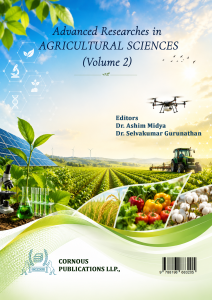
Editorial Book
Book Title: Advanced Researches in Agricultural Sciences (Volume 2)
OPEN ACCESS | Published on : 13-May-2026 | Pages: 117-128 | Doi : 10.37446/vol2book092025/117-128
Compost application, residual toxicity, heavy metal contamination, and associated potential health risk in leafy vegetable production in Northern Region of Ghana
- Mutari Abubakari
- Council for Scientific and Industrial Research (CSIR), Savanna Agricultural Research Institute (CSIR - SARI), P.O. Box 52, Tamale, Ghana.
- Issah Sugri
- Council for Scientific and Industrial Research (CSIR), Savanna Agricultural Research Institute (CSIR - SARI), P.O. Box 52, Tamale, Ghana.
- Fulera Tahiru
- Council for Scientific and Industrial Research (CSIR), Savanna Agricultural Research Institute (CSIR - SARI), P.O. Box 52, Tamale, Ghana.
- Abdulai Haruna
- Council for Scientific and Industrial Research (CSIR), Savanna Agricultural Research Institute (CSIR - SARI), P.O. Box 52, Tamale, Ghana.
- Abdul Latif Abdul Aziz
- Council for Scientific and Industrial Research (CSIR), Savanna Agricultural Research Institute (CSIR - SARI), P.O. Box 52, Tamale, Ghana.
- Issah Alidu Abilari
- Council for Scientific and Industrial Research (CSIR), Savanna Agricultural Research Institute (CSIR - SARI), P.O. Box 52, Tamale, Ghana.
- Rashidatu Abdulai
- Council for Scientific and Industrial Research (CSIR), Savanna Agricultural Research Institute (CSIR - SARI), P.O. Box 52, Tamale, Ghana.
- Mohammed Mujitaba Dawuda
- Faculty of Agriculture, Department of Horticulture, University for Development Studies, P.O. Box TL 1882, Nyankpala, Ghana.
- Askia Musah Mohammed
- Tamale Technical University, P.O. Box 3 E/R, Tamale, Ghana.
Abstract
The addition of manure, and compost to the soil can improve soil structure, water holding capacity, and nutrient retention, all of which support long term carbon storage, improve crop productivity and quality, and play a pivotal role in climate-resilient regenerative sustainable agricultural system. Compost, by contributing humified carbon, can build passive Soil Organic Carbon pool as compared to fresh residues or raw manure. However, compost produced from industrial effluents, municipal waste and other sources may induce to potential health risk, residual toxicity and heavy metal contamination in fresh or processed produce. This chapter highlights the effect of compost application in leafy vegetable production in Northern region of Ghana and the potential health risk associated with the practice. The chapter delves into the effect of compost application and subsequent potential health risk associated through the outcome of an experiment conducted in the upland research field of the CSIR – SARI located near Nyankpala in the Northern Region of Ghana. To elucidate the basic essence of the chapter, an on-station experiment was set up to assess the impact of certain commercial composts (ACARP and DeCo) as well as chicken manure (CM) on the levels of heavy metals in the leaves of roselle (Hibiscus sabdariffa L.) and jute mallow (Corchorus olitorius), which are commonly used as green vegetables and subsequently to evaluate the health risks linked to consuming these leafy vegetables grown with these soil amendments applied @ 10 t/ ha. The experimental design employed was a randomized complete block design (RCBD) with four replications. The levels of cadmium (Cd) and lead (Pb) found in the processed leaves of roselle were (0.8 mg/kg) and (5.0 mg/kg), respectively. Cadmium and lead are present in CM, ACARP, and DeCo composts in addition to necessary elements like zinc and copper. Applying these composts to the production of roselle and jute mallow may result in heavy metal residues at concentrations higher than international standards, which could be harmful to consumer’s health. So, it is high time for concerted research for consideration while applying compost in crop production to minimize residual toxicity of heavy metals, harmful toxicant and other associated potential health hazards.
Keywords
Compost, bioavailability, amendments, potential health Risk, MRL, ACARP, DeCo
References
Agriculture and Agri-Food Canada. (1990). A review of poultry manure management: Directions for the future (Poultry section).
Alloway, B. J. (2008). Zinc in soils and crop nutrition (2nd ed.). IZA & IFA.
Antonio, P. M., & John, E. S. (2013). Interpretation of soil test results (PM 1310 revised). Iowa State University Extension Outreach. https://store.extension.iastate.edu/
Agency for Toxic Substances and Disease Registry (ATSDR). (2004). Toxicological profile for copper. U.S. Department of Health and Human Services.
Agency for Toxic Substances and Disease Registry (ATSDR). (2012). Lead toxicity.
Ayari, F., Hamdi, H., Jedidi, N., Gharbi, N., & Kossai, R. (2010). Heavy metal distribution in soil and plant in municipal solid waste compost amended plots. International Journal of Environmental Science and Technology, 7(3), 465–472.
Biernacka, E., & Maluszynski, M. J. (2006). The content of cadmium, lead, and selenium in soils from selected sites in Poland. Polish Journal of Environmental Studies, 15(2a), 7–9.
Chaney, R. L. (2012). Food safety issues for mineral and organic fertilizers. Advances in Agronomy, 117, 51–116.
Chastain, J. P., Camberato, J. J., & Skewes, P. (n.d.). Poultry manure production and nutrient content. Clemson University. https://www.clemson.edu/extension/livestock/camm/camm_files/poultry/pch3b_00.pdf
Chibuike, G. U., & Obiora, S. C. (2014). Heavy metal polluted soils: Effects on plants and bioremediation methods. Applied and Environmental Soil Science. http://www.hindawi.com
Codex Alimentarius Commission. (2011). Joint FAO/WHO food standards programme: Codex committee on contaminants in foods (5th session).
Delgado Arroyo, M. M., Miralles de Imperial Hornedo, R., Alonso Peralta, F., Rodríguez Almestre, C., & Martín Sánchez, J. V. (2014). Heavy metals concentration in soil, plant, earthworm, and leachate from poultry manure applied to agricultural land. Revista Internacional de Contaminación Ambiental, 30(1), 43–50.
Drechsel, P., & Keraita, B. (Eds.). (2014). Irrigated urban vegetable production in Ghana. International Water Management Institute.
European Commission. (2006). Setting maximum levels for certain contaminants in foodstuffs (Regulation No. 1881).
FAO-UNESCO. (2002). Major soils of the world.
Ghaly, A. E., & Alkoaik, F. N. (2010). Effect of municipal solid waste compost on vegetable crops. American Journal of Agricultural and Biological Sciences, 5(3), 274–281.
IFPRI, IFDC, ILFSP, MSU, & IITA. (2015). Towards a sustainable soil fertility strategy in Ghana.
Irshad, M., Malik, A. H., Shaukat, S., Mushtaq, S., & Ashraf, M. (2013). Characterization of heavy metals in livestock manures. Polish Journal of Environmental Studies, 22(4), 1257–1262.
IWMI. (2008). Good farming practices to reduce vegetable contamination.
Jena, V., Dixit, S., & Gupta, S. (2012). Risk assessment of heavy metal toxicity. International Journal of Research in Environmental Science and Technology, 2(4), 124–127.
Kabata-Pendias, A. (2011). Trace elements in soils and plants (4th ed.). CRC Press.
Karman, S., Ali, S., Hameed, S., Afzal, S., Samar, F., Shakoor, M. B., Bharwana, S. A., & Tauqeer, H. M. (2013). Heavy metals contamination and impacts on living organisms. Greener Journal of Environmental Management and Public Safety, 2(4), 172–179.
Martin, S. E., & Griswold, W. (2009). Human health effects of heavy metals. Kansas State University.
MoFA. (2013). Agriculture in Ghana: Facts and figures.
Motsara, M. R., & Roy, R. N. (2008). Guide to laboratory establishment and plant nutrient analysis. FAO.
Nachtigall, G. R., Nogueirol, R. C., Alleoni, L. R. F., & Cambri, M. A. (2007). Copper concentration in vineyard soils. Brazilian Archives of Biology and Technology, 50(6), 941–948.
Obeng, H. (2000). Soil classification in Ghana. Centre for Policy Analysis.
Pariera, D., & Clain, J. (2013). Interpretation of soil test reports for agriculture. Montana State University.
Popescu, C. G. (2011). Relation between traffic and heavy metals in particulate matter. Romanian Reports in Physics, 63(2), 471–482.
Puschenreiter, M., Horak, O., Friesl, W., & Hartl, W. (2005). Measures to reduce heavy metal transfer. Plant, Soil and Environment, 51(1), 1–11.
Ruel, M. T., Minot, N., & Smith, L. (2005). Patterns of fruit and vegetable consumption in sub-Saharan Africa.
Sarma, H. (2011). Metal hyperaccumulation in plants. Journal of Environmental Science and Technology, 4(2), 118–138.
SCOOP. (2004). Assessment of dietary exposure to heavy metals in EU populations.
Soudek, P., Petrova, S., & Vanek, T. (2012). Phytostabilization of heavy metals using sorghum. International Conference on Biology, Environment and Chemistry.
Suciu, I., Cosma, C., Todică, M., Balboacă, S. D., & Jäntschi, L. (2008). Soil heavy metal pollution in Transylvania. International Journal of Molecular Sciences, 9, 434–453.
Tangahu, B. V., Abdullah, S. R. S., Basri, H., Idris, M., Anuar, N., & Mukhlisin, M. (2011). Heavy metal uptake by plants. International Journal of Chemical Engineering.
Tchounwou, P. B., Yedjou, C. G., Patlolla, A. K., & Sutton, D. J. (2014). Heavy metal toxicity and environment. EXS, 101, 133–164.
Wamalwa, K. W., Lusweti, J., Lutta, S., Anditi, B. C., & Martin, O. I. (2015). Pollutant levels in vegetables. Journal of Environment and Earth Science, 5(13), 197–208.
World Health Organization (WHO). (2007). Health risks of heavy metals.
World Health Organization (WHO). (2010). Childhood lead poisoning.
Yadav, B. K., Siebel, M. A., & van Bruggen, J. J. A. (2011). Rhizofiltration of lead wastewater. Clean – Soil, Air, Water, 39(5), 467–474.
Zhou, H., Yang, W. T., Zhou, X., Liu, L., Gu, J. F., Wang, W. L., Zou, J. L., Tian, T., Peng, P. Q., & Liao, B. H. (2016). Heavy metals in vegetables and health risks. International Journal of Environmental Research and Public Health, 13, 289.
Indexing In




Types of Books We Publish



Uniqueness of our Publication

DOI Assignment

ISBN Registration

Online Publication

High Visibility

Open & Closed Access
DOI Assignment
ISBN Registration
Online Publication
High Visibility