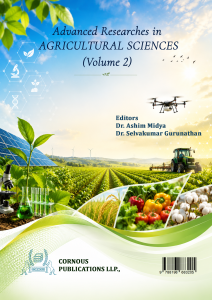
Editorial Book
Book Title: Advanced Researches in Agricultural Sciences (Volume 2)
PAID ACCESS | Published on : 23-Oct-2026 | Pages: 168-174 | Doi : https://doi.org/10.37446/vol2book092025/168-174
Climate- Resilient Horticulture: Emerging Challenges and Sustainable Solution for Food and Nutrition
- Dr. Vivek Kumar Kurrey
- 1Rural Horticulture Extension Officer, Department of Horticulture and Farm Forestry Government of Chhattisgarh, India.
- Dr. Jitendra Singh
- Director Research (DRS) Mahatma Gandhi Udyanikee evam Vanikee Vishwavidyalaya Durg Chhattisgarh, India.
- Dr. Yogesh Kumar Sidar
- Subject matter specialist, Department of Entomology, Krishi Vigayan Kendra Sukma, Indira Gandhi krishi vishwavidyalaya Raipur, Chhattisgarh, India.
- Amar Prakash Kurrey
- Phd Research Scholar Department of Floriculture and landscaping Mahatma Gandhi Udyanikee evam Vanikee Vishwavidyalaya Durg Chhattisgarh, India.
Abstract
Climate change poses major challenges to horticultural production through rising temperatures, irregular rainfall, droughts, floods, and increased pest and disease incidence. These factors affect crop productivity, produce quality, and nutritional security. Climate-resilient horticulture promotes sustainable solutions such as climate-tolerant varieties, crop diversification, precision irrigation, protected cultivation, integrated pest management, and improved soil health. Emerging technologies, including genomics, remote sensing, and artificial intelligence, offer opportunities to enhance crop adaptation and resource-use efficiency. Integrating these strategies can strengthen farmers’ resilience, reduce environmental impacts, and ensure sustainable production of nutritious fruits and vegetables. Climate-resilient horticulture is essential for achieving long-term food security, nutritional well-being, and sustainable agricultural development.
Keywords
Climate change, Horticulture, Crop resilience, Sustainable agriculture, Food security, Nutritional security
References
Bates, B. C., Kundzewicz, Z. W., Wu, S., & Palutikof, J. P. (2008). Climate change and water (IPCC Technical Paper VI). Intergovernmental Panel on Climate Change.
Bray, E. A., Bailey-Serres, J., & Weretilnyk, E. (2000). Responses to abiotic stresses. In W. Gruissem, B. Buchannan, & R. Jones (Eds.), Biochemistry and molecular biology of plants (pp. 1158–1249). American Society of Plant Physiologists.
Kang, Y., Khan, S., & Ma, X. (2009). Climate change impacts on crop yield, crop water productivity and food security–A review. Progress in Natural Science, 19, 1665–1674.
Malhotra, S. K., & Srivastva, A. K. (2014). Climate-smart horticulture for addressing food, nutritional security and climate challenges. In A. K. Srivastava et al. (Eds.), Shodh Chintan: Scientific articles (pp. 83–97). ASM Foundation.
Sato, P. M. M., & Thomas, J. F. (2002). Determining critical pre- and post-anthesis periods and physiological processes in Lycopersicon esculentum Mill. exposed to moderately elevated temperature. Journal of Experimental Botany, 53, 1187–1195.
Singh, R. N., Majumder, P. K., & Sharma, D. K. (1966). Sex expression in mango (Mangifera indica L.) with reference to prevailing temperature. Proceedings of the American Society for Horticultural Science, 89, 228.
Srinivasa Rao, N. K. (1995). Management of heat, moisture and other physical stress factors in tomato and chilli in India. In Collaborative vegetable research in South Asia: Proceedings of the SAVERNET midterm review workshop. Asian Vegetable Research and Development Center.
Srinivasa Rao, N. K., Laxman, R. H., & Bhatt, R. M. (2010). Impact of climate change on vegetable crops. In H. P. Singh, J. P. Singh, & S. S. Lal (Eds.), Challenges of climate change in Indian horticulture (pp. 113–123). Westville Publishing House.
Turner, D. W., Fortescue, J. A., & Thomas, D. S. (2007). Environmental physiology of bananas (Musa spp.). Brazilian Journal of Plant Physiology, 19, 463–484.
Wheeler, T. R., Ellis, R. H., Hadley, P., Morison, J. I. L., Batts, G. R., & Daymond, A. J. (1996). Assessing the effects of climate change on field crop production aspects. Applied [publication details incomplete in the supplied reference].
Yadaukumar, N., Raniprasad, T. N., & Bhat, M. G. (2010). Effect of climate change on yield and insect pest incidence on cashew. In H. P. Singh, J. P. Singh, & S. S. Lal (Eds.), Challenges of climate change in Indian horticulture (pp. 49–54). Westville Publishing House.
Indexing In




Types of Books We Publish




Uniqueness of our Publication

DOI Assignment

ISBN Registration

Online Publication

High Visibility

Open & Closed Access
DOI Assignment
ISBN Registration
Online Publication
High Visibility