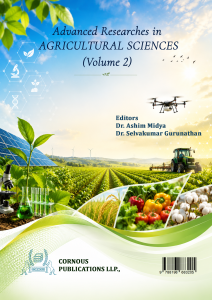
Editorial Book
Book Title: Advanced Researches in Agricultural Sciences (Volume 2)
OPEN ACCESS | Published on : 26-Oct-2026 | Pages: 193-227 | Doi : https://doi.org/10.37446/vol2book092025/193-227
Bulb Vegetables Production Technology
- Dr. Sable PA
- Associate Research Scientist (Horticulture) Date Palm Research Station, Sardarkrushinagar Dantiwada Agricultural University, Mundra 370 421, Gujarat (India).
- Dr. Pawar YD
- Associate Professor (Vegetable Science) College of Horticulture, Sardarkrushinagar Dantiwada Agricultural University, Jagudan 384 460, India.
- Dr. Vijay Mahajan
- Former Director, ICAR-Directorate of Onion and Garlic Research, Rajgurunagar, Pune, MS.
- Nandre B M
- Associate Professor (Horticulture), Chimanbhai Patel College of Agriculture, Sardarkrushinagar Dantiwada Agricultural University, Sardarkrushinagar 385 506, Gujarat, India.
- Dr. Rathwa A D
- Assistant Research Scientist (Fruit Science), Sardarkrushinagar Dantiwada Agricultural University, Dahegam 382 305, Gujarat, India.
Abstract
Bulb vegetables constitute an important group of horticultural crops that are valued for their nutritional, medicinal, culinary, and economic value. Basic bulb vegetables such as onions, garlic, shallots, and leeks are widely cultivated underground for food, for processing and preservation, and for various uses in the food and pharmaceutical industries. Production techniques for bulb vegetables include variety selection, climate and soil conditions, land preparation, propagation methods, nutrient management, irrigation, weed management, and integrated pest and disease management. Modern production approaches such as precision agriculture, drip irrigation, fertilization, mulching, improved planting techniques, and integrated nutrient management play an important role in improving productivity, resource use efficiency, and crop quality. Special emphasis is placed on bulb development, maturity assessment, harvesting techniques, curing, grading, packaging, storage, and post-harvest management to minimize losses and extend shelf life. Furthermore, the adoption of improved cultivars, climate-resilient production practices, and sustainable crop management strategies can help address challenges associated with climate variability, soil degradation, and fluctuating market demands. Understanding the scientific principles and practical aspects of bulb vegetable production techniques is essential to achieve higher yields, improve bulb quality, increase farmer incomes, and ensure a sustainable supply of these commercially important crops. This chapter provides students, researchers, agricultural professionals, and growers with a comprehensive overview of production practices, technological advances, and future prospects for bulb vegetable cultivation.
Keywords
Bulb vegetables, Onion, garlic, Shallot, leek, Production technology, Cultivation practices, Nutrient management, Irrigation management, Integrated pest and disease management, Bulb development, Harvesting, Post-harvest management
References
Anonymous. (n.d.). Agriculture Institute. https://agriculture.institute
Anonymous. (n.d.). Agricultural and Processed Food Products Export Development Authority (APEDA). https://apeda.gov.in
Anonymous. (n.d.). Directorate of Onion and Garlic Research. https://dogr.icar.gov.in
Anonymous. (n.d.). Indian Institute of Horticultural Research. https://www.iihr.res.in (Updated August 5, 2025).
Anonymous. (n.d.). National Horticultural Research and Development Foundation. https://nhrdf.org
Anonymous. (n.d.). The Times of India. https://timesofindia.indiatimes.com
Anonymous. (n.d.). Tamil Nadu Agricultural University Agritech Portal. https://www.agritech.tnau.ac.in (Updated November 2022).
Department of Agriculture and Farmers Welfare, Ministry of Agriculture and Farmers Welfare, Government of India. (2025). Area and production of horticultural crops for 2024–25: Final estimates. Government of India.
Chaudhary, J. (2026). Effect of organic and inorganic nutrient sources on growth, yield and quality of onion (Allium cepa L.) [Master’s thesis, Sardarkrushinagar Dantiwada Agricultural University].
Dubey, B. K., & Gupta, P. K. (2021). Yamuna Purple-10 (G-404): A new promising garlic variety. Indian Horticulture, May–June, 16–17.
Dubey, R. K., Singh, V., & Pandey, S. (2023). Underexploited vegetables of northeastern region. Indian Horticulture, November–December, 54.
Gupta, P. K., Tiwari, S. K., & Jankiram, T. (2023). Onion bulb production through bulblets for enhancing farmers’ income. Indian Horticulture, January–February, 10–13.
Joshi, H. C., & Tandon, J. P. (1976). Heterosis for yield and its genetic basis in the onion. Indian Journal of Agricultural Sciences, 46, 88.
Kumar, S., Nongthombam, J., Dubey, R. K., Chaudhary, K. P., Devi, N. L., & Khangembam, J. K. (2020). Status, diversity and potential of indigenous and minor Allium species. Indian Horticulture, May–June, 58–61.
Lawande, K. E., Khar, A., Mahajan, V., Krishna Prasad, V. S. R., Devi, A., & Srinivas, P. S. (2010a). Proceedings of AINRPOG group meeting.
Lawande, K. E., Krishna Prasad, V. S. R., Mahajan, V., & Srinivas, P. S. (2010b). Proceedings of IRC, DOGR, DOGR and ICAR newsletter.
Lawande, K. E., Mahajan, V., Krishna Prasad, V. S. R., & Khar, A. (2007). Proceedings of IRC and DOGR, DOGR and ICAR newsletter, and proceedings of the XXV AICRP (VC) group meeting.
Lawande, K. E., Mahajan, V., Krishna Prasad, V. S. R., & Khar, A. (2009). Proceedings of the XXVII AICRP (VC) group meeting.
Mahajan, V., Gupta, A. J., Benke, A., Singh, M., & Lawande, K. E. (2020). Improvement in onion (Allium cepa L.) in India. In P. A. Sable, Y. Pawar, & P. H. Dave (Eds.), National webinar on approaches towards onion cultivation (pp. 12–34). Indian Society of Alliums.
Mahajan, V., Lawande, K. E., Krishna Prasad, V. S. R., & Srinivas, P. S. (2010). Proceedings of IRC DOGR, DOGR and ICAR newsletter.
Mani, V. P., Chauhan, V. S., Joshi, H. S., & Tandon, J. P. (1999). Exploiting gene effects for improving bulb yield in onion. The Indian Journal of Genetics and Plant Breeding, 59(4), 511–514.
Manthesha, H. D., Kenganal, M., Yenjerappa, S. T., Aswathanarayana, D. S., & Kulkarni, V. (2022). Management of onion twister disease under field condition. The Pharma Innovation Journal, 11(4S), 551–555.
Ochar, K., & Kim, S. H. (2023). Conservation and global distribution of onion (Allium cepa L.) germplasm for agricultural sustainability. Plants, 12(18), Article 3294. https://doi.org/10.3390/plants12183294
Sable, P. A., Acharya, S. K., Mistry, J. J., & Verma, P. (2024). Effect of potash and sulphur levels on growth, yield, quality parameters and economics in onion. International Journal of Research in Agronomy, 7(3), 567–571.
Sable, P. A., Kurubar, A. R., & Hugar, A. (2013). Study of weed management practices on weed dry weight, growth, yield and economics parameter of onion (Allium cepa L.). The Asian Journal of Horticulture, 8(1), 269–273.
Sable, P. A., Mahajan, V., & Sonpure, S. (2021). Scientific cultivation of onion. Indian Horticulture, March–April, 16–18.
Sable, P. A., & Patel, J. R. (2023). Seed is key factor in onion production: Farmer’s feedback. Indian Horticulture, May–June, 36–38.
Sable, P. A., & Sonpure, S. (2023a). How to get high yield from rabi onion? Indian Horticulture, July–August, 15–19.
Sable, P. A., Jadhav, S. N., & Purane, A. B. (2014). Weed management in onion (Allium cepa L.). Environment, Development and Sustainability?
Sheshadri, V. S., & Chaterjee, S. S. (1996). The history and adaptability of some introduced vegetable crops in India. Vegetable Science, 23(2), 114–140.
Singh, D. (1997). Onion improvement in India. In International symposium on edible Alliaceae. https://www.actahort.org/books/433/433_4.htm
Singh, N., & Pal, N. (2022). Onion (Allium cepa L.). In S. Thamburaj & N. Singh (Eds.), Vegetables, tubercrops and spices (10th reprint, pp. 165–187). Indian Council of Agricultural Research.
Vaddoria, M. A., & Kulkarni, G. (2018). Onion. In K. V. Peter (Ed.), Biodiversity in horticultural crops (Vol. 6, pp. 211–225). Daya Publishing House.
Vavilov, N. I. (1992). Origin and geography of cultivated plants (D. Love, Trans.). Cambridge University Press. (Original work published 1926).
Vavilov, N. I., & Burkinich, D. D. (1929). Zemledelcheskii Afganistan. Trudy po Prikladnoi Botanike, Genetike i Selektsii, 156–158.
Indexing In




Types of Books We Publish



Uniqueness of our Publication

DOI Assignment

ISBN Registration

Online Publication

High Visibility

Open & Closed Access
DOI Assignment
ISBN Registration
Online Publication
High Visibility