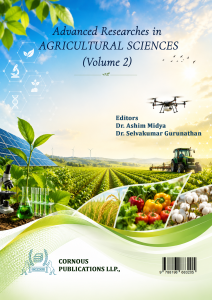
Editorial Book
Book Title: Advanced Researches in Agricultural Sciences (Volume 2)
PAID ACCESS | Published on : 03-Aug-2026 | Pages: 136-143 |
Botanicals, Biopesticides, and Eco-Friendly Pest Control Approaches
- Mohd Anas
- PhD scholar, Division of Entomology, ICAR- IARI, New Delhi, India.
- S Vinotha
- PhD scholar, Division of Entomology, ICAR- IARI, New Delhi, India.
- Prajwal Gowda MA
- PhD scholar, Division of Entomology, ICAR- IARI, New Delhi, India.
- Sumaiya .
- PhD scholar, Division of Agricultural Chemicals, ICAR- IARI, New Delhi, India.
Abstract
Synthetic insecticides have driven insect pest management in cereal and other cropping systems for decades, but resistance, pest resurgence, and non-target toxicity have exposed the limits of continued reliance on broad-spectrum chemistry. This chapter reviews botanicals, biopesticides, and related eco-friendly approaches for insect pest management, restricting its scope to insect pests specifically. It covers plant-derived compounds such as azadirachtin, pyrethrins, and essential oils; microbial biopesticides including Bacillus thuringiensis, entomopathogenic fungi, viruses, and nematodes; biochemical and semiochemical tools such as insect growth regulators, pheromones, and push-pull strategies; and emerging technologies including RNA interference and nanotechnology-based delivery systems. The chapter also examines how these tools integrate with conservation biological control, and the practical constraints: formulation stability, speed of action, cost, and regulatory friction, that continue to limit their field-scale adoption. While botanicals and biopesticides are unlikely to replace synthetic insecticides outright in the near term, their selectivity, compatibility with natural enemies, and lower resistance-development burden make them an increasingly important component of integrated pest management. The chapter concludes that the practical way forward lies not in choosing eco-friendly tools over conventional ones, but in deliberately integrating both, guided by pest biology, economic thresholds, and the natural enemy community already present in the field.
Keywords
Botanical insecticides, Microbial biopesticides, Semiochemicals, RNA interference, Biological control, Integrated pest management
References
Baum, J. A., Bogaert, T., Clinton, W., Heck, G. R., Feldmann, P., Ilagan, O., Johnson, S., Plaetinck, G., Munyikwa, T., Pleau, M., Vaughn, T., & Roberts, J. (2007). Control of coleopteran insect pests through RNA interference. Nature Biotechnology, 25, 1322–1326.
Bravo, A., Gill, S. S., & Soberón, M. (2007). Mode of action of Bacillus thuringiensis Cry and Cyt toxins and their potential for insect control. Toxicon, 49(4), 423–435.
Cardé, R. T., & Minks, A. K. (1995). Control of moth pests by mating disruption: Successes and constraints. Annual Review of Entomology, 40, 559–585.
Chandler, D., Bailey, A. S., Tatchell, G. M., Davidson, G., Greaves, J., & Grant, W. P. (2011). The development, regulation and use of biopesticides for integrated pest management. Philosophical Transactions of the Royal Society B: Biological Sciences, 366(1573), 1987–1998.
Davies, T. G. E., Field, L. M., Usherwood, P. N. R., & Williamson, M. S. (2007). DDT, pyrethrins, pyrethroids and insect sodium channels. IUBMB Life, 59(3), 151–162.
Dhadialla, T. S., Carlson, G. R., & Le, D. P. (1998). New insecticides with ecdysteroidal and juvenile hormone activity. Annual Review of Entomology, 43, 545–569.
Heinrichs, E. A., & Mochida, O. (1984). From secondary to major pest status: The case of insecticide-induced rice brown planthopper, Nilaparvata lugens, resurgence. Protection Ecology, 7, 201–218.
Isman, M. B. (2000). Plant essential oils for pest and disease management. Crop Protection, 19(8–10), 603–608.
Isman, M. B. (2006). Botanical insecticides, deterrents, and repellents in modern agriculture and an increasingly regulated world. Annual Review of Entomology, 51, 45–66.
Kaya, H. K., & Gaugler, R. (1993). Entomopathogenic nematodes. Annual Review of Entomology, 38, 181–206.
Landis, D. A., Wratten, S. D., & Gurr, G. M. (2000). Habitat management to conserve natural enemies of arthropod pests in agriculture. Annual Review of Entomology, 45, 175–201.
Mallet, J. (1989). The evolution of insecticide resistance: Have the insects won? Trends in Ecology & Evolution, 4(11), 336–340.
Mordue, A. J., & Blackwell, A. (1993). Azadirachtin: An update. Journal of Insect Physiology, 39(11), 903–924.
Moscardi, F. (1999). Assessment of the application of baculoviruses for control of Lepidoptera. Annual Review of Entomology, 44, 257–289.
Nuruzzaman, M., Rahman, M. M., Liu, Y., & Naidu, R. (2016). Nanoencapsulation, nano-guard for pesticides: A new window for safe application. Journal of Agricultural and Food Chemistry, 64(7), 1447–1483.
Price, D. R. G., & Gatehouse, J. A. (2008). RNAi-mediated crop protection against insects. Trends in Biotechnology, 26(7), 393–400.
Romeis, J., Meissle, M., & Bigler, F. (2006). Transgenic crops expressing Bacillus thuringiensis toxins and biological control. Nature Biotechnology, 24(1), 63–71.
Roy, H. E., Steinkraus, D. C., Eilenberg, J., Hajek, A. E., & Pell, J. K. (2006). Bizarre interactions and endgames: Entomopathogenic fungi and their arthropod hosts. Annual Review of Entomology, 51, 331–357.
Sanahuja, G., Banakar, R., Twyman, R. M., Capell, T., & Christou, P. (2011). Bacillus thuringiensis: A century of research, development and commercial applications. Plant Biotechnology Journal, 9(3), 283–300.
Schmutterer, H. (1990). Properties and potential of natural pesticides from the neem tree, Azadirachta indica. Annual Review of Entomology, 35, 271–297.
Witzgall, P., Kirsch, P., & Cork, A. (2010). Sex pheromones and their impact on pest management. Journal of Chemical Ecology, 36(1), 80–100.
Indexing In




Types of Books We Publish




Uniqueness of our Publication

DOI Assignment

ISBN Registration

Online Publication

High Visibility

Open & Closed Access
DOI Assignment
ISBN Registration
Online Publication
High Visibility