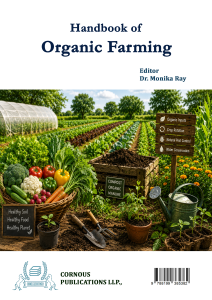
Editorial Book
Book Title: Handbook of Organic Farming
PAID ACCESS | Published on : 23-May-2026 | Pages: 76-90 |
Biological Pests and Disease Management
- Nidheesh T. D
- Forest Protection Division, ICFRE–Tropical Forest Research Institute, Jabalpur, Madhya Pradesh, India.
- Preethi C
- Department of Agriculture, Adhiyamaan College of Agriculture and Research, affiliated to Tamil Nadu Agricultural University (TNAU), Krishnagiri District, Tamil Nadu, India.
Abstract
Biological pest and disease management represents a transformative shift from chemically intensive crop protection to eco-friendly pest and disease management strategies. This approach utilizes living organisms - including predators, parasitoids, entomopathogens, and antagonistic microorganisms - to regulate pest populations and suppress plant diseases below economically damaging thresholds. By harnessing natural ecological processes such as predation, parasitism, competition, and induced systemic resistance, biological control provides an effective and environmentally safe alternative to conventional chemical-intensive management. The approach is implemented through key strategies such as classical, augmentative, and conservation biological control, each contributing to long-term pest suppression and ecosystem stability. In addition to minimizing chemical residues and reducing the risk of resistance development, biological control supports biodiversity conservation and enhances agroecosystem resilience. Recent advancements in biotechnology, microbial formulations, and precision agriculture have further improved the efficiency, reliability, and scalability of biological interventions. Despite certain limitations, including relatively slower action and sensitivity to environmental conditions, biological pest and disease management has become a central component of Integrated Pest and Disease Management (IPDM). It plays a crucial role in promoting sustainable agriculture, ensuring food security, and safeguarding environmental health for future generations.
Keywords
Biological control, IPDM, Agroecosystem, Entomopathogens, Sustainability, Biopesticides
References
Aktar, W., Sengupta, D., & Chowdhury, A. (2009). Impact of pesticides use in agriculture: Their benefits and hazards. Interdisciplinary Toxicology, 2(1), 1–12.
Baker, B. P., Green, T. A., & Loker, A. J. (2020). Biological control and integrated pest management in organic and conventional systems. Biological Control, 140, 104095.
Compant, S., Duffy, B., Nowak, J., Clément, C., & Barka, E. A. (2005). Use of plant growth-promoting bacteria for biocontrol of plant diseases: Principles, mechanisms of action, and future prospects. Applied and Environmental Microbiology, 71(9), 4951–4959.
Cook, R. J., & Baker, K. F. (1983). The nature and practice of biological control of plant pathogens. APS Press.
Dessaux, Y., Grandclément, C., & Faure, D. (2016). Engineering the rhizosphere. Trends in Plant Science, 21(3), 266–278.
Doumbou, C. L., Hamby Salove, M. K., Crawford, D. L., & Beaulieu, C. (2001). Actinomycetes, promising tools to control plant diseases and to promote plant growth. Phytoprotection, 82(3), 85–102.
Dubey, A., Malla, M. A., Vimal, S. R., Kumar, A., Prasad, S. M., & Khan, M. L. (2025). Plant-microbiome engineering: Synergistic microbial partners for crop health and sustainability. Plant Growth Regulation, 1–15.
Faria, M., & Wraight, S. P. (2007). Mycoinsecticides and mycoacaricides: A comprehensive list with worldwide coverage and international classification of formulation types. Biological Control, 43(3), 237–256.
Glare, T. R., Caradus, J. R., Gelernter, W. D., Jackson, T. A., Keyhani, N. O., Köhl, J., Marrone, P. G., Morin, L., & Stewart, A. (2012). Have biopesticides come of age? Trends in Biotechnology, 30(5), 250–258.
Hajek, A. E., & Eilenberg, J. (2018). Natural enemies: An introduction to biological control. Cambridge University Press.
Harman, G. E., Howell, C. R., Viterbo, A., Chet, I., & Lorito, M. (2004). Trichoderma species Opportunistic, avirulent plant symbionts. Nature Reviews Microbiology, 2, 43–56.
Herren, H. R., & Neuenschwander, P. (1991). Biological control of cassava pests in Africa. Annual Review of Entomology, 36, 257–283.
Isman, M. B. (2006). Botanical insecticides, deterrents, and repellents in modern agriculture and an increasingly regulated world. Annual Review of Entomology, 51, 45–66.
Jadhav, H. P., Shaikh, S. S., & Sayyed, R. Z. (2017). Role of hydrolytic enzymes of rhizoflora in biocontrol of fungal phytopathogens: An overview. In S. Mehnaz (Ed.), Rhizotrophs: Plant growth promotion to bioremediation (pp. 183–203). Springer.
Jones, J. B., Jackson, L. E., Balogh, B., Obradovic, A., Iriarte, F. B., & Momol, M. T. (2007). Bacteriophages for plant disease control. Annual Review of Phytopathology, 45, 245–262.
Julien, M. H., & Griffiths, M. W. (1998). Biological control of weeds: A world catalogue of agents and their target weeds (4th ed.). CABI Publishing.
Kloepper, J. W., Ryu, C. M., & Zhang, S. (2004). Induced systemic resistance and promotion of plant growth by Bacillus spp. Phytopathology, 94(11), 1259–1266.
Kogan, M. (1998). Integrated pest management: Historical perspectives and contemporary developments. Annual Review of Entomology, 43, 243–270.
Lacey, L. A., & Unruh, T. R. (2005). Biological control of codling moth (Cydia pomonella, Lepidoptera: Tortricidae) and its integration with other control methods in orchard ecosystems. Journal of Nematology, 37(2), 233–245.
Landis, D. A., Wratten, S. D., & Gurr, G. M. (2000). Habitat management to conserve natural enemies of arthropod pests in agriculture. Annual Review of Entomology, 45, 175–201.
Mahanta, D. K., Komal, J., Bhoi, T. K., Samal, I., Dash, S., & Jangra, S. (2025). RNA interference (RNAi) for insect pest management: Understanding mechanisms, strategies, challenges and future prospects. Biologia Futura, 76(4), 465–477.
Neuenschwander, P. (2001). Biological control of cassava pests in Africa. Annual Review of Entomology, 46, 195–216.
Ongena, M., & Jacques, P. (2008). Bacillus lipopeptides: Versatile weapons for plant disease biocontrol. Trends in Microbiology, 16(3), 115–125.
Pandareesh, M. D., Bhumika, H. S., Ramadas, D., & Gnanesh, B. N. (2026). Nanotechnology in crop protection: Smart delivery of agrochemicals and biopesticides. In Next generation crop protection for agricultural sustainability and food security (pp. 95–122). CRC Press.
Parra, J. R. P. (2014). Biological control in Brazil: An overview. Journal of Insect Science, 14(1), 1–10.
Pieterse, C. M. J., Zamioudis, C., Berendsen, R. L., Weller, D. M., Van Wees, S. C. M., & Bakker, P. A. H. M. (2014). Induced systemic resistance by beneficial microbes. Annual Review of Phytopathology, 52, 347–375.
Pimentel, D., & Burgess, M. (2014). Environmental and economic costs of the application of pesticides primarily in the United States. In R. Peshin & D. Pimentel (Eds.), Integrated pest management: Pesticide problems (pp. 47–71). Springer.
Ramos Aguila, L. C., Li, X., Akutse, K. S., Bamisile, B. S., Sánchez Moreano, J. P., Lie, Z., & Liu, J. (2023). Host–parasitoid phenology, distribution, and biological control under climate change. Life, 13(12), 2290.
Santoyo, G., Guzmán-Guzmán, P., Parra-Cota, F. I., Santos-Villalobos, S. D. L., Orozco-Mosqueda, M. D. C., & Glick, B. R. (2021). Plant growth stimulation by microbial consortia. Agronomy, 11(2), 219.
Singh, A., Verma, P., & Rao, N. (2024). Artificial intelligence in pest management. Computers and Electronics in Agriculture, 210, 107–120.
Singh, H., & Kaur, T. (2020). Pathogenicity of entomopathogenic fungi against aphid and whitefly species on crops grown under greenhouse conditions in India. Egyptian Journal of Biological Pest Control, 30(1), 84.
Smith, S. M. (1996). Biological control with Trichogramma: Advances, successes, and potential of their use. Annual Review of Entomology, 41, 375–406.
Strange, R. N., & Scott, P. R. (2005). Plant disease: A threat to global food security. Annual Review of Phytopathology, 43, 83–116.
Talekar, N. S., & Shelton, A. M. (1993). Biology, ecology, and management of the diamondback moth. Annual Review of Entomology, 38, 275–301.
van Lenteren, J. C. (2012). The state of commercial augmentative biological control: Plenty of natural enemies, but a frustrating lack of uptake. BioControl, 57, 1–20.
van Lenteren, J. C., Bale, J., Bigler, F., Hokkanen, H. M. T., & Loomans, A. J. M. (2006). Assessing risks of releasing exotic biological control agents of arthropod pests. Annual Review of Entomology, 51, 609–634.
Vidhyasekaran, P., Kamala, N., Ramanathan, A., Rajappan, K., Paranidharan, V., & Velazhahan, R. (2001). Induction of systemic resistance by Pseudomonas fluorescens Pf1 against Xanthomonas oryzae pv. oryzae in rice leaves. Phytoparasitica, 29(2), 155–166.
Woo, S. L., Ruocco, M., Vinale, F., Nigro, M., Marra, R., Lombardi, N., Pascale, A., Lanzuise, S., Manganiello, G., & Lorito, M. (2014). Trichoderma-based products and their widespread use in agriculture. The Open Mycology Journal, 8(1), 71–126.
World Health Organization. (2023). Report of the 15th FAO/WHO Joint Meeting on Pesticide Management: Rome, Italy and online, 15–18 November 2022 (pp. 1–23). Food and Agriculture Organization & World Health Organization.
Yuan, X., Zhang, B., Guo, Y., Zhao, C., & Li, D. (2026). Evaluation of green control efficacy of Trichogramma chilonis Ishii against rice stem borers in paddy field. Journal of South China Agricultural University, 47(2), 298–304.
Indexing In




Types of Books We Publish




Uniqueness of our Publication

DOI Assignment

ISBN Registration

Online Publication

High Visibility

Open & Closed Access
DOI Assignment
ISBN Registration
Online Publication
High Visibility