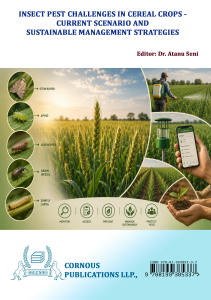
Editorial Book
Book Title: Insect Pest Challenges in Cereal Crops - Current Scenario and Sustainable Management Strategies
OPEN ACCESS | Published on : 03-Feb-2026 | Pages: 63-82 | Doi : 10.37446/edibook212025/63-82
Advancement in Biocontrol Agent Performance for Sustainable Cereal Farming
- Thakoor Pavan
- Department of Agricultural Entomology, BCKV-Agri University, Mohanpur, Nadia, West Bengal, India.
- Sunil Kumar Ghosh
- AINP on Agricultural Acarology, Department of Agricultural Entomology, BCKV-Agri University, Mohanpur, Nadia, West Bengal, India.
Abstract
Cereal crops such as rice, wheat, maize, and barley are central to global food systems, contributing to the dietary caloric intake of billions of people worldwide. However, these crops are constantly under threat from a wide range of biotic stresses, including fungal, bacterial, and viral pathogens, as well as insect pests. Traditionally, the management of these threats has relied heavily on synthetic chemical pesticides and fertilizers, which, while effective in the short term, have led to several unintended consequences. These include the emergence of pesticide-resistant strains, degradation of soil health, disruption of beneficial microbial communities, and contamination of water bodies and food chains. In response to these concerns, there has been a growing emphasis on the development and adoption of environmentally sustainable and ecologically sound alternatives, among which biocontrol agents (BCAs) are prominent. Biocontrol agents beneficial microbes such as bacteria, fungi, viruses, and nematodes exert their effects through multiple mechanisms, including antibiosis, parasitism, competition, and induction of host plant resistance. Recent advancements in biotechnology, microbiology, and precision agriculture have significantly enhanced the efficacy, reliability, and scalability of BCAs. Techniques such as genomic sequencing, strain improvement, synthetic biology, and nano-formulation technologies have enabled the development of robust, target-specific biocontrol solutions that are compatible with integrated pest management (IPM) strategies.This chapter provides a comprehensive overview of the latest innovations in the field of biocontrol agent development and deployment, with a focus on cereal crop production. It examines the various types of BCAs in use, their modes of action, and the technologies that have improved their formulation, delivery, and field performance. Additionally, the chapter addresses the challenges that limit broader adoption such as regulatory hurdles, environmental variability, and knowledge gaps and outlines strategic directions for future research and policy support. By advancing the performance and reliability of BCAs, modern agriculture can move toward more sustainable, resilient, and climate-smart cereal farming systems that maintain productivity while safeguarding ecological integrity.
Keywords
Beneficial microbes, Bio-pesticides, IPM, Ecological integrity, Environmentally sustainable
References
Altieri, M. A., Nicholls, C. I., Henao, A., & Lana, M. A. (2015). Agroecology and the design of climate change-resilient farming systems. Agronomy for Sustainable Development, 35(3), 869–890.
Bhattacharyya, P. N., & Jha, D. K. (2012). Plant growth-promoting rhizobacteria (PGPR): Emergence in agriculture. World Journal of Microbiology and Biotechnology, 28(4), 1327–1350.
Berendsen, R. L., Pieterse, C. M., & Bakker, P. A. (2012). The rhizosphere microbiome and plant health. Trends in Plant Science, 17(8), 478–486.
Backer, R., Rokem, J. S., Ilangumaran, G., Lamont, J., Praslickova, D., Ricci, E., & Smith, D. L. (2018). Plant growth-promoting rhizobacteria: context, mechanisms of action, and roadmap to commercialization of biostimulants for sustainable agriculture. Frontiers in Plant Science, 9, 1473.
Bithell, S. L., McKay, A. C., & Barnett, S. J. (2015). The impact of Trichoderma and Pseudomonas inoculants on barley yield under Rhizoctonia root rot pressure. Crop and Pasture Science, 66(9), 885–893.
Bakker, P. A. H. M., Pieterse, C. M. J., & de Jonge, R. (2020). The soil-borne legacy. Cell, 183(6), 1127–1128.
Berg, G., Rybakova, D., Fischer, D., & Cernava, T. (2021). Microbiome-based products for sustainable agriculture. Nature Reviews Microbiology, 19(8), 497–498.
Chandler, D., Bailey, A. S., Tatchell, G. M., Davidson, G., Greaves, J., & Grant, W. P. (2011). The development, regulation and use of biopesticides for integrated pest management. Philosophical Transactions of the Royal Society B: Biological Sciences, 366(1573), 1987–1998.
fChakraborty, K., Ghosh, S. K., & Roy, G. C. (2015). Abundance of yellow stem borer Scirpophaga incertulas Walker egg parasitoids in relation to cultural practices in West Bengal, India. Research Journal of Pharmaceutical, Biological and Chemical Sciences, 6(1), 265–270.
Chowdhury, S. P., Hartmann, A., Gao, X., & Borriss, R. (2022). AI-driven systems for monitoring biocontrol performance in precision agriculture. Frontiers in Sustainable Food Systems, 6, 945230.
Chandler, D., Davidson, G., Grant, W. P., Greaves, J., & Tatchell, G. M. (2011). Microbial biological control agents for integrated pest management: An overview. Biocontrol Science and Technology, 21(9), 847–872.
Chhipa, H. (2019). Nanofertilizers and nanopesticides for agriculture. Environmental Chemistry Letters, 17(1), 15–20.
Derpsch, R., Friedrich, T., Kassam, A., & Hongwen, L. (2010). Current status of adoption of no-till farming in the world and some of its main benefits. International Journal of Agricultural and Biological Engineering, 3(1), 1–25.
Doumbou, C. L., Hamby Salove, M. K., Crawford, D. L., Beaulieu, C., & Beaulieu, C. (2001). Actinomycetes, promising tools to control plant diseases and to promote plant growth. Phytoprotection, 82(3), 85–102.
De Souza, R., Ambrosini, A., & Passaglia, L. M. (2020). Plant growth-promoting bacteria as inoculants in agricultural soils. Genetics and Molecular Biology, 38(4), 401–419.
Fravel, D. R. (2005). Commercialization and implementation of biocontrol. Annual Review of Phytopathology, 43, 337–359.
Food and Agriculture Organization of the United Nations. (2021). The State of Food and Agriculture 2021: Making agrifood systems more resilient to shocks and stresses.
Garbeva, P., van Elsas, J. D., & van Veen, J. A. (2004). Rhizosphere microbial community and its response to plant species and soil history. Plant and Soil, 259, 47–58.
Glare, T. R., Caradus, J. R., & Gelernter, W. D. (2012). Have biopesticides come of age? Trends in Biotechnology, 30(5), 250–258.
Gaugler, R. (2002). Entomopathogenic Nematology. CABI Publishing.
Ghosh, S. K., Chakraborty, K., & Mandal, T. (2013). Bio-Ecology of Predatory Coccinellid Beetle, Coccinella septempunctata (Coleoptera: Coccinellidae) and its Dynamics in Rice Field of Terai Region of West Bengal, India. Internal Journal of Bio-resource and Stress Management, 4(4), 571–575.
Ghosh, S. K. (2016). Harmful effect of insecticides against predator, Coccinella sp. (Lady bird beetle) on eggplant (Solanum melongena L.). Uttar Pradesh J. Zool., 36(1), 17–23.
Ghosh, S. K. (2022). Bio-pesticides – A New Era for Controlling the Pests of Brinjal (Eggplant) and Related Vegetable Crops, and Development of IPM. SATSA Mukhapatra - Annual Technical Issue, 26, 39–60.
Ghosh, S. K., Karmakar, R., Pramanik, K., & Mandal, G. S. (2022). Application of Nanotechnology in Agriculture and Allied Sciences. In Futuristic Trend in Agriculture Engineering and Food Sciences (Vol. 2, Book 9, Chapter 3, pp. 41–52). IIP proceedings.
Ghosh, S. K. (2023). Prospect of Nano Technology in Applied Agriculture. SATSA Mukhapatra - Annual Technical Issue, 27, 121–133.
Ghosh, S. K., Sonowal, M., Chakraborty, G., & Pal, P. K. (2009). Bio-efficacy of microbial formulation against red spider mite (Tetranychus urticae Koch.) infesting ladysfinger (Abelmoschus esculentus L.). Green Farming, 2(10), 685–688.
Ghosh, S. K., & Senapati, S. K. (2009). Seasonal fluctuation in the population of Leucinodes orbonalis Guen. under the sub-Himalayan region of West Bengal, India and its control on eggplant (Solanum melongena L.). Precision Agriculture, 10, 443–449.
Ghosh, S. K. (2013). Incidence of red spider mite (Tetranychus urticae Koch) on okra (Abelmoschus esculentus (L.) Moench) and their sustainable management. Current Biotica, 7(1&2), 40–50.
Ghosh, S. K. (2020). Aphid (Aphis craccivora Koch.) Management on Groundnut Crop (Arachis hypogaea) by using Biopesticides. Int. J. Curr. Microbiol. App. Sci., 9(10), 24–34. https://doi.org/10.20546/ijcmas.2020.910.004
Ghosh, S. K., & Mondal, G. S. (2025). Sustainable Management of Insect Pests of Tree Borne Oilseed Species and Pesticide Properties of their Oil Extracted. SATSA Mukhapatra - Annual Technical Issue, 29, 98–108.
Ghosh, S. K., Laskar, N., & Chakraborty, G. (2012). Plant protection of tree borne oilseed species in North Bengal. In S. Chakraborty (Ed.), Tree borne oilseed species (Ecological and Economic Benefits) (pp. 97–110). LAP LAMBERT Academic Publishing, Germany.
Ghosh, S. K., Laskar, N., & Senapati, S. K. (2004). Seasonal fluctuation of Aphis gossypii Glov. on brinjal and field evaluation of pesticides from different origin against A. gossypii under terai region. Indian J. Agric. Res., 38(3), 171–177.
Ghosh, S. K., Laskar, N., Basak, S. N., & Senapati, S. K. (2004). Seasonal fluctuation of Bemisia tabaci Genn. on brinjal and field evaluation of some pesticides against B. tabaci under terai region of West Bengal. Environment and Ecology, 22(4), 758–762.
Ghosh, S. K., Chaudhuri, N., Ghosh, J., Chatterjee, H., & Senapati, S. K. (2001). Field evaluation of pesticides against the pest complex of cabbage under terai region of West Bengal. Pestology, 25(2), 40–43.
Ghosh, J., Ghosh, S. K., Chatterjee, H., & Senapati, S. K. (1999). Pest constraints of okra under terai region of West Bengal. Indian J. Ent., 61(4), 362–371.
Hallmann, J., Quadt-Hallmann, A., Mahaffee, W. F., & Kloepper, J. W. (1997). Bacterial endophytes in agricultural crops. Canadian Journal of Microbiology, 43(10), 895–914.
Hardoim, P. R., van Overbeek, L. S., & van Elsas, J. D. (2015). Properties of bacterial endophytes and their proposed role in plant growth. Trends in Microbiology, 23(12), 749–759.
Harman, G. E. (2004). Trichoderma in agriculture. Phytopathology, 94(11), 1259–1265.
Huang, Y., Reddy, K. N., Fletcher, R. S., & Pennington, D. (2018). Use of UAVs in precision agriculture for biocontrol application. Precision Agriculture, 19(1), 73–93.
Hobbs, P. R., Sayre, K., & Gupta, R. (2008). The role of conservation agriculture in sustainable agriculture. Philosophical Transactions of the Royal Society B: Biological Sciences, 363(1491), 543–555.
Harman, G. E., Howell, C. R., Viterbo, A., Chet, I., & Lorito, M. (2004). Trichoderma species opportunistic, avirulent plant symbionts. Nature Reviews Microbiology, 2(1), 43–56.
Ingham, E. (2005). The compost tea brewing manual. Soil Food web Incorporated.
Kumar, S., Kaushik, N., & Singh, A. (2020). Recent trends in integrated pest management. Indian Journal of Agricultural Sciences, 90(4), 654–660.
Kumar, S., Kaushik, N., & Dubey, R. C. (2021). Current trends in formulation and delivery of microbial biopesticides. Environmental Sustainability, 4(1), 59–67.
Kloepper, J. W., Ryu, C. M., & Zhang, S. (2004). Induced systemic resistance and promotion of plant growth by Bacillus spp. Phytopathology, 94(11), 1259–1266.
Lori, M., Symnaczik, S., Mäder, P., De Deyn, G., & Gattinger, A. (2017). Organic farming enhances soil microbial abundance and activity A meta-analysis and meta-regression. PLOS ONE, 12(7), e0180442.
Loper, J. E., & Henkels, M. D. (1997). Availability of iron to Pseudomonas fluorescens in rhizosphere and bulk soil evaluated with an iron-responsive biosensor. Applied and Environmental Microbiology, 63(1), 99–105.
López-Bucio, J., Campos-Cuevas, J. C., Hernández-Calderón, E., Velásquez-Becerra, C., Farías-Rodríguez, R., Macías-Rodríguez, L. I., & Valencia-Cantero, E. (2007). Bacillus megaterium rhizobacteria promote growth and alter root-system architecture through an auxin- and ethylene-independent signaling mechanism. Plant Physiology, 142(2), 620–631.
Mew, T. W., & Rosales, A. M. (1986). Bacterization of rice plants for control of sheath blight caused by Rhizoctonia solani. Crop Protection, 5(5), 292–298.
Moscardi, F. (1999). Assessment of the application of baculoviruses for control of Lepidoptera. Annual Review of Entomology, 44(1), 257–289.
Mäder, P., Fliessbach, A., Dubois, D., Gunst, L., Fried, P., & Niggli, U. (2002). Soil fertility and biodiversity in organic farming. Science, 296(5573), 1694–1697.
Mullins, J. G. L., Bailey, A. M., & Foster, G. D. (2021). Engineering enhanced biological control agents through synthetic biology. Current Opinion in Biotechnology, 70, 150–157.
Mendes, R., Garbeva, P., & Raaijmakers, J. M. (2011). The rhizosphere microbiome: significance of plant beneficial, plant pathogenic, and human pathogenic microorganisms. FEMS Microbiology Reviews, 37(5), 634–663.
Nguyen, V. H., et al. (2019). Organic rice production and the role of Trichoderma asperellum in disease control and yield enhancement. Journal of Plant Protection Research, 59(2), 179–187.
Ongena, M., & Jacques, P. (2008). Bacillus lipopeptides: versatile weapons for plant disease biocontrol. Trends in Microbiology, 16(3), 115–125.
Pieterse, C. M., Van der Does, D., Zamioudis, C., Leon-Reyes, A., & Van Wees, S. C. (2014). Hormonal modulation of plant immunity. Annual Review of Cell and Developmental Biology, 28, 489–521.
Pandey, A., Soccol, C. R., & Mitchell, D. (2000). New developments in solid state fermentation: I-bioprocesses and products. Process Biochemistry, 35(10), 1153–1169.
Pretty, J., & Bharucha, Z. P. (2015). Integrated pest management for sustainable intensification of agriculture in Asia and Africa. Insects, 6(1), 152–182.
Pretty, J., Toulmin, C., & Williams, S. (2018). Sustainable intensification in African agriculture. International Journal of Agricultural Sustainability, 9(1), 5–24.
Purkait, A., Biswas, S., Saha, S., Hazra, D. K., Roy, K., Biswas, P. K., Ghosh, S. K., & Kole, R. K. (2019). Formulation of plant-based insecticides, their bio-efficacy evaluation and chemical characterization. Crop Protection, 125, 104907, 1–9.
Pimentel, D., & Burgess, M. (2014). Environmental and economic costs of the application of pesticides primarily in the United States. In Integrated Pest Management (pp. 47–71). Springer.
Raaijmakers, J. M., Vlami, M., & de Souza, J. T. (2002). Antibiotic production by bacterial biocontrol agents. Antonie van Leeuwenhoek, 81(1), 537–547.
Savary, S., Willocquet, L., Pethybridge, S. J., Esker, P., McRoberts, N., & Nelson, A. (2019). The global burden of pathogens and pests on major food crops. Nature Ecology & Evolution, 3(3), 430–439.
Reddy, P. P., Venkateswarlu, B., & Naidu, M. A. (2019). Bioformulations: Biotechnological Approaches for Sustainable Agriculture. Springer.
Rosas, S. B., Andres, J. A., Rovera, M., & Correa, O. S. (2018). Bio-encapsulation of PGPR in biopolymeric matrices for seed coating: benefits and perspectives. Plant and Soil, 435, 1–15.
Ryu, C. M., Farag, M. A., Hu, C. H., Reddy, M. S., Kloepper, J. W., & Paré, P. W. (2003). Bacterial volatiles promote growth in Arabidopsis. Proceedings of the National Academy of Sciences, 100(8), 4927–4932.
Shah, P. A., & Pell, J. K. (2003). Entomopathogenic fungi as biological control agents. Applied Microbiology and Biotechnology, 61(5-6), 413–423.
Schisler, D. A., et al. (2011). Biological control of Fusarium head blight: development of Bacillus-based strategies. Biological Control, 56(1), 1–11.
Sisay, B., et al. (2019). The effectiveness of Metarhizium anisopliae against Spodoptera frugiperda in maize fields. Journal of Pest Science, 92, 1235–1245.
Sundar, A. R., & Vidhyasekaran, P. (2008). Biological control of sheath blight in rice with Pseudomonas fluorescens. Phytoparasitica, 36(2), 173–181.
Shamshiri, R. R., et al. (2018). Research and development in agricultural robotics: A perspective of digital farming. International Journal of Agricultural and Biological Engineering, 11(4), 1–14.
Singh, H. B., et al. (2019). Bioformulations for plant growth promotion and disease management. In Plant-Microbe Interactions in Agro-Ecological Perspectives. Springer.
Subba, B., & Ghosh, S. K. (2016). Population dynamics of lady bird beetle and spiders in relation to weather factors in tomato (Lycopersicon esculentum L.). Life Sciences International Research Journal, 3(1), 35–37.
Shaikh, S., Ghosh, S., & Ghosh, S. K. (2024). Bio-control of Important Pests on Vegetable Crops by Using Microorganisms and Microbial Toxins. SATSA Mukhapatra - Annual Technical Issue, 28, 98–117.
Shaikh, S. I., Ghosh, S., Ghosh, S. K., & Mandal, G. S. (2024). Biological management of major vegetable insect pests with microorganisms for food safety and security. In Futuristic Trends in Agriculture Engineering & Food Sciences (Vol. 3, Book 3, pp. 16–30). IIP Series. https://doi.org/10.58532/V3BCAG3P1CH2
Smith, S. E., & Read, D. J. (2008). Mycorrhizal Symbiosis (3rd ed.). Academic Press.
Stein, T. (2005). Bacillus subtilis antibiotics: structures, syntheses and specific functions. Molecular Microbiology, 56(4), 845–857.
Vessey, J. K. (2003). Plant growth promoting rhizobacteria as biofertilizers. Plant and Soil, 255(2), 571–586.
Wezel, A., et al. (2020). Agroecology and sustainable development: Implications for research, education, and policy. Sustainability, 12(7), 2764.
Weller, D. M. (2007). Pseudomonas biocontrol agents of soilborne pathogens: looking back over 30 years. Phytopathology, 97(2), 250–256.
Wang, J., Wei, G., Li, Y., Li, X., & Li, B. (2022). CRISPR-mediated gene editing in biocontrol bacteria: emerging strategies to enhance efficacy and field adaptability. Frontiers in Microbiology, 13, 812304.
Xue, A. G., et al. (2014). Biological control of Fusarium head blight in wheat with Clonostachys rosea. Canadian Journal of Plant Pathology, 36(1), 19–29.
Indexing In




Types of Books We Publish




Uniqueness of our Publication

DOI Assignment

ISBN Registration

Online Publication

High Visibility

Open & Closed Access
DOI Assignment
ISBN Registration
Online Publication
High Visibility