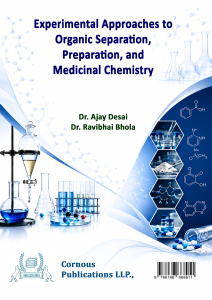
Full Book
PAID ACCESS | Published on : 29-May-2026 | Pages: 1-74 | Doi : 10.37446/978-81-686689-1-1
Experimental Approaches to Organic Separation, Preparation, And Medicinal Chemistry
- Dr. Ajay Desai
- Assistant Professor at Ganpat University, Mehsana-Gozaria Highway, North Gujarat, India.
- Dr. Ravibhai Bhola
- Assistant Professor at Ganpat University, Mehsana-Gozaria Highway, North Gujarat, India.
Preface
This laboratory manual brings together twelve carefully selected medicinal chemistry practicals that form the backbone of undergraduate and postgraduate pharmacy and pharmaceutical science programmes. The practicals span a purposefully broad range of reaction types- condensation, electrophilic aromatic substitution, Fischer esterification, Claisen condensation, photochemical radical coupling, N-acetylation, O-alkylation, base hydrolysis, and aromatic sulphonation each of which is directly applicable to the industrial and clinical synthesis of important drug molecules.
The compounds prepared in this manual include aspirin, paracetamol, phenacetin, benzocaine, phenytoin, cinnamic acid, p-bromoaniline, ethyl acetoacetate, salol, methyl salicylate, benzopinacol, benzopinacolone, and sulphanilic acid. Every one of these molecules carries well-established significance in the history and present practice of pharmaceutical science from the century-long global use of aspirin as an analgesic, antipyretic, and antiplatelet agent to phenytoin's foundational role in the management of epilepsy. Every practical in this book follows a consistent, academically rigorous structure: a detailed scientific background placing the compound in its pharmacological and historical context; a clearly stated aim and working principle; a complete list of chemicals and apparatus; specific safety precautions and chemical handling guidance; a balanced reaction equation; a step-by-step, electron-pushing reaction mechanism; a thoroughly explained experimental procedure; stoichiometric calculations for theoretical and percentage yield; spectroscopic characterisation data covering infrared spectroscopy, mass spectrometry, and proton nuclear magnetic resonance; a result table; and a conclusion. This integrated design enables students to perform the experiment competently while simultaneously developing a deep understanding of the mechanistic and molecular chemistry that drives it.
The manual gives particular attention to laboratory safety. Detailed precautionary guidance is provided for every hazardous material concentrated sulphuric acid, liquid bromine, acetic anhydride, phenol, sodium metal, and flammable organic solvents so that students approach each experiment with complete awareness of the risks involved and the controls required. An introductory chapter on general laboratory safety and chemical handling precedes all practical work.
Spectroscopic characterisation is treated as an integral component of each practical rather than as an optional appendage. Students learn to correlate observed infrared absorptions, mass spectral fragmentation patterns, and proton NMR chemical shifts with the structural features of the compound they have synthesised, building the interpretive skills expected of a qualified pharmaceutical scientist. All spectroscopic reference data cited have been sourced from peer-reviewed databases and authoritative primary literature. The consolidated reference list, compound physical data appendix, and infrared correlation appendix collectively make this manual a self-contained reference of lasting utility.
Keywords
Medicinal chemistry; organic synthesis; reaction mechanism; electrophilic aromatic substitution; nucleophilic acyl substitution; Knoevenagel condensation; Claisen condensation; Fischer esterification; O-acylation; N-acetylation; O-alkylation; aromatic halogenation; aromatic sulphonation; photochemical synthesis; pinacol rearrangement; benzilic acid rearrangement; aspirin; paracetamol; phenacetin; benzocaine; phenytoin; cinnamic acid; benzopinacol; benzopinacolone; sulphanilic acid; salol; methyl salicylate; p-bromoaniline; ethyl acetoacetate; infrared spectroscopy; mass spectrometry; proton nuclear magnetic resonance; theoretical yield; percentage yield; chemical safety; laboratory manual; pharmacy education; drug discovery; characterisation; stoichiometry; tautomerism.
Indexing In




Types of Books We Publish




Uniqueness of our Publication

DOI Assignment

ISBN Registration

Online Publication

High Visibility

Open & Closed Access
DOI Assignment
ISBN Registration
Online Publication
High Visibility