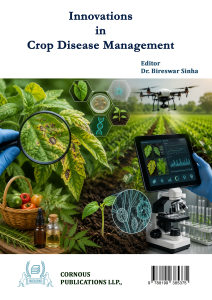
Editorial Book
Book Title: Innovations in Crop Disease Management
OPEN ACCESS | Published on : 24-Apr-2026 | Pages: 79-92 | Doi : 10.37446/edibook162024 /79-92
Traditional methods for plant disease management
- Monalisa Sen
- M.Sc. (Ag) Plant Pathology from Palli Siksha Bhavana (Visva-Bharati University), Bolpur, Sriniketan, West Bengal, India.
Abstract
Traditional methods of plant disease management form an important component of Indian agriculture, developed through centuries of farmer experience and indigenous knowledge across diverse agro-climatic regions. This chapter reviews major traditional practices used to manage fungal, bacterial and viral diseases in field crops, vegetables and fruit crops and discusses their scientific relevance in sustainable crop protection. In cereals such as rice, wheat, maize, bajra and jowar, practices including healthy seed selection, sun drying, timely sowing, crop rotation, mixed cropping, field sanitation, and balanced nutrient application are widely followed to reduce diseases such as blast, sheath blight, rusts, smuts, downy mildews and grain moulds. In sugarcane, the use of disease-free setts, roguing of infected clumps, trash mulching, and sett treatments using lime, ash, botanicals, cow urine and cow milk-based preparations contribute to reducing red rot, smut and wilt complexes. Vegetable crops such as potato, chilli and cucurbits are traditionally protected through seed tuber selection, removal of infected plants, crop residue management, and sprays of neem, garlic, turmeric extracts and diluted cow urine or cow milk to reduce late blight, bacterial wilt, mosaic viruses and powdery mildew. In fruit crops including apple, pear, guava and mango, orchard sanitation, pruning, canopy management, organic amendments, and locally used botanical and cow-based sprays are practised for reducing scab, blights, anthracnose and fruit rots. Traditional approaches mainly function by lowering inoculum levels, breaking disease cycles, improving soil health and reducing disease-favouring microclimates. Key advantages include low cost, local availability, reduced pesticide residues, and ecological safety; however, limitations include variable effectiveness, lack of standardization, slower action under severe epidemics, and limited validation for large-scale adoption. The chapter highlights the scope for scientific validation, refinement and integration of these practices with modern integrated disease management (IDM) for resilient crop health management in India.
Keywords
Indigenous knowledge, Traditional plant protection, Cultural practices, Seed health, Orchard sanitation, Advantages and limitations, Integrated disease management (IDM)
References
Agrios, G. N. (2005). Plant pathology (5th ed.). Elsevier Academic Press.
Aneja, K. R. (2003). Experiments in microbiology, plant pathology and biotechnology (4th ed.). New Age International Publishers.
Choudhary, B., & Kumar, S. (2019). Indigenous technical knowledge in plant disease management. Journal of Pharmacognosy and Phytochemistry, 8(3), 1234–1240.
Nene, Y. L., & Thapliyal, P. N. (2011). Fungicides in plant disease control (3rd ed.). Oxford & IBH Publishing Co. Pvt. Ltd.
Palti, J. (1981). Cultural practices and infectious crop diseases. Springer-Verlag.
Prakash, A., Rao, J., & Nandagopal, V. (2008). Future of indigenous knowledge in crop protection. Agrobios (India).
Rangaswami, G., & Mahadevan, A. (2002). Diseases of crop plants in India (4th ed.). Prentice Hall of India.
Sharma, P. D. (2012). Plant pathology. Rastogi Publications.
Sharma, S., Singh, R., & Kumar, A. (2015). Cow urine as a potential bio-enhancer in agriculture. International Journal of Agricultural Sciences, 7(1), 12–18.
Singh, D., & Singh, H. B. (2014). Botanical extracts in plant disease management: A review. Archives of Phytopathology and Plant Protection, 47(9), 1015–1032.
Singh, R. S. (2017). Introduction to principles of plant pathology (4th ed.). Oxford & IBH Publishing Co. Pvt. Ltd.
Upadhyay, R. K., Mukerji, K. G., & Chamola, B. P. (2001). Biocontrol potential and its exploitation in sustainable agriculture. Springer.
Indexing In




Types of Books We Publish




Uniqueness of our Publication

DOI Assignment

ISBN Registration

Online Publication

High Visibility

Open & Closed Access
DOI Assignment
ISBN Registration
Online Publication
High Visibility