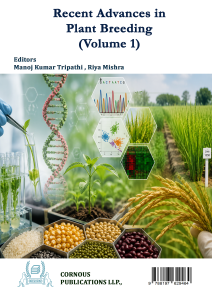
Editorial Book
Book Title: Recent Advances in Plant Breeding-Volume 1
PAID ACCESS | Published on : 12-Feb-2025 | Pages: 182-187 |
Pineapple Crop Improvement through Advanced Breeding Technologies
- Manasa Bodakuntla
- Department of Fruit Science, SKLTHU, Rajendra Nagar, Hyderabad, Telangana, India.
- Srikanth Thippani
- Department of GPBR, PJTAU, Rajendra Nagar, Hyderabad, Telangana, India.
Abstract
Pineapple (Ananas comosus (L.) Merr.) is an economically important tropical fruit crop valued for its fresh consumption, processing quality, nutraceutical properties, and adaptability to diverse agro-climatic conditions. Conventional breeding in pineapple has been constrained by biological limitations such as long juvenile phase, self-incompatibility, high heterozygosity, vegetative propagation, and narrow genetic base of commercial cultivars. In recent decades, advanced breeding technologies integrating biotechnology, genomics, and precision breeding tools have emerged as powerful approaches to accelerate pineapple improvement. This chapter comprehensively discusses the role of modern breeding technologies including mutation breeding, polyploidy induction, tissue culture and somaclonal variation, molecular markers, genomics-assisted breeding, genetic transformation, genome editing, and emerging omics approaches in enhancing yield, fruit quality, biotic and abiotic stress tolerance in pineapple. The integration of these advanced tools with conventional breeding strategies is emphasized for sustainable pineapple improvement.
Keywords
Conventional breeding, biotechnology, genomics, enhancing yield
References
Kumar, S., Nath, V., & Singh, A. K. (2023). Molecular breeding approaches in pineapple (Ananas comosus L.). Indian Journal of Horticulture, 80, 257–266.
Mohamed, A. A., Abdallah, N. A., & El-Shemy, H. A. (2024). Genome editing applications in tropical fruit crops: Progress and prospects. Frontiers in Plant Science, 15, 1282146.
Sharma, S., Rana, J. C., & Bansal, K. C. (2023). Genomics-enabled utilization of plant genetic resources in horticultural crops. Theoretical and Applied Genetics, 136, 63.
Indexing In




Types of Books We Publish




Uniqueness of our Publication

DOI Assignment

ISBN Registration

Online Publication

High Visibility

Open & Closed Access
DOI Assignment
ISBN Registration
Online Publication
High Visibility