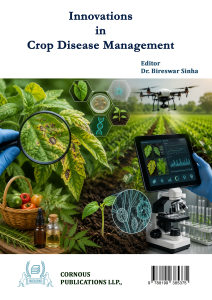
Editorial Book
Book Title: Innovations in Crop Disease Management
OPEN ACCESS | Published on : 28-Feb-2026 | Pages: 64-78 | Doi : 10.37446/edibook162024 /64-78
Necessities and Strategies of Plant Biosecurity in the context of Plant Disease
- Shinee De
- Department of Plant Pathology, Bidhan Chandra Krishi Viswavidyalaya, Mohanpur, Nadia, West Bengal, India.
- Ayan Pramanik
- Department of Plant Pathology, Bidhan Chandra Krishi Viswavidyalaya, Mohanpur, Nadia, West Bengal, India.
- Debargha Patra
- Department of Plant Pathology, Bidhan Chandra Krishi Viswavidyalaya, Mohanpur, Nadia, West Bengal, India.
- Poulomi Gangopadhyay
- Department of Plant Pathology, Bidhan Chandra Krishi Viswavidyalaya, Mohanpur, Nadia, West Bengal, India.
- Birendranath Panja
- Department of Plant Pathology, Bidhan Chandra Krishi Viswavidyalaya, Mohanpur, Nadia, West Bengal, India.
Abstract
Plant biosecurity employs a strategic socio-economic approach aiming the protection of natural and managed plant systems from alien as well as emerging indigenous pests and pathogens by the regulation of both intentional and unintentional introductions. Phytopathogens pose a substantial threat to the plant ecosystems by compromising their productivity, sustainability and biodiversity. Unwanted invasion of the phytopathogens has accelerated mostly with the exponential growth of international trade of ‘plants for planting’, as an externality cost of globalization. Several new records on deliberate introduction of pests and diseases have put forth the newest fear - ‘Agroterrorism’. In the rising background of potential biothreats, plant biosecurity system is the need of the era, demanding the perfect amalgamation of knowledge and efficient risk analysis tools like early detection, accurate diagnosis and rapid response, to minimise the subsequent impact. In this context, idea of the ‘Biosecurity continuum’ stands inevitable, stating the need of strategies starting from the offshore or pre-border zone, border zone upto the post-border area. Advances in the knowledge and research in plant pathology, are crucial for formulating these strategies. Fundamentals of biosecurity strategies lies in risk analysis, risk assessment and rapid response. Various diagnostic tools of phytopathology, like molecular methodologies, imaging technologies, specialized biosensors etc facilitate accurate, on-site diagnosis of disease. Whereas, need-based enforcement of legislations such as, issuing import permits, phytosanitary certificates, post entry quarantine, inspection at point of entry etc. can be upgraded by incorporation of the knowledge on the nature of potential phytopathogens, their host range etc.
Keywords
Plant biosecurity, Phytopathogens, Diagnostic tools, Phytosanitary legislation
References
Akhtar, J., Singh, B., Kandan, A., Kumar, P., Maurya, A. K., & Dubey, S. C. (2017). Interception of pathogens during quarantine processing: An effort towards safe import of oilseed and vegetable Brassicas germplasm in India. Journal of Oilseed Brassica, 8(2), 120–130.
Datta, S., Vanlalhmuakha, & Dwibedi, S. K. (2020). Agroterrorism in Indian context. Defence Life Science Journal, 5(2), 125–132.
Hu, S., Yu, H., & Zhang, C. (2024). Development of recombinase polymerase amplification–lateral flow dipstick (RPA–LFD) as a rapid on-site detection technique for Fusarium oxysporum. Bio-protocol, 14(1), e4915.
Hulme, P. E. (2013). An introduction to plant biosecurity: Past, present and future. In G. Groth & S. McKirdy (Eds.), The handbook of plant biosecurity: Principles and practices for the identification, containment and control of organisms that threaten agriculture and the environment globally (pp. 1–25).
Jafar, A., Bibi, N., Naqvi, R. A., Sadeghi-Niaraki, A., & Jeong, D. (2024). Revolutionizing agriculture with artificial intelligence: Plant disease detection methods, applications, and their limitations. Frontiers in Plant Science, 15, e1356260.
Khetarpal, R. K., & Gupta, K. (2007). Plant biosecurity in India: Status and strategy. Asian Biotechnology and Development Review, 9(2), 83–107.
Perrings, C., Dehnen-Schmutz, K., Touza, J., & Williamson, M. (2005). How to manage biological invasions under globalization. Trends in Ecology & Evolution, 20(5), 212–215.
Ristaino, J. B., Anderson, P. K., Bebber, D. P., Brauman, K. A., Cunniffe, N. J., Fedoroff, N. V., et al. (2021). The persistent threat of emerging plant disease pandemics to global food security. Proceedings of the National Academy of Sciences, 118(23), e2022239118.
Sharma, M., Singh, P., Tewari, A. K., & Lavania, P. (2018). The current status of begomovirus research in India: Solemn threat to crop production. International Journal of Current Microbiology and Applied Sciences, 7, 288–299.
Yang, C. (2020). Remote sensing and precision agriculture technologies for crop disease detection and management with a practical application example. Engineering, 6(5), 528–532.
Indexing In




Types of Books We Publish




Uniqueness of our Publication

DOI Assignment

ISBN Registration

Online Publication

High Visibility

Open & Closed Access
DOI Assignment
ISBN Registration
Online Publication
High Visibility