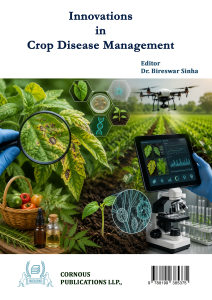
Editorial Book
Book Title: Innovations in Crop Disease Management
PAID ACCESS | Published on : 28-Feb-2026 | Pages: 14-33 | Doi : 10.37446/edibook162024 /14-33
Gene Editing in Plant Disease Management - A Revolutionary Approach
- Neeraj Dwivedi
- Manav Rachna Centre for Medicinal Plant Pathology, Department of Biotechnology, Manav Rachna International Institute of Research and Studies, Faridabad, Haryana, India.
- Shiwani Singh
- Manav Rachna Centre for Medicinal Plant Pathology, Department of Biotechnology, Manav Rachna International Institute of Research and Studies, Faridabad, Haryana, India.
- Shivani Yadav
- Manav Rachna Centre for Medicinal Plant Pathology, Department of Biotechnology, Manav Rachna International Institute of Research and Studies, Faridabad, Haryana, India.
- Nidhi Didwania
- Manav Rachna Centre for Medicinal Plant Pathology, Department of Biotechnology, Manav Rachna International Institute of Research and Studies, Faridabad, Haryana, India.
- Ramesh Kumar Singh
- Research and Development Centre, Eagle Seeds and Biotech Pvt. Ltd., Indore (ESBPL), India.
- Maneesh S. Bhandari
- Division of Genetics & Tree Improvement, ICFRE-Forest Research Institute, Dehradun, Uttarakhand, India.
Abstract
Gene editing has emerged as a transformative tool in plant disease management, providing precise and efficient modifications to enhance disease resistance. Traditional breeding and genetic modification techniques often face limitations such as long breeding cycles, regulatory constraints, and unintended genetic alterations. Now, with gene editing tools like clustered regularly interspaced short palindromic repeats (CRISPR-Cas9), transcription activator-like effector nucleases (TALENs), and zinc finger nucleases (ZFNs), researchers can make precise changes to plant genomes more easily than ever before. This chapter discusses the molecular process of gene editing and its application for developing disease-resistant crops. Notable breakthroughs include CRISPR-modified rice resistant to bacterial blight and powdery mildew-resistant wheat, demonstrating the potential of gene editing to mitigate major crop diseases. Compared to conventional approaches, gene editing provides faster, more precise, and eco-friendly solutions, reducing dependence on chemical pesticides and improving agricultural sustainability. Despite its advantages, challenges such as off-target effects, regulatory complexities, and public perception remain significant barriers. However, innovations like prime editing, base editing, and AI-driven gene modifications are enhancing precision and expanding possibilities. Integrating gene editing with synthetic biology and bioinformatics is a promising next-generation approach to crop protection. This chapter discusses the current advancements, challenges, and future prospects of gene editing in plant disease management, emphasising its role in global food security and sustainable agriculture.
Keywords
Gene Editing, CRISPR-Cas9, Plant Disease Management, Disease Resistance, Crop Improvement, Genetic Engineering
References
Abdelrahman, M., Wei, Z., Rohila, J. S., & Zhao, K. (2021). Multiplex genome-editing technologies for revolutionizing plant biology and crop improvement. Frontiers in Plant Science, 12, 721203.
Ahmad, M. (2023). Plant breeding advancements with “CRISPR-Cas” genome editing technologies will assist future food security. Frontiers in plant science, 14, 1133036.
Ahmar, S., Saeed, S., Khan, M. H. U., Ullah Khan, S., Mora-Poblete, F., Kamran, M., & Jung, K. H. (2020). A revolution toward gene-editing technology and its application to crop improvement. International Journal of Molecular Sciences, 21(16), 5665.
Alabdullah, A. K., Borrill, P., Martin, A. C., Ramirez-Gonzalez, R. H., Hassani-Pak, K., Uauy, C., & Moore, G. (2019). A co-expression network in hexaploid wheat reveals mostly balanced expression and lack of significant gene loss of homeologous meiotic genes upon polyploidization. Frontiers in Plant Science, 10, 1325.
Ali, Q., Yu, C., Hussain, A., Ali, M., Ahmar, S., Sohail, M. A., & Zhou, L. (2022). Genome engineering technology for durable disease resistance: Recent progress and future outlooks for sustainable agriculture. Frontiers in Plant Science, 13, 860281.
Amaresh, G., Nunavath, A., Appunu, C., Viswanathan, C., Kumar, R., Gujjar, R. S., & Manimekalai, R. (2025). Advanced Genome Editing Technologies: Potentials and Prospects in Improvement of Sugar crops. Sugar Tech, 27(1), 14-28.
Bhardwaj, A., & Nain, V. (2021). TALENs an indispensable tool in the era of CRISPR: a mini review. Journal of Genetic Engineering and Biotechnology, 19(1), 125.
Bi, H., & Yang, B. (2017). Gene editing with TALEN and CRISPR/Cas in rice. Progress in molecular biology and translational science, 149, 81-98.
Chen, P. J., & Liu, D. R. (2023). Prime editing for precise and highly versatile genome manipulation. Nature Reviews Genetics, 24(3), 161-177.
Das, K., Ayim, B. Y., Borodynko-Filas, N., Das, S. C., & Aminuzzaman, F. M. (2023). Genome editing (CRISPR/Cas9) in plant disease management: challenges and future prospects. Journal of Plant Protection Research, 159-172.
Dong, O. X., & Ronald, P. C. (2019). Genetic engineering for disease resistance in plants: recent progress and future perspectives. Plant physiology, 180(1), 26-38.
Doudna, J. A., & Charpentier, E. (2014). The new frontier of genome engineering with CRISPR-Cas9.
Science, 346(6213), 1258096.
Erdoğan, İ., Cevher-Keskin, B., Bilir, Ö., Hong, Y., & Tör, M. (2023). Recent developments in CRISPR/Cas9 genome-editing technology related to plant disease resistance and abiotic stress tolerance. Biology, 12(7), 1037.
Food and Agriculture Organization of the United Nations. (2017). The future of food and agriculture: Trends and challenges. Fao.
Han, F., Shelton, A. M., & Zhou, D. (2016). How China can enhance adoption of biotech crops. Nature Biotechnology, 34(7), 693-693.
Jinek, M., Chylinski, K., Fonfara, I., Hauer, M., Doudna, J. A., & Charpentier, E. (2012). A programmable dual-RNA–guided DNA endonuclease in adaptive bacterial immunity. science, 337(6096), 816-821.
Kalendar, R., Orbovic, V., Egea-Cortines, M., & Song, G. Q. (2022). Recent advances in plant genetic engineering and innovative applications. Frontiers in plant science, 13, 1045417.
Kamburova, V. S., Nikitina, E. V., Shermatov, S. E., Buriev, Z. T., Kumpatla, S. P., Emani, C., & Abdurakhmonov, I. Y. (2017). Genome editing in plants: an overview of tools and applications. International Journal of Agronomy, 2017(1), 7315351.
Kent, R., & Dixon, N. (2020). Contemporary tools for regulating gene expression in bacteria. Trends in Biotechnology, 38(3), 316-333.
Khalil, A. M. (2020). The genome editing revolution. Journal of genetic engineering and biotechnology, 18(1), 68.
Khan, Z., Khan, S. H., Mubarik, M. S., Sadia, B., & Ahmad, A. (2017). Use of TALEs and TALEN technology for genetic improvement of plants. Plant molecular biology reporter, 35, 1-19.
Komatsu, A., Ohtake, M., Shimatani, Z., & Nishida, K. (2020). Production of herbicide-sensitive strain to prevent volunteer rice infestation using a CRISPR-Cas9 cytidine deaminase fusion. Frontiers in Plant Science, 11, 925.
Komor, A. C., Kim, Y. B., Packer, M. S., Zuris, J. A., & Liu, D. R. (2016). Programmable editing of a target base in genomic DNA without double-stranded DNA cleavage. Nature, 533(7603), 420-424.
Kumar, V., & Jain, M. (2015). The CRISPR–Cas system for plant genome editing: advances and opportunities. Journal of experimental botany, 66(1), 47-57.
Li, M., Li, X., Zhou, Z., Wu, P., Fang, M., Pan, X., & Li, H. (2016). Reassessment of the four yield-related genes Gn1a, DEP1, GS3, and IPA1 in rice using a CRISPR/Cas9 system. Frontiers in plant science, 7, 377.
Li, S., Zhang, C., Li, J., Yan, L., Wang, N., & Xia, L. (2021). Present and future prospects for wheat improvement through genome editing and advanced technologies. Plant Communications, 2(4).
Li, Y., Li, W., & Li, J. (2021). The CRISPR/Cas9 revolution continues: from base editing to prime editing in plant science. Journal of Genetics and Genomics, 48(8), 661-670.
Lin, Q., Zong, Y., Xue, C., Wang, S., Jin, S., Zhu, Z., & Gao, C. (2020). Prime genome editing in rice and wheat. Nature biotechnology, 38(5), 582-585.
Liu, H., Chen, W., Li, Y., Sun, L., Chai, Y., Chen, H., & Huang, C. (2022). CRISPR/Cas9 technology and its utility for crop improvement. International Journal of Molecular Sciences, 23(18), 10442.
Mahfouz, M. M., Piatek, A., & Stewart Jr, C. N. (2014). Genome engineering via TALENs and CRISPR/Cas9 systems: challenges and perspectives. Plant biotechnology journal, 12(8), 1006-1014.
Mahmudul, H., & Tuskan Gerald, A. (2020). Prime editing technology and its prospects for future applications in plant biology research. BioDesign Research.
Manzoor, S., Nabi, S. U., Rather, T. R., Gani, G., Mir, Z. A., Wani, A. W., & Manzar, N. (2024). Advancing crop disease resistance through genome editing: a promising approach for enhancing agricultural production. Frontiers in Genome Editing, 6, 1399051.
Mao, Y., Botella, J. R., & Zhu, J. K. (2017). Heritability of targeted gene modifications induced by plant-optimized CRISPR systems. Cellular and Molecular Life Sciences, 74(6), 1075-1093.
Miglani, G. S. (2017). Genome editing in crop improvement: Present scenario and future prospects. Journal of Crop Improvement, 31(4), 453-559.
Mishra, R., Joshi, R. K., & Zhao, K. (2018). Genome editing in rice: recent advances, challenges, and future implications. Frontiers in Plant Science, 9, 1361.
Mohanta, T. K., Bashir, T., Hashem, A., Abd Allah, E. F., & Bae, H. (2017). Genome editing tools in plants. Genes, 8(12), 399.
Molla, K. A., Sretenovic, S., Bansal, K. C., & Qi, Y. (2021). Precise plant genome editing using base editors and prime editors. Nature Plants, 7(9), 1166-1187.
Mushtaq, M., Sakina, A., Wani, S. H., Shikari, A. B., Tripathi, P., Zaid, A., & Salgotra, R. K. (2019). Harnessing genome editing techniques to engineer disease resistance in plants. Frontiers in plant science, 10, 550.
Permyakova, N. V., & Deineko, E. V. (2024). Crop improvement: comparison of transgenesis and gene editing. Horticulturae, 10(1), 57.
Ren, C., Lin, Y., & Liang, Z. (2022). CRISPR/Cas genome editing in grapevine: recent advances, challenges and future prospects. Fruit Research, 2(1), 1-9.
Saravanan, K., Praveenkumar, K., Vidya, N., Gowtham, K., & Saravanan, M. (2021). Enhancement of agricultural crops: A CRISPR/Cas9-based approach. In Vegetable Crops-Health Benefits and Cultivation. IntechOpen.
Scholefield, J., & Harrison, P. T. (2021). Prime editing–an update on the field. Gene Therapy, 28(7), 396-401.
Sedeek, K. E., Mahas, A., & Mahfouz, M. (2019). Plant genome engineering for targeted improvement of crop traits. Frontiers in plant science, 10, 114.
Sheng, X., Sun, Z., Wang, X., Tan, Y., Yu, D., Yuan, G., & Duan, M. (2020). Improvement of the rice “easy-to-shatter” trait via CRISPR/Cas9-mediated mutagenesis of the qSH1 gene. Frontiers in plant science, 11, 619.
Songstad, D. D., Petolino, J. F., Voytas, D. F., & Reichert, N. A. (2017). Genome editing of plants.
Critical Reviews in Plant Sciences, 36(1), 1-23.
Sun, Y., Jiao, G., Liu, Z., Zhang, X., Li, J., Guo, X., & Xia, L. (2017). Generation of high-amylose rice through CRISPR/Cas9-mediated targeted mutagenesis of starch branching enzymes. Frontiers in plant science, 8, 298.
Tang, X., Sretenovic, S., Ren, Q., Jia, X., Li, M., Fan, T., & Zhang, Y. (2020). Plant prime editors enable precise gene editing in rice cells. Molecular plant, 13(5), 667-670.
Vats, S., Kumawat, S., Kumar, V., Patil, G. B., Joshi, T., Sonah, H., & Deshmukh, R. (2019). Genome editing in plants: exploration of technological advancements and challenges. Cells, 8(11), 1386.
Wang, Q., Gao, H., Liu, K., Wang, H., Zhang, F., Wei, L., & Yuan, H. (2024). CRISPR/Cas9-mediated enhancement of semi-dwarf glutinous traits in elite Xiangdaowan rice (Oryza sativa L.): targeting SD1 and Wx genes for yield and quality improvement. Frontiers in Plant Science, 15, 1333191.
Wang, Y., Zafar, N., Ali, Q., Manghwar, H., Wang, G., Yu, L., & Jin, S. (2022). CRISPR/Cas genome editing technologies for plant improvement against biotic and abiotic stresses: advances, limitations, and future perspectives. Cells, 11(23), 3928.
Xu, R., Li, J., Liu, X., Shan, T., Qin, R., & Wei, P. (2020). Development of plant prime-editing systems for precise genome editing. Plant Communications, 1(3).
Yin, K., & Qiu, J. L. (2019). Genome editing for plant disease resistance: applications and perspectives. Philosophical Transactions of the Royal Society B, 374(1767), 20180322.
Zhang, K., Raboanatahiry, N., Zhu, B., & Li, M. (2017). Progress in genome editing technology and its application in plants. Frontiers in Plant science, 8, 177.
Zhao, Z., Shang, P., Mohanraju, P., & Geijsen, N. (2023). Prime editing: advances and therapeutic applications. Trends in Biotechnology, 41(8), 1000-1012.
Zheng, X., Qi, C., Yang, L., Quan, Q., Liu, B., Zhong, Z., & Zhang, Y. (2020). The improvement of CRISPR-Cas9 system with ubiquitin-associated domain fusion for efficient plant genome editing. Frontiers in plant science, 11, 621.
Zhou, J., Deng, K., Cheng, Y., Zhong, Z., Tian, L., Tang, X., & Zhang, Y. (2017). CRISPR-Cas9 based genome editing reveals new insights into microRNA function and regulation in rice. Frontiers in Plant Science, 8, 1598.
Zhu, G., & Zhu, H. (2022). Modified gene editing systems: diverse bioengineering tools and crop improvement. Frontiers in plant science, 13, 847169.
Zong, Y., Liu, Y., Xue, C., Li, B., Li, X., Wang, Y., & Gao, C. (2022). An engineered prime editor with enhanced editing efficiency in plants. Nature Biotechnology, 40(9), 1394-1402.
Indexing In




Types of Books We Publish




Uniqueness of our Publication

DOI Assignment

ISBN Registration

Online Publication

High Visibility

Open & Closed Access
DOI Assignment
ISBN Registration
Online Publication
High Visibility