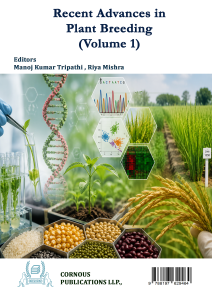
Editorial Book
Book Title: Recent Advances in Plant Breeding-Volume 1
PAID ACCESS | Published on : 17-Dec-2024 | Pages: 170-174 |
Floral Development of Papaya (Carica papaya L.) - Morphological, Molecular and Breeding Perspectives
- Manasa Bodakuntla
- Department of Fruit Science, SKLTHU, Rajendra Nagar, Hyderabad, Telangana, India.
- Srikanth Thippani
- Department of GPBR, PJTAU, Rajendra Nagar, Hyderabad, Telangana, India.
Abstract
Carica papaya L. is a major tropical fruit crop of global economic importance, distinguished by its unique trioecious sexual system comprising male, female, and hermaphrodite plants. Floral development and sex differentiation in papaya directly influence fruit set, yield stability, and breeding efficiency. An in-depth understanding of floral organogenesis, genetic regulation of sex expression, and their manipulation is therefore critical for papaya improvement. This review synthesizes current knowledge on floral morphology, ontogeny, molecular genetics, hormonal regulation, and developmental plasticity of papaya flowers, with special emphasis on their implications for breeding and hybrid seed production. Advances in molecular markers, sex chromosome biology, and modern breeding approaches are discussed in the context of achieving stable hermaphroditism and improved cultivar performance.
Keywords
Carica papaya, floral development, sex determination, trioecy, breeding, molecular genetics
References
Das, S., Dey, P., & Banerjee, N. (2023). Floral morphology, sex expression and breeding implications in papaya (Carica papaya L.). Indian Journal of Horticulture, 80, 123–131.
Sharma, A., Pandey, S., & Singh, B. (2024). Integration of molecular markers and breeding strategies for stable hermaphroditism in papaya. Euphytica, 220, 98.
Tripathi, P. C., Karunakaran, G., & Lal, S. (2025). Genomics-assisted breeding for sex stability and yield improvement in papaya. Frontiers in Plant Science, 16, 1298745.
Indexing In




Types of Books We Publish




Uniqueness of our Publication

DOI Assignment

ISBN Registration

Online Publication

High Visibility

Open & Closed Access
DOI Assignment
ISBN Registration
Online Publication
High Visibility