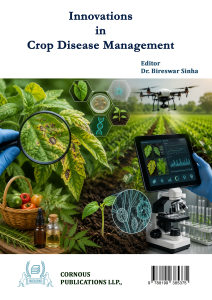
Editorial Book
Book Title: Innovations in Crop Disease Management
OPEN ACCESS | Published on : 28-Feb-2026 | Pages: 1-13 | Doi : 10.37446/edibook162024 /1-13
Drones in Plant Disease Management
- Kiran Mohan
- Department of Forest Resource Management, College of Forestry, Kerala Agricultural University, Thrissur, Kerala, India.
- Murali K V
- Department of Forest Resource Management, College of Forestry, Kerala Agricultural University, Thrissur, Kerala, India.
- Gopakumar S
- Department of Forest Resource Management, College of Forestry, Kerala Agricultural University, Thrissur, Kerala, India.
- Srinivasan K
- Department of Forest Resource Management, College of Forestry, Kerala Agricultural University, Thrissur, Kerala, India.
Abstract
Forest diseases pose a significant threat to global forest ecosystems, exposing biodiversity, carbon storage capacity, and valuable timber resources. Pathogens such as Phytophthora ramorum (sudden oak death), Austropuccinia psidii (myrtle rust), Hymenoscyphus fraxineus (ash dieback), and Cryphonectria parasitica (chestnut blight) are spreading rapidly, exacerbated by climate change and human activities. Conventional monitoring methods, such as ground surveys, are typically labor-intensive, time-consuming, and insufficient for early-stage detection of these diseases. In contrast, Unmanned Aerial Vehicles (UAVs) equipped with advanced remote sensing technologies offer a high-resolution, scalable, and cost-effective approach to forest health evaluations. This chapter synthesizes current research on UAV-based forest disease monitoring, with a particular focus on the integration of multispectral, hyperspectral, thermal, and LiDAR sensors for early pathogen detection and management. UAVs have demonstrated their ability to successfully identify a range of forest diseases through machine learning-driven spectral analysis, 3D canopy mapping, and thermal anomaly detection. UAVs provide distinct advantages over traditional methods, including rapid data acquisition, real-time monitoring, and access to remote and difficult-to-reach terrains. Fusing UAV data with satellite imagery and artificial intelligence (AI) algorithms further enhances predictive modelling, enabling more proactive and efficient disease management. Despite these advancements, challenges such as limited flight endurance, sensor calibration inconsistencies, and regulatory restrictions hinder their widespread use. Future research should prioritize standardizing monitoring protocols, improving sensor sensitivity for pre-symptomatic disease detection, and developing autonomous UAV systems for large-scale forest monitoring. Integrating UAV technology into forest management frameworks holds the potential to revolutionize disease surveillance, supporting global conservation efforts to preserve forest ecosystems in the face of increasing climate and anthropogenic pressures.
Keywords
UAVs, Forest disease monitoring, Remote sensing, Machine learning, Early detection
References
Abdulridha, J., Ampatzidis, Y., Kakarla, S. C., & Roberts, P. (2020). Detection of target spot and bacterial spot diseases in tomato using UAV-based and benchtop-based hyperspectral imaging techniques. Precision Agriculture, 21, 955-978.
Bandte, M., Rehanek, M., Leder, B., von Bargen, S., & Büttner, C. (2020). Identification of an emaravirus in a common Oak (Quercus robur L.) Conservation seed orchard in Germany: Implications for Oak health. Forests, 11(11), 1174.
Boufleur, T. R., Morales, J. J. V., Martins, T. V., Gonçalves, M. P., Júnior, N. S. M., & Amorim, L. (2023). A diagnostic guide for myrtle rust. Plant Health Progress, 24(2), 242-251.
Brovkina, O., Cienciala, E., Surový, P., & Janata, P. (2018). Unmanned aerial vehicles (UAVs) for assessment of qualitative classification of Norway spruce in temperate forest stands. Geo-spatial Information Science, 21(1), 12-20.
Cardil, A., Otsu, K., Pla, M., Silva, C. A., & Brotons, L. (2019). Quantifying pine processionary moth defoliation in a pine-oak mixed forest using unmanned aerial systems and multispectral imagery. PLoS One, 14(3), e0213027.
Cardil, A., Vepakomma, U., & Brotons, L. (2017). Assessing pine processionary moth defoliation using unmanned aerial systems. Forests, 8(10), 402.
Dainelli, R., Toscano, P., Di Gennaro, S. F., & Matese, A. (2021). Recent advances in Unmanned Aerial Vehicles Forest remote sensing - A systematic review. Part II: Research applications. Forests, 12(4), 397.
Dash, J. P., Watt, M. S., Pearse, G. D., Heaphy, M., & Dungey, H. S. (2017). Assessing very high-resolution UAV imagery for monitoring forest health during a simulated disease outbreak. ISPRS Journal of Photogrammetry and Remote Sensing, 131, 1-14.
Dell, M., Stone, C., Osborn, J., Glen, M., McCoull, C., Rimbawanto, A., & Mohammed, C. (2019). Detection of necrotic foliage in a young Eucalyptus pellita plantation using unmanned aerial vehicle RGB photography – A demonstration of concept. Australian Forestry, 82(2), 79-88.
Dennert, F., Augustinus, B. A., Ruffner, B., & Queloz, V. (2024). Bacterial Diseases: An Emerging Threat for Central European Forest and Urban Trees? Forest Pathology, 54(6), e70002.
Ding, X., Guo, Y., Ye, J., Wu, X., Lin, S., Chen, F., & Li, D. W. (2022). Population differentiation and epidemic tracking of Bursaphelenchus xylophilus in China based on chromosome‐level assembly and whole‐genome sequencing data. Pest Management Science, 78(3), 1213-1226.
Duarte, A., Borralho, N., Cabral, P., & Caetano, M. (2022). Recent advances in forest insect pests and diseases monitoring using UAV-based data: A systematic review. Forests, 13(6), 911.
Ecke, S., Dempewolf, J., Frey, J., Schwaller, A., Endres, E., Klemmt, H. J., & Seifert, T. (2022). UAV-based forest health monitoring: A systematic review. Remote Sensing, 14(13), 3205.
Eger, A. M., Marzinelli, E. M., Beas-Luna, R., Blain, C. O., Blamey, L. K., Byrnes, J. E., & Vergés, A. (2023). The value of ecosystem services in global marine kelp forests. Nature Communications, 14(1), 1894.
Ganthaler, A., Losso, A., & Mayr, S. (2018). Using image analysis for quantitative assessment of needle bladder rust disease of Norway spruce. Plant Pathology, 67(5), 1122-1130.
García-Guzmán, G., Trejo, I., & Sánchez-Coronado, M. E. (2016). Foliar diseases in a seasonal tropical dry forest: Impacts of habitat fragmentation. Forest Ecology and Management, 369, 126-134.
Guliutin, N., & Antamoshkin, O. (2024). Enhancing unmanned aerial vehicle capabilities: Integrating YOLO algorithms for diverse industrial applications. In ITM Web of Conferences (Vol. 59, p. 03012). EDP Sciences.
Harris, R. C., Kennedy, L. M., Pingel, T. J., & Thomas, V. A. (2022). Assessment of canopy health with drone-based orthoimagery in a Southern Appalachian red spruce forest. Remote Sensing, 14(6), 1341.
Hartmann, H., Bastos, A., Das, A. J., Esquivel-Muelbert, A., Hammond, W. M., Martínez-Vilalta, J., & Allen, C. D. (2022). Climate change risks to global forest health: Emergence of unexpected events of elevated tree mortality worldwide. Annual Review of Plant Biology, 73(1), 673-702.
Hlaiem, S., Yangui, I., Della Rocca, G., Barberini, S., Danti, R., & Ben Jamaa, M. L. (2023). Diplodia species causing dieback on Pinus pinea: Relationship between disease incidence, dendrometric and ecological parameters. Journal of Sustainable Forestry, 42(1), 59-76.
Hornero, A., Marengo, I., Faria, N., & Hemandez-Clemente, R. (2022). Monitoring Phytophthora disease symptoms through very-high-resolution multispectral and thermal drone imagery. In IGARSS 2022-2022 IEEE International Geoscience and Remote Sensing Symposium (pp. 7787-7790). IEEE.
Indrioko, S., Rahayu, S., & Ardiyan, T. (2021). Spatial and temporal distribution of pink fungus Corticium salmonicolor in Lanete, Jackfruit, and Indian prickly ash plantations. International Journal of Agriculture, Forestry and Plantation (Malaysia), 11.
Iordache, M. D., Mantas, V., Baltazar, E., Pauly, K., & Lewyckyj, N. (2020). A machine learning approach to detecting pine wilt disease using airborne spectral imagery. Remote Sensing, 12(14), 2280.
Kampen, M., Lederbauer, S., Mund, J. P., & Immitzer, M. (2019). UAV-based multispectral data for tree species classification and tree vitality analysis. Proceedings of the Dreiländertagung der Deutschen Gesellschaft für Photogrammetrie, Fernerkundung und Geoinformation (DGPF), der OVG und der SGPF, Wien, Austria, 20-22.
Kang, X., Chen, W., Li, S., Wang, T., Yu, L., & Singh, R. P. (2024). Spatiotemporal distribution of sudden oak death in the US and Europe. Agricultural and Forest Meteorology, 346, 109891.
Lausch, A., Erasmi, S., King, D. J., Magdon, P., & Heurich, M. (2016). Understanding forest health with remote sensing-part I, a review of spectral traits, processes and remote-sensing characteristics. Remote Sensing, 8(12), 1029.
Lechner, A. M., Foody, G. M., & Boyd, D. S. (2020). Applications in remote sensing to forest ecology and management. One Earth, 2(5), 405-412.
Lee, S., Park, S. J., Baek, G., Kim, H., & Lee, C. W. (2019). Detection of damaged pine tree by the pine wilt disease using UAV images. Korean Journal of Remote Sensing, 35(3), 359-373.
López-García, N. (2024). Forest Phytophthora–Ecology, Diversity and Management. Acta Universitatis Agriculturae Sueciae, (2024: 67).
Mahmudnia, D., Arashpour, M., Bai, Y., & Feng, H. (2022). Drones and blockchain integration to manage forest fires in remote regions. Drones, 6(11), 331.
Manfreda, S., McCabe, M. F., Miller, P. E., Lucas, R., Pajuelo Madrigal, V., Mallinis, G., ... & Toth, B. (2018). On the use of unmanned aerial systems for environmental monitoring. Remote Sensing, 10(4), 641.
Marçais, B., Kosawang, C., Laubray, S., Kjær, E., & Kirisits, T. (2022). Ash dieback. In Forest microbiology (pp. 215-237). Academic Press.
Michez, A., Piégay, H., Lisein, J., Claessens, H., & Lejeune, P. (2016). Classification of riparian forest species and health condition using multi-temporal and hyperspatial imagery from an unmanned aerial system. Environmental Monitoring and Assessment, 188, 1-19.
Mondal, S., Sundararaj, R., & Yashavantha Rao, H. C. (2020). A critical appraisal of the recurrence of sandalwood spike disease and its management practices. Forest Pathology, 50(6), e12648.
Oliveira, H. C., Guizilini, V. C., Nunes, I. P., & Souza, J. R. (2018). Failure detection in row crops from UAV images using morphological operators. IEEE Geoscience and Remote Sensing Letters, 15(7), 991-995.
Park, J. K., & Kim, M. G. (2014). Application of unmanned aerial vehicles for the detection of pine wilt disease. Asia Life Sci, 10, 191-202.
Park, J. M., Choi, I. G., & Lee, J. S. (2019). Detection of Pine Wilt Disease Tree Using High Resolution Aerial Photographs Case Study of Kangwon National University Research Forest. Journal of the Korean Association of Geographic Information Studies, 22(2), 36-49.
Pörtner, H. O., Roberts, D. C., Poloczanska, E. S., Mintenbeck, K., Tignor, M., Alegría, A., & Okem, A. (2022). Summary for policymakers. In H.-O. Pörtner, D. C. Roberts, E. S. Poloczanska, K. Mintenbeck, M. Tignor, A. Alegría, & A. Okem (Eds.), Climate Change 2022: Impacts, Adaptation and Vulnerability. Contribution of Working Group II to the Sixth Assessment Report of the Intergovernmental Panel on Climate Change. Cambridge University Press.
Qin, J., Wang, B., Wu, Y., Lu, Q., & Zhu, H. (2021). Identifying pine wood nematode disease using UAV images and deep learning algorithms. Remote Sensing, 13(2), 162.
Romon‐Ochoa, P., Kranjec Orlović, J., Gorton, C., Lewis, A., van der Linde, S., & Pérez‐Sierra, A. (2022). New detections of chestnut blight in Great Britain during 2019–2020 reveal high Cryphonectria parasitica diversity and limited spread of the disease. Plant Pathology, 71(4), 793-804.
Sandino, J., Pegg, G., Gonzalez, F., & Smith, G. (2018). Aerial mapping of forests affected by pathogens using UAVs, hyperspectral sensors, and artificial intelligence. Sensors, 18(4), 944.
Sazonov, A. A., Zvyagintsev, V. B., & Zaitseva, E. M. (2023). Belarusian Oak Forests Afflicted with Armillaria Root Rot during Their Mass Desiccation. Lesovedenie, (5), 451-461.
Schuldt, B., Buras, A., Arend, M., Vitasse, Y., Beierkuhnlein, C., Damm, A., & Kahmen, A. (2020). A first assessment of the impact of the extreme 2018 summer drought on Central European forests. Basic and Applied Ecology, 45, 86-103.
Seidl, R., Schelhaas, M. J., Rammer, W., & Verkerk, P. J. (2014). Increasing forest disturbances in Europe and their impact on carbon storage. Nature Climate Change, 4(9), 806-810.
Smigaj, M., Gaulton, R., Barr, S. L., & Suárez, J. C. (2015). UAV-borne thermal imaging for forest health monitoring: Detection of disease-induced canopy temperature increase. The International Archives of the Photogrammetry, Remote Sensing and Spatial Information Sciences, 40, 349-354.
Smigaj, M., Gaulton, R., Suárez, J. C., & Barr, S. L. (2019). Canopy temperature from an Unmanned Aerial Vehicle as an indicator of tree stress associated with red band needle blight severity. Forest Ecology and Management, 433, 699-708.
Thornley, R. (2018). Leaf level detection of European Ash (Fraxinus excelsior) and Its Associated Fungal Pathogen Hymenoscyphus fraxineus Using Spectral Analysis (Doctoral dissertation, Imperial College London).
Tmušić, G., Manfreda, S., Aasen, H., James, M. R., Gonçalves, G., Ben-Dor, E., & McCabe, M. F. (2020). Current practices in UAS-based environmental monitoring. Remote Sensing, 12(6), 1001.
Torresan, C., Berton, A., Carotenuto, F., Di Gennaro, S. F., Gioli, B., Matese, A., & Wallace, L. (2017). Forestry applications of UAVs in Europe: A review. International Journal of Remote Sensing, 38(8-10), 2427-2447.
Tsiamis, N., Efthymiou, L., & Tsagarakis, K. P. (2019). A comparative analysis of the legislation evolution for drone use in OECD countries. Drones, 3(4), 75.
Udali, A., Persson, H. J., Talbot, B., & Grigolato, S. (2024). SAR Data and Harvesting Residues: An Initial Assessment of Estimation Potential. Earth, 5(4), 945-962.
Wu, Q., Su, Y., Tan, W., Zhan, R., Liu, J., & Jiang, L. (2025). UAV Path Planning Trends from 2000 to 2024: A Bibliometric Analysis and Visualization. Drones, 9(2), 128.
Yu, R., Luo, Y., Zhou, Q., Zhang, X., Wu, D., & Ren, L. (2021a). A machine learning algorithm to detect pine wilt disease using UAV-based hyperspectral imagery and LiDAR data at the tree level. International Journal of Applied Earth Observation and Geoinformation, 101, 102363.
Yu, R., Luo, Y., Li, H., Yang, L., Huang, H., Yu, L., & Ren, L. (2021b). Three-dimensional convolutional neural network model for early detection of pine wilt disease using UAV-based hyperspectral images. Remote Sensing, 13(20), 4065.
Zarco-Tejada, P. J., Camino, C., Beck, P. S. A., Calderon, R., Hornero, A., Hernández-Clemente, R., & Navas-Cortes, J. A. (2018). Previsual symptoms of Xylella fastidiosa infection revealed in spectral plant-trait alterations. Nature Plants, 4(7), 432-439.
Zhang, N., Wang, Y., & Zhang, X. (2020). Extraction of tree crowns damaged by Dendrolimus tabulaeformis Tsai et Liu via spectral-spatial classification using UAV-based hyperspectral images. Plant Methods, 16, 1-19.
Indexing In




Types of Books We Publish




Uniqueness of our Publication

DOI Assignment

ISBN Registration

Online Publication

High Visibility

Open & Closed Access
DOI Assignment
ISBN Registration
Online Publication
High Visibility