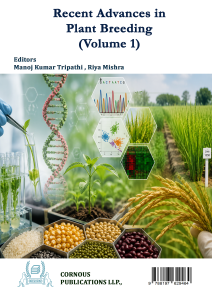
Editorial Book
Book Title: Recent Advances in Plant Breeding-Volume 1
PAID ACCESS | Published on : 17-Jan-2024 | Pages: 21-30 | Doi : 10.37446/volbook102024/21-30
Application of Genome Editing in Crop Improvement
- Anurag Sharma
- Department of Genetics & Plant Breeding, Rajmata Vijayaraje Scindia Krishi Vishwa Vidyalaya, Gwalior, Madhya Pradesh, India.
- Yamini Gautam
- Department of Genetics & Plant Breeding, Rajmata Vijayaraje Scindia Krishi Vishwa Vidyalaya, Gwalior, Madhya Pradesh, India.
- Goutam Mohbe
- Department of Genetics & Plant Breeding, Rajmata Vijayaraje Scindia Krishi Vishwa Vidyalaya, Gwalior, Madhya Pradesh, India.
- Omesh Kumar
- Department of Genetics & Plant Breeding, Rajmata Vijayaraje Scindia Krishi Vishwa Vidyalaya, Gwalior, Madhya Pradesh, India.
- Shruti Bhardwaj
- Department of Genetics & Plant Breeding, Rajmata Vijayaraje Scindia Krishi Vishwa Vidyalaya, Gwalior, Madhya Pradesh, India.
- Dhuruv Dangi
- Department of Genetics & Plant Breeding, Rajmata Vijayaraje Scindia Krishi Vishwa Vidyalaya, Gwalior, Madhya Pradesh, India.
Abstract
Genome editing has appeared as a transformative tool in plant breeding, offering an extraordinary exactness and competence for crop improvement. Technologies such as CRISPR-Cas9, TALENs and ZFNs empower beleaguered alterations of plant genomes, enabling the expansion of crops with improved traits, including higher yield, improved nutritional quality, disease resistance and abiotic stress tolerance. Unlike conventional breeding methods, genome editing permits accurate modification of specific genes, meaningfully plummeting the time and resources necessitated for trait improvement. In recent years, CRISPR-Cas9 has gained eminence owing to its straightforwardness, cost-effectiveness and flexibility across different plant species. Applications array from improving agronomic traits and battling universal food diffidence to reducing environmental influence by improving crop resilience. Despite its potential, contests for instance off-target effects, regulatory complexities and public acceptance endure. This book chapter highlights the potential of genome editing to transform plant breeding, addressing worldwide challenges in agriculture while accenting the necessity for accountable revolution and public rendezvous. By integrating genome editing with advanced biotechnological tools, plant breeders are poised to generate maintainable solutions for future food security and environmental pliability.
Keywords
Agricultural productivity, CRISPR-Cas9, Genetic modifications, Genome editing, Food security, Plant breeding, TALENs, ZFNs
References
Abdallah, N. A., Prakash, C. S., & McHughen, A. G. (2015). Genome editing for crop improvement: Challenges and opportunities. GM Crops & Food, 6(4), 183–205. https://doi.org/10.1080/21645698.2015.1129937
Abdul Aziz, M., & Masmoudi, K. (2024). Molecular breakthroughs in modern plant breeding techniques. Horticultural Plant Journal. https://doi.org/10.1016/j.hpj.2024.01.004
Adli, M. (2018). The CRISPR tool kit for genome editing and beyond. Nature Communications, 9(1), 1911. https://doi.org/10.1038/s41467-018-04252-2
Ahmar, S., Gill, R. A., Jung, K.-H., Faheem, A., Qasim, M. U., Mubeen, M., & Zhou, W. (2020). Conventional and Molecular Techniques from Simple Breeding to Speed Breeding in Crop Plants: Recent Advances and Future Outlook. International Journal of Molecular Sciences, 21(7), 2590. https://doi.org/10.3390/ijms21072590
Anzalone, A. v., Koulan, L. W., & Liu, D. R. (2020). Genome editing with CRISPR–Cas nucleases, base editors, transposases and prime editors. Nature Biotechnology, 38(7), 824–844. https://doi.org/10.1038/s41587-020-0561-9
AYANOĞLU, F. B., ELÇİN, A. E., & ELÇİN, Y. M. (2020). Bioethical issues in genome editing by CRISPR-Cas9 technology. Turkish Journal of Biology, 44(2), 110–120. https://doi.org/10.3906/biy-1912-52
Ballester, A.-R., Molthoff, J., de Vos, R., Hekkert, B. te L., Orzaez, D., Fernaݩndez-Moreno, J.-P., Tripodi, P., Grandillo, S., Martin, C., Heldens, J., Ykema, M., Granell, A., & Bovy, A. (2009). Biochemical and Molecular Analysis of Pink Tomatoes: Deregulated Expression of the Gene Encoding Transcription Factor SlMYB12 Leads to Pink Tomato Fruit Color. Plant Physiology, 152(1), 71–84. https://doi.org/10.1104/pp.109.147322
Becker, S., & Boch, J. (2021). TALE and TALEN genome editing technologies. Gene and Genome Editing, 2,100007. https://doi.org/10.1016/j.ggedit.2021.100007
Benitez-Alfonso, Y., Soanes, B. K., Zimba, S., Sinanaj, B., German, L., Sharma, V., Bohra, A., Kolesnikova, A., Dunn, J. A., Martin, A. C., Khashi u Rahman, M., Saati-Santamaría, Z., García-Fraile, P., Ferreira, E. A., Frazão, L. A., Cowling, W. A., Siddique, K. H. M., Pandey, M. K., Farooq, M., … Foyer, C. H. (2023). Enhancing climate change resilience in agricultural crops. Current Biology, 33(23), R1246–R1261. https://doi.org/10.1016/j.cub.2023.10.028
Bhardwaj, A., & Nain, V. (2021). TALENs—an indispensable tool in the era of CRISPR: a mini review. Journal of Genetic Engineering and Biotechnology, 19(1), 125. https://doi.org/10.1186/s43141-021-00225-
Bhuyan, S. J., Kumar, M., Ramrao Devde, P., Rai, A. C., Mishra, A. K., Singh, P. K., & Siddique, K. H. (2023). Progress in gene editing tools, implications and success in plants: a review. Frontiers in Genome Editing, 5, 1272678. https://doi.org/10.3389/fgeed.2023.1272678
Boch, J., Scholze, H., Schornack, S., Landgraf, A., Hahn, S., Kay, S., Lahaye, T., Nickstadt, A., & Bonas, U. (2009). Breaking the Code of DNA Binding Specificity of TAL-Type III Effectors. Science, 326(5959), 1509–1512. https://doi.org/10.1126/science.1178811
Carroll, D. (2011). Genome Engineering with Zinc-Finger Nucleases. Genetics, 188(4), 773–782. https://doi.org/10.1534/genetics.111.131433
Chandrasekaran, A. P., Song, M., & Ramakrishna, S. (2017). Genome editing: a robust technology for human stem cells. Cellular and Molecular Life Sciences, 74(18), 3335–3346. https://doi.org/10.1007/s00018-017-2522-0
Gaj, T., Gersbach, C. A., & Barbas, C. F. (2013). ZFN, TALEN, and CRISPR/Cas-based methods for genome engineering. Trends in Biotechnology, 31(7), 397–405. https://doi.org/10.1016/j.tibtech.2013.04.004
Gao, C. (2021). Genome engineering for crop improvement and future agriculture. Cell, 184(6), 1621–1635. https://doi.org/10.1016/j.cell.2021.01.005
Gupta, R. M., & Musunuru, K. (2014). Expanding the genetic editing tool kit: ZFNs, TALENs, and CRISPR-Cas9. Journal of Clinical Investigation, 124(10), 4154–4161. https://doi.org/10.1172/JCI72992
Hamdan, M. F., & Tan, B. C. (2024). Genetic modification techniques in plant breeding: A comparative review of CRISPR/Cas and GM technologies. Horticultural Plant Journal. https://doi.org/10.1016/j.hpj.2024.02.012
Hong, Y., Meng, J., He, X., Zhang, Y., Liu, Y., Zhang, C., ... & Luan, Y. (2021). Editing miR482b and miR482c simultaneously by CRISPR/Cas9 enhanced tomato resistance to Phytophthora infestans. Phytopathology®, 111(6), 1008-1016.https://doi.org/10.1094/PHYTO-08-20-0360-R
Hsu, P. D., Lander, E. S., & Zhang, F. (2014). Development and Applications of CRISPR-Cas9 for Genome Engineering. Cell, 157(6), 1262–1278. https://doi.org/10.1016/j.cell.2014.05.010
Ito, Y., Nishizawa-Yokoi, A., Endo, M., Mikami, M., & Toki, S. (2015). CRISPR/Cas9-mediated mutagenesis of the RIN locus that regulates tomato fruit ripening. Biochemical and Biophysical Research Communications, 467(1), 76–82. https://doi.org/10.1016/j.bbrc.2015.09.117
Joung, J. K., & Sander, J. D. (2013). TALENs: a widely applicable technology for targeted genome editing. Nature Reviews Molecular Cell Biology, 14(1), 49–55. https://doi.org/10.1038/nrm3486
Kamburova, V. S., Nikitina, E. V., Shermatov, S. E., Buriev, Z. T., Kumpatla, S. P., Emani, C., & Abdurakhmonov, I. Y. (2017). Genome editing in plants: an overview of tools and applications. International Journal of Agronomy, 2017(1), 7315351.https://doi.org/10.1155/2017/7315351
Khan, Z., Khan, S. H., Ahmed, A., Iqbal, M. U., Mubarik, M. S., Ghouri, M. Z., Ahmad, F., Yaseen, S., Ali, Z., Khan, A. A., & Azhar, M. T. (2023). Genome editing in cotton: challenges and opportunities. Journal of Cotton Research, 6(1), 3. https://doi.org/10.1186/s42397-023-00140-3
Khatodia, S., Bhatotia, K., Passricha, N., Khurana, S. M. P., & Tuteja, N. (2016). The CRISPR/Cas genome-editing tool: application in improvement of crops. Frontiers in plant science, 7, 506.https://doi.org/10.3389/fpls.2016.00506
Liu, L., Zhang, J., Xu, J., Li, Y., Guo, L., Wang, Z., Zhang, X., Zhao, B., Guo, Y.-D., & Zhang, N. (2020). CRISPR/Cas9 targeted mutagenesis of SlLBD40, a lateral organ boundaries domain transcription factor, enhances drought tolerance in tomato. Plant Science, 301, 110683. https://doi.org/10.1016/j.plantsci.2020.110683
Maguin, P., & Marraffini, L. A. (2021). From the discovery of DNA to current tools for DNA editing. Journal of Experimental Medicine, 218(4). https://doi.org/10.1084/jem.20201791
Mansoor, S., Karunathilake, E. M. B. M., Tuan, T. T., & Chung, Y. S. (2024). Genomics, Phenomics, and Machine Learning in Transforming Plant Research: Advancements and Challenges. Horticultural Plant Journal. https://doi.org/10.1016/j.hpj.2023.09.005
Mao, Y., Botella, J. R., Liu, Y., & Zhu, J.-K. (2019). Gene editing in plants: progress and challenges. National Science Review, 6(3), 421–437. https://doi.org/10.1093/nsr/nwz005
Menz, J., Modrzejewski, D., Hartung, F., Wilhelm, R., & Sprink, T. (2020). Genome Edited Crops Touch the Market: A View on the Global Development and Regulatory Environment. Frontiers in Plant Science, 11. https://doi.org/10.3389/fpls.2020.586027
Moon, S. bin, Kim, D. Y., Ko, J.-H., & Kim, Y.-S. (2019). Recent advances in the CRISPR genome editing tool set. Experimental & Molecular Medicine, 51(11), 1–11. https://doi.org/10.1038/s12276-019-0339-7
Nemudryi, A. A., Valetdinova, K. R., Medvedev, S. P., & Zakian, S. M. (2014). TALEN and CRISPR/Cas Genome Editing Systems: Tools of Discovery. Acta Naturae, 6(3), 19–40.
Nonaka, S., Arai, C., Takayama, M., Matsukura, C., & Ezura, H. (2017). Efficient increase of ɣ-aminobutyric acid (GABA) content in tomato fruits by targeted mutagenesis. Scientific Reports, 7(1), 7057. https://doi.org/10.1038/s41598-017-06400-y
Ogata, T., Ishizaki, T., Fujita, M., & Fujita, Y. (2020). CRISPR/Cas9-targeted mutagenesis of OsERA1 confers enhanced responses to abscisic acid and drought stress and increased primary root growth under nonstressed conditions in rice. PloS one, 15(12), e0243376. https://doi.org/10.1371/journal.pone.0243376
Pixley, K. v., Cairns, J. E., Lopez-Ridaura, S., Ojiewo, C. O., Dawud, M. A., Drabo, I., Mindaye, T., Nebie, B., Asea, G., Das, B., Daudi, H., Desmae, H., Batieno, B. J., Boukar, O., Mukankusi, C. T. M., Nkalubo, S. T., Hearne, S. J., Dhugga, K. S., Gandhi, H., … Zepeda-Villarreal, E. A. (2023). Redesigning crop varieties to win the race between climate change and food security. Molecular Plant, 16(10), 1590–1611. https://doi.org/10.1016/j.molp.2023.09.003
Rathore, M. S., Tiwari, S., Tripthi N., Tripathi, M. K. & Tiwari, S. (2021). Status and scenario of genome editing device CRISPR-Cas9 in crop advancement. Current Journal of Applied Science and Technology, 40(48): 8-20.
Rozas, P., Kessi-Pérez, E. I., & Martínez, C. (2022). Genetically modified organisms: adapting regulatory frameworks for evolving genome editing technologies. Biological Research, 55(1), 31. https://doi.org/10.1186/s40659-022-00399-x
Shen, S., Loh, T. J., Shen, H., Zheng, X., & Shen, H. (2017). CRISPR as a strong gene editing tool. BMB Reports, 50(1), 20–24. https://doi.org/10.5483/BMBRep.2017.50.1.128
Shi, J., Gao, H., Wang, H., Lafitte, H. R., Archibald, R. L., Yang, M., Hakimi, S. M., Mo, H., & Habben, J. E. (2017). ARGOS8 variants generated by CRISPR‐Cas9 improve maize grain yield under field drought stress conditions. Plant Biotechnology Journal, 15(2), 207–216. https://doi.org/10.1111/pbi.12603
Sun, L., Lai, M., Ghouri, F., Nawaz, M. A., Ali, F., Baloch, F. S., Nadeem, M. A., Aasim, M., & Shahid, M. Q. (2024). Modern Plant Breeding Techniques in Crop Improvement and Genetic Diversity: From Molecular Markers and Gene Editing to Artificial Intelligence—A Critical Review. Plants, 13(19), 2676. https://doi.org/10.3390/plants13192676
Tachikawa, M., & Matsuo, M. (2023). Divergence and convergence in international regulatory policies regarding genome-edited food: How to find a middle ground. Frontiers in Plant Science, 14, 1105426. https://doi.org/10.3389/fpls.2023.1105426
Urnov, F. D., Rebar, E. J., Holmes, M. C., Zhang, H. S., & Gregory, P. D. (2010). Genome editing with engineered zinc finger nucleases. Nature Reviews Genetics, 11(9), 636–646. https://doi.org/10.1038/nrg2842
Wang, F., Wang, C., Liu, P., Lei, C., Hao, W., Gao, Y., ... & Zhao, K. (2016). Enhanced rice blast resistance by CRISPR/Cas9-targeted mutagenesis of the ERF transcription factor gene OsERF922. PloS one, 11(4), e0154027. https://doi.org/10.1371/journal.pone.0154027
Yadav, R. K., Tripathi, M. K., Tiwari, S., Tripathi, N., Asati, R., Chauhan, S., Tiwari, P. N., & Payasi, D. K. (2023). Genome Editing and Improvement of Abiotic Stress Tolerance in Crop Plants. Life, 13(7), 1456. https://doi.org/10.3390/life13071456
Yu, Q., Wang, B., Li, N., Tang, Y., Yang, S., Yang, T., Xu, J., Guo, C., Yan, P., Wang, Q., & Asmutola, P. (2017). CRISPR/Cas9-induced Targeted Mutagenesis and Gene Replacement to Generate Long-shelf-Life Tomato Lines. Scientific Reports, 7(1), 11874. https://doi.org/10.1038/s41598-017-12262-1
Zhang, C., Srivastava, A. K., & Sadanandom, A. (2019). Targeted mutagenesis of the SUMO protease, Overly Tolerant to Salt1 in rice through CRISPR/Cas9-mediated genome editing reveals a major role of this SUMO protease in salt tolerance. BioRxiv, 555706.https://doi.org/10.1101/555706
Zhang, Y., Massel, K., Godwin, I. D., & Gao, C. (2018). Applications and potential of genome editing in crop improvement. Genome Biology, 19(1), 210. https://doi.org/10.1186/s13059-018-1586-y
Zhu, Q., Jin, S., Yuan, Y., Liu, Q., Zhang, X., & Wilson, I. (2022). CRISPR/Cas9‐mediated saturated mutagenesis of the cotton MIR482 family for dissecting the functionality of individual members in disease response. Plant Direct, 6(6). https://doi.org/10.1002/pld3.410
Zhu, Y. (2022). Advances in CRISPR/Cas9. BioMed research international, 2022(1), 9978571.https://doi.org/10.1155/2022/9978571
Indexing In




Types of Books We Publish




Uniqueness of our Publication

DOI Assignment

ISBN Registration

Online Publication

High Visibility

Open & Closed Access
DOI Assignment
ISBN Registration
Online Publication
High Visibility